

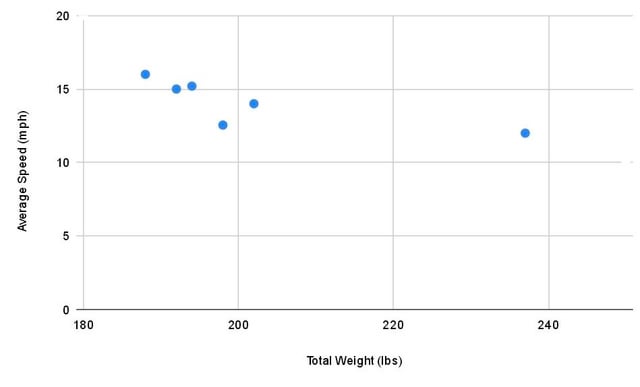
After completing the TransAm Express (re: early post in this sub a few weeks ago), I was curious how much weight effected my average speed. On the tour, I was usually the last to arrive at camp, something that also happens when I join local group rides at home. But when solo touring, I never feel slow because I am just going my own pace and there is nobody else to compare to.
I have been using 1995 Diamondback Topangas for all my touring over the past 20+ years. I currently have 2 set up. But I finally caved and purchased my first carbon bike, the Seigla-rigid gravel bike by Lauf. Using the Topanga and Seigla under different load conditions, I embarked on several controlled rides along the same route in the south SF bay. The route was a 30 mile loop and included steady climbing, one sharp decent, and long straightaways. As a loop, it averaged out any (un)favorable wind conditions. Attached is a modest plot of what I recorded.
By shaving off the touring weight from the Topanga, I was able to increase the average speed easily. I switched out the stock 50mm Goodyear gravel tires that came with the Seigla in favor of 35mm Continental Grand Prix 5000 AS TR tires, and then went tubeless. Further decreases in weight resulted in more increased average speeds, but the benefits were incremental as my own body weight became more dominant.
I have since added a rack and small touring pannier to the Seigla, and that resulted in the 12.5 mph @ 198 lbs data point.
by majwilsonlion
4 Comments
Thanks for the data. What tires are on the Topanga? Also do you think your position is more aerodynamic on the plastic bike?
Cyclingabout did a similar experiment and basically concluded that weight matters very little. Although one thing he didn’t really consider was starting/getting up to speed, which may be relevant on trips in more urban/developed areas where you are forced to stop often:
https://youtu.be/sDzMrbJTK-U?si=xyRycriGLyAxpjIw
Like he says in the video, it’s likely that the difference in tires and aerodynamics (riding position, panniers/no panniers, etc) between your different setups matters more than the weight.
At the end of the day, for the vast majority of bicycle tourers weight shouldnt be a major concern. Of course you should still be mindful, but there is very little reason to aim for a sub 5kg base weight like we see on UL hiking. If you’re able to fit all your gear inside a standard 4 pannier setup(which if you come from the UL world is a lot of stuff), then you are reasonably optimized, which is more like a sub 20kg setup.
With UL hiking the great benefit is that you are more comfortable carrying your light gear on your back, but with cycling it’s the bike that’s carrying the load, so weight is really only a matter of slowing you down, and likely only by a few minutes on a full day of riding. But if a bit of extra/better gear allows you to get better sleep/have a more enjoyable time, then it’s well worth it.
Yeah of course weight matters. Everyone on their first tour always packs way too much for example. However why are people in a rush? For me it’s about comfort.
I really don’t get this analysis and why it matters. Just find what works for you. I’m a slow and comfort type and carry way too many luxuries. But at the end of the day those luxuries mean a lot.
At the same time if you want to rack up the kms then go for it.
If you do a full day of riding with any substantial climbing, 20lbs of weight makes a massive difference. I found that out the hard way on my first overnight trip. I was pretty comfortable doing 60-80miles with climbing on regular rides, but with the loaded bike I was absolutely fucked on the same big climbs I was doing before. 5lbs here or there is no big deal, but when you’re loaded, and particularly with anything above 8-10% it can be brutal and slow you to an absolute snail’s pace.