
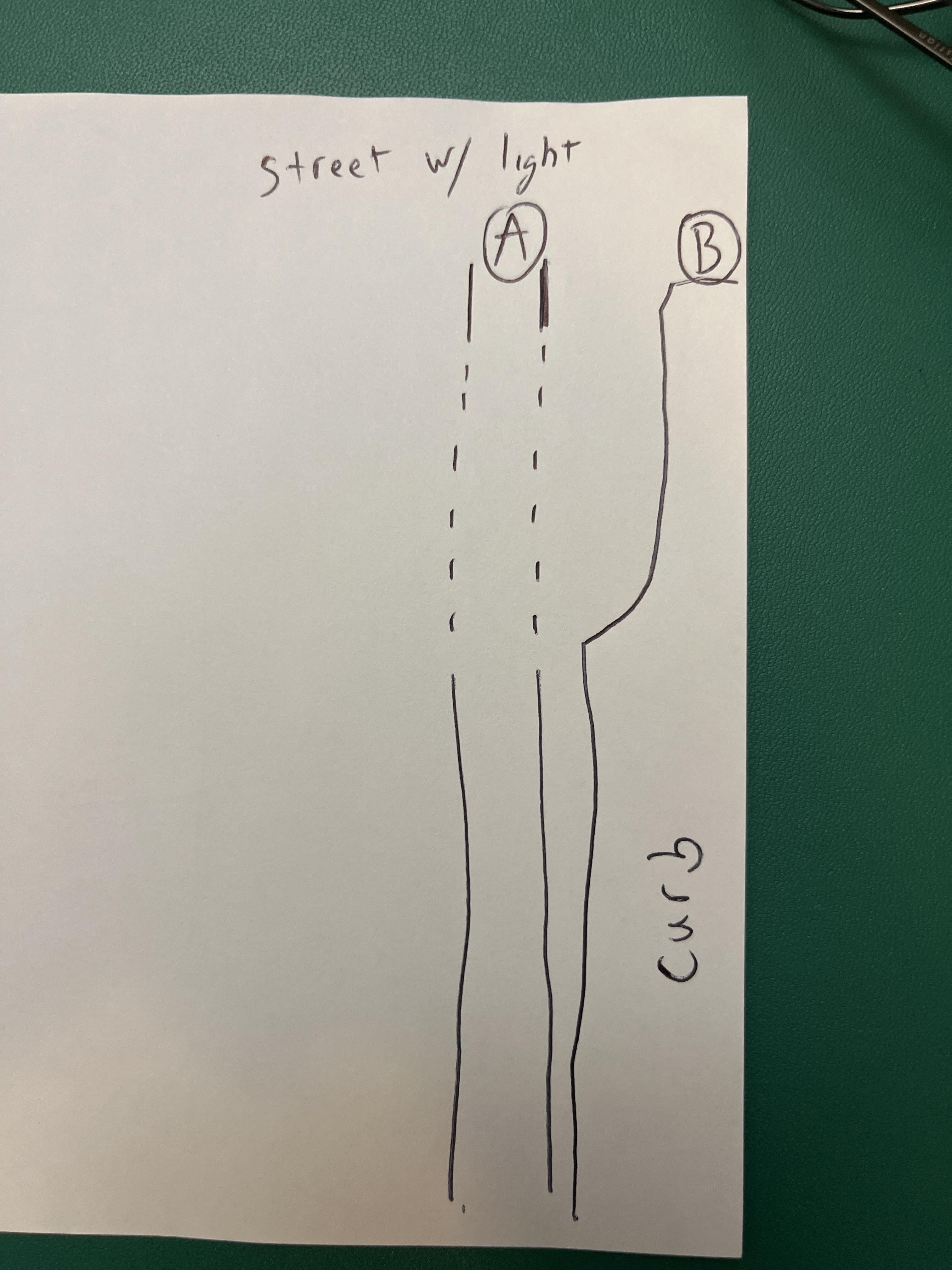
So I’m from Phoenix metro, we’re famous for cyclist getting run down…. A lot. We got 6 land “local” streets where the limit is 45 but everyone drives 60+. So far I been cycling for a few weeks for exercise but I never crossed a real intersection, I just been making right turns and in and around HOA’s.
So my question is we have a lot intersections that look like this and I want to know both while crossing and waiting, do I wait at A or wait at B? My experience is I seen drivers plow pretend they see nothing whether road markings or red lights. I just want the highest chance of not getting run over by clean non working pickups.
by Deezhellazn00ts
13 Comments
Get the designers to ride along with you with their children
Could do with less sensationalism. The city isn’t trying to kill you. They just don’t care.
I’m not sure I entirely understand the crossing here, but as a general rule of thumb, if I feel unsafe crossing an intersection, I will dismount and cross on foot as a pedestrian (which I gather would be at B here).
To go straight through a signaled intersection? Is that a bike lane where A is? If it’s a bike lane, I’d wait at A, using extreme caution where the right turn vehicle lane merges through the bike lane.
However, that sounds like a road I would avoid altogether. Your risk tolerance may vary, but I generally won’t ride an unprotected lane on anything with a posted speed limit over 30.
If there is a pedestrian signal, you can right turn onto the sidewalk at the curb cut, if one exists, and then walk the bike across with the pedestrian signal. This puts you in a better position to see and avoid traffic trying to make a right on red, as well as red light runners, and has the advantages that you only have to deal with one direction at once, and are able to jump out of the way if necessary.
If you stay mounted on the bike, and you are at the front, you wait at A, in the CENTER of the lane, or slightly off to the left or right in the appropriate turn lane if you are turning in that direction. Busy intersections are not a safe place to let drivers squeeze past by lane splitting. Try to be in front, and then let traffic go by wherever you find a safe place to do so after the intersection. If there are two or more through lanes, don’t worry about getting over at all, take up space and been visible and relevant. The earlier they can see you, the earlier they can pass you the right way, and the less close calls you will have.
If you are only a few cars back, lane filtering to the front can be safer, but only if you can do it without getting involved in a road rage incident or getting caught in the no-mans-land between two moving lanes of traffic when the light turns green. Don’t try it on a stale red, in case the light cycles unexpectedly, and don’t try it from more than 2-3 cars back.
If you get there too late to be in front, and that results in you being behind a car, you wait behind it’s left taillight, angled outward toward the space between lanes, so that if you are rear ended, you get pushed clear rather than sandwiched.
Remember: Any time you don’t have the space to assure your safety and avoid close passes at the speeds present on the road, you need to default to controlling the lane, so that cars wanting to pass have to use another full lane to do it, and so that cars directly behind you have to slow down to your speeds and wait for a safe opportunity to pass, instead of trying to squeeze by at speed in a lane that’s too narrow. On a 2-lane road, you can move over to let 1-2 cars at a time squeeze by, once they’ve come down to your speed. Any more than that, and you need a safe place before you can let backed up traffic go by.
Do not go straight from the right turn lane. You will be right hooked by traffic treating the right on red as their own personal permanent green light.
Do not exist in the space to the right of a tractor trailer, bus, or other large commercial vehicle. This blindspot is the motorcycle and bicycle death zone. If you find yourself in it, take immediate evasive action to not be there.
Download ridewithgps and use the heat maps function to find where everyone else is riding. Hopefully you can find quieter streets or streets with protected infrastructure. Always take a longer quieter route over more direct but higher traffic option.
If A is supposed to be a bike line, I know exactly the sorts of terrible Phoenix intersections you’re talking about lol. I’m assuming you want to proceed straight through this intersection?
Imo, A is actually pretty safe to wait in once you’ve gotten to the light. A driver has to be doing something way more egregious than simply being inattentive, because it’s its own bike lane. The problem is getting to A. Right turning cars are going to be crossing the dashed lines, and you have to be really watching out for them cutting you off in the process.
I still think A is the better option though, because B exposes you to those same right turning cars, except now they’re in a right-hook situation and visibility for both you and the car is even worse. You can easily get taken out by someone coming up behind you and making a fast right turn. Option A exists specifically to avoid that, even though it’s also kinda ass.
I do this every day in Tucson. A is the place to be. You need to build up confidence to ride in such traffic, so it would be best to practice on slower streets for a few months if you can.
If there aren’t any side streets available (for example, Standage or Westwood instead of Alma School in [this area](https://maps.app.goo.gl/pGrDnQUJ1iJxcbaX9?g_st=ac)), I tend to stand at A or the spot I marked in purple below. That way, cars can filter past me and turn right (good bye! see you! have a nice day!), and when the light turns green, I can claim my space, cross the intersection, and get over to the bike lane or right shoulder immediately. I also like standing at A because where I live, B takes longer and adds a risk of getting “right hooked” by a car turning right.
https://preview.redd.it/nch2z05r8vah1.jpeg?width=1080&format=pjpg&auto=webp&s=d07011fce28c431ddbd985f0b8f783cada8c2e11
I usually go A or lane split right next to A.
I just carry a gun in my waistband clearly visible to drivers and they treat me great
hey there. I’m in Chandler. Hard to tell from your diagram, but, assuming there’s a turn lane as B, I stay in lane A, take my lane, and then move to the right while in the intersection. That’s assuming a bike lane is available. I know some cities around here love to disappear bike lanes at intersections.
You can call a non emergency phone number and complain about people running lights or speeding.
Sometimes the police will start watching those intersections and give tickets.