
I haven’t fixed a puncture on a Brompton and planning for it I am not sure about two things.
1. All discussion and videos I’ve seen assume that you will remove the wheel, and most people replace the tube. With conventional bikes I always pulled out the affected section of the tube and patched it. I think it is faster this way, but I am not sure if small wheels are different. I would think that hub gears complicate removing the wheel more.
2. In servicing my Brompton I would want to turn it upside down. I suspect if I do that with my straight bars something very bad will happen to the shifters etc carrying the weight. How do you do that? Or do you have to have a special stand?
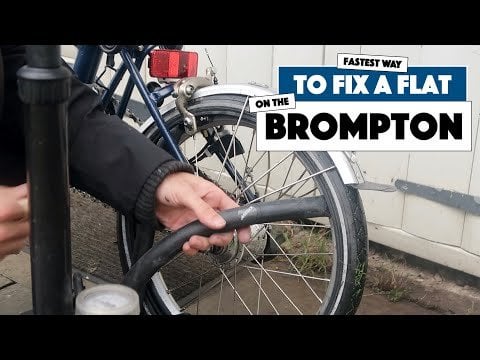
EDIT: Hoping it will help someone, [here](https://www.youtube.com/watch?v=CCZlT58GTKg) is a video showing how some of us fix punctures without removing the wheel.
by gl0cal
9 Comments
1. Your way is more advanced and faster. Most videos are for the beginner. I do the full dismount cause of fat fingers 😅 and I like to inspect the inside of the entire tire. It’s a smaller wheel so everything is tighter.
2. I use blocks of wood or small Amazon boxes under the handlebars and a plastic bag on the seat to prevent damage when bike on its back.
There’s also what I call the maintenance fold. I do this if I suffer flat far from home. You fold the rear wheel under the brompton. Put a plastic bag on the seat. Unfold the rest of the bike so the seat rear is resting on the ground and the front wheel is up in the air while not moving the rear triangle at all. I’ll try adding a picture later.
1. Punctures on the front or rear wheels will unfortunately require removal of the wheels from the bike. How you repair your puncture from there is up to you – I’m an advocate of having at least one fresh spare (I carry two on my gravel bike) so I don’t have to faff about patching and can do so at home in the warm. Patch/puncture repair is the same re wheel size. The sturmey hub system is initially a complication but just a new set of skills to learn – it’s worth learning how the gear indexing is set via cable tension for the hub, but if you’ve got a threaded indicator spindle chain (the unit that exits the right hand side of the axle and connects to the gear cable) the lock ring on that can be used as an indicator. Then it’s a simple case of detach the cable from the spindle chain by twisting it off until it disengages, then removing the wheel as normal. I personally think it’s easier than removal of the wheel of a derailleur-equipped bike, but benefit of experience! A complication but you’ll get there.
2. I’m a big advocate of having a proper bike stand if you’re going to do work on your own bike. Doesn’t have to be incredibly expensive or name brand – but robust enough that you can manipulate the bike enough to test it (not going to wobble dangerously when pedalling to check gear indexing for example) – I like three legged stands and I’m sure ALDI do a reasonably well received one. In a fit of laziness I bought one from Amazon several years ago that folds up and haven’t had issues since. Worth the investment for ease of servicing and preventing the bike from falling over if upside down, let alone the damage to grips, shifters and bell!
For punctures on the road I have the back wheel turned under for the front as once you take the wheel off the fork won’t hit the floor. Fortunately not had to do the rear wheel out but I’d imagine I’d go the same and work from the non drive side, maybe resting on the back of the saddle if necessary. I don’t think there’s a need to waste energy flipping the bike – well it feels like effort to me I’m 5ft2ish and not the strongest person so it feels quite awkward for me to manage. I’ve got a leather brooks saddle so I’m keen to protect it. I bought a folding bike stand for at home after 6 months of having the brompton to make maintenance and cleaning less taxing on my back.
As for just slipping the tube out. Well I don’t. I take the wheel off check the tyre after finding after a few miles I’d punctured again because I’d not removed the source. I have small child like hands and I can’t manage to get the tube in/out without taking the tyre off. Idk if it’s a skill or strength issue or just a tyre tolerance issue. Plus if it’s raining who wants to be sanding and patching when you can just swap a tube?
Tip: check the internet for how to fold, wrap and store a space tube inside the frame.
I prefer to replace the tube than just patch it. A functional ‘work stand’ mode is to fold the rear wheel under (kick stand mode) and then just tip the bike back till the seat touches the ground (mainframe pointing straight up), but I have a rack and wheel extender for a more stable base.
Take the tire off and check it before fixing or replacing the tube. I stopped once to help a gal in tears. Three times she had pulled her tire off and fixed the flat only to have it go flat again a few miles on. I took her tire off and gently ran my finger along the inside of the tire until the tip of my finger caught on something sharp. She had run over a tiny bit of metal, like part of a nail, that projected through the tire but was not visible in the tread. Every time she fixed it, the same “nail” pierced her tube in a different place. Lesson learned for both of us. Lesson learned for both of us.
This is how I do it on the ride: [https://www.reddit.com/media?url=https%3A%2F%2Fpreview.redd.it%2Foexscetbakv81.jpg%3Fwidth%3D4864%26format%3Dpjpg%26auto%3Dwebp%26s%3D82d1adf63550c0b267942816c9729b2ba3801ac9](https://www.reddit.com/media?url=https%3A%2F%2Fpreview.redd.it%2Foexscetbakv81.jpg%3Fwidth%3D4864%26format%3Dpjpg%26auto%3Dwebp%26s%3D82d1adf63550c0b267942816c9729b2ba3801ac9)
I wonder how you know “the affected part of the tube” without removing it. I’ve already fixed 3 punctures, roughly one per month, and in two of them it was not at all obvious where the affected area was from the outside (very sharp and thin thorns).
I’ve fixed plenty of functions without completely removing the wheel. It’s fine. I’ve never had issues identifying the puncture source this way, except for recent puncture caused by rim tape.
It was a pain when I had regular Schwalbe marathons and Marathon pluses, but with the Continental Contact Urbans and the Schwalbe Marathon almotion, removing and re-seating the bead is a piece of cake.
I’ve also been able to use self-adhesive park tool GP-2s without issues. Recently I’ve been trying muc-off internal tube sealant, but haven’t had long enough to see if it’s really helping.
i have a spare tube with me at all times (hidden in the main tube). One never knows how it breaks. But you are right, on a brompton it should easier to patch it in place.