
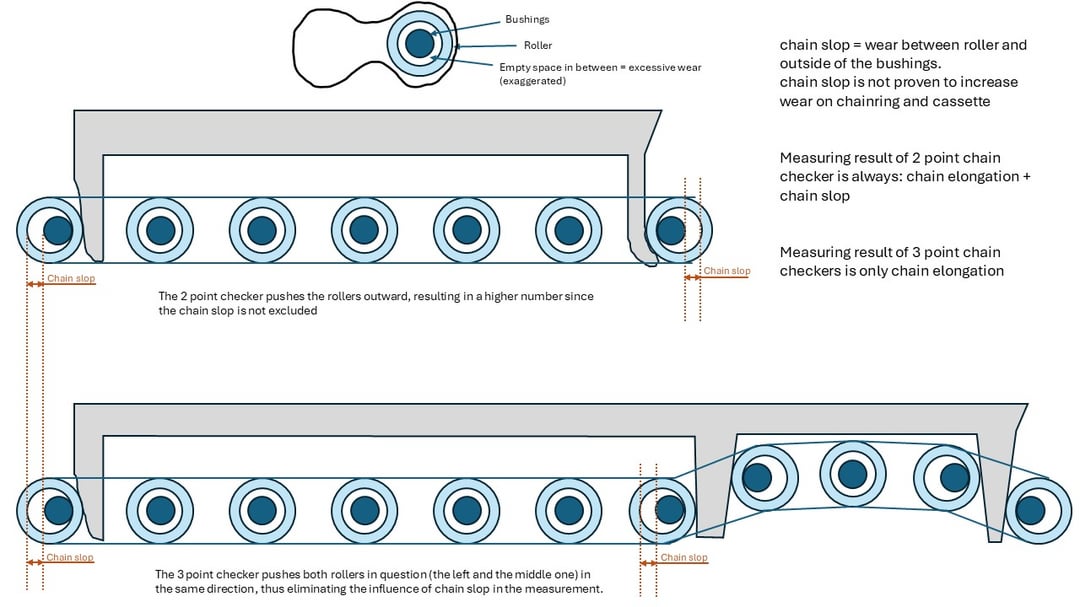
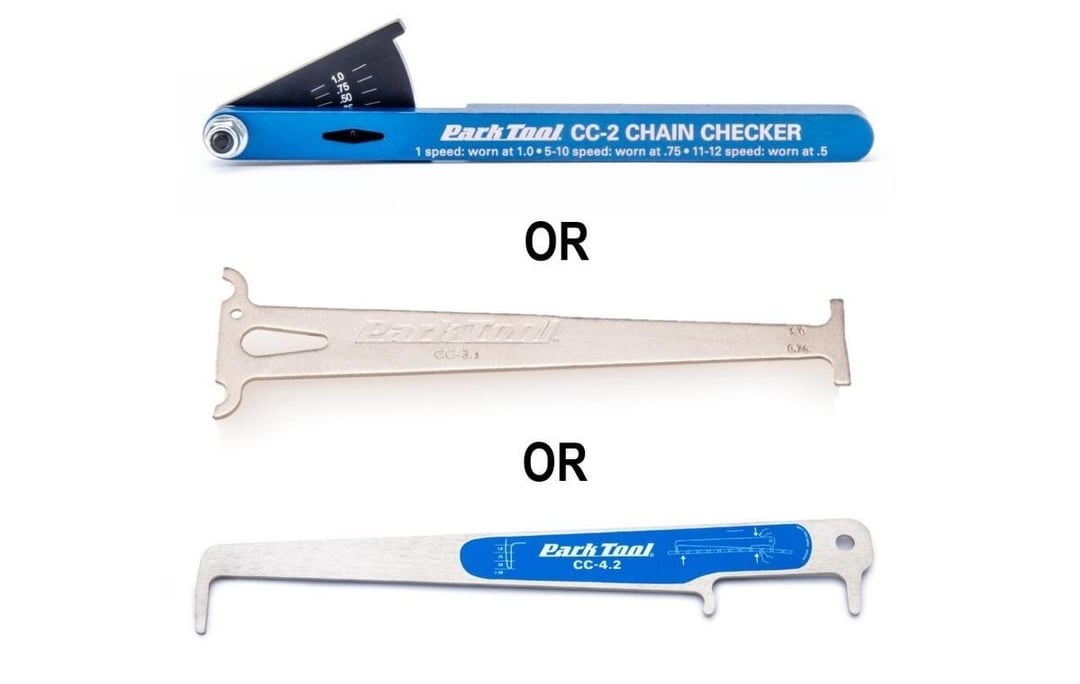
i have watched a lot of youtube videos and read comments about the difference between 2 point and 3 point chain checkers. Consensus is, that 3 point checkers eliminate the wear between the outside of the bushings and the rollers, which is considered irrelevant for wear of other components like the chainring and cassette. Thus far, i have had a hard time understanding where the difference in measurement actually comes from. Therefore i have visualised the issue how i understand it.
Can you verify if my point is correct?
NOTE: my shematics only show chain slop wear in an exaggerated form to make it easier to see. In my example, the outer side of the bushings and the roller have really bitten off each other, resulting in a completely worn out chain. I know the more relevant chain wear is chain elongation through wear of the plates. Still, i want to know what the fuss about chain slack is about or rather, why are there 3 point chain checkers in the first place.
i appreciate answers from the experts
thank you!
by Ok-Loquat-9409
8 Comments
an interesting video is this one here, he explains chain elongation and chain slop quite well. it was the basis on which i based my shematics
[https://www.youtube.com/watch?v=f1cyVt6Zq10](https://www.youtube.com/watch?v=f1cyVt6Zq10)
If you draw a thinner middle checker pin, it will only contact the right roller 🙂
Yes, your understanding is correct.
Did you make these drawings? These are some of the best drawings I’ve seen that illustrate why 2-point chain checkers are inaccurate. If this is your work, great job.
The only thing is, as Responsible_Pool9923 mentioned, the middle prong only really has to contact the right side of the roller to the left of it, and the rightmost prong only has to contact the left side of the roller right of it. They don’t need to contact both rollers on either side.
I thought all that chain lengthening is, is basically slob. Not necessarily the one of the rollers but the one of the inner plates. But I guess they’re linked with each other. Yes literally, but I mean if one wears, the other does too.
The slop itself is irrelevant, because the slop is taken up by chain tension (and by both types of chain checker).
What’s important is the pin and inner/outer roller diameters (plus contamination). These dimensions will vary between brands, within brands, and as the chain wears. The 2-point checker must make an assumption about what those dimensions are, since it’s measuring off the trailing edge of one of the rollers, and will therefore be off if those dimensions are different. On the other hand, the 3-point checker only contacts the leading edges, which is the same as a chain contacts the chainrings/cogs, so roller/pin diameters are irrelevant.
Edit: Extreme example, think about SRAM Flattop, which works with the 3-point checker, and would be horribly off with the 2-point checker. Clearly roller OD is important, but it does not contribute to slop.
Nice! I love this post. Let’s have a level headed discussion about chain wear.
Good video too, by the way. I’ll start off (sometimes the quickest way to the right answer is to provide the wrong one, so here goes…)
I’d argue that both slop and elongation combine to produce a chain that will wear a drivetrain faster, and therefore differentiating between slop and elongation is pointless and may provide a false sense of security.
My reasoning is this: the cause that will accelerate wear on your chainrings and sprockets is concentration of load on one or a few teeth rather than distributing the load amongst all teeth. I hope we can all agree on this.
If you want to ensure full distribution of load across all teeth, it doesn’t matter if the loss of precision comes from wear of the pins, the rollers (bushings) or the plates. All result in the bearing stress and contact point flowing from the front of the chainring tooth, to the valley of the chainring tooth, and finally (insignificantly) the back of the chainring tooth. The load on the back of the chainring tooth is mostly insignificant because it’s just the tension of the chain pushing on the chainring tooth causing this force. On a bike with a derailleur or a chain tensioner this is insignificant. However on a track bike or a single speed this is still significant.
It would be interesting to see if different wear – slop or elongation – cause different wear artifacts on chainring teeth (like the deep square valley wear vs the shark tooth chain climbing out of the valleys wear) but either one will destroy your drivetrain, and I don’t have the data to support either case.
Thoughts?
I think i finally get it… the two prong is bad because the chain slop of the right roller is not included (as you said it measures wear and elongation)
This helped a lot thank you!!
This is vaguely related and I figured I’d post it on this thread since we’ve got chain wear enthusiasts in the building. Has anyone found a way to accurately assess lateral wear? I frequently have customer come into the shop who ride cross chained all day and wear the chain lateraly to the point where is provides significantly poorer/non-existent shifting. I’ve considered making arc templates out of bar stock just to have comparisons on a new vs. Known to be bad amount of lateral play, but I feel like there has to be a better way. Thoughts?