
Hey r/bikewrench, I’d really appreciate some collective wisdom on this one.
The wheels: Elitewheels Drive Helix CS (carbon spokes, ceramic bearings, open-flange hub). Rear wheel is the one with the issue, front looks fine. Used as intended – road riding, no crashes, no impacts.
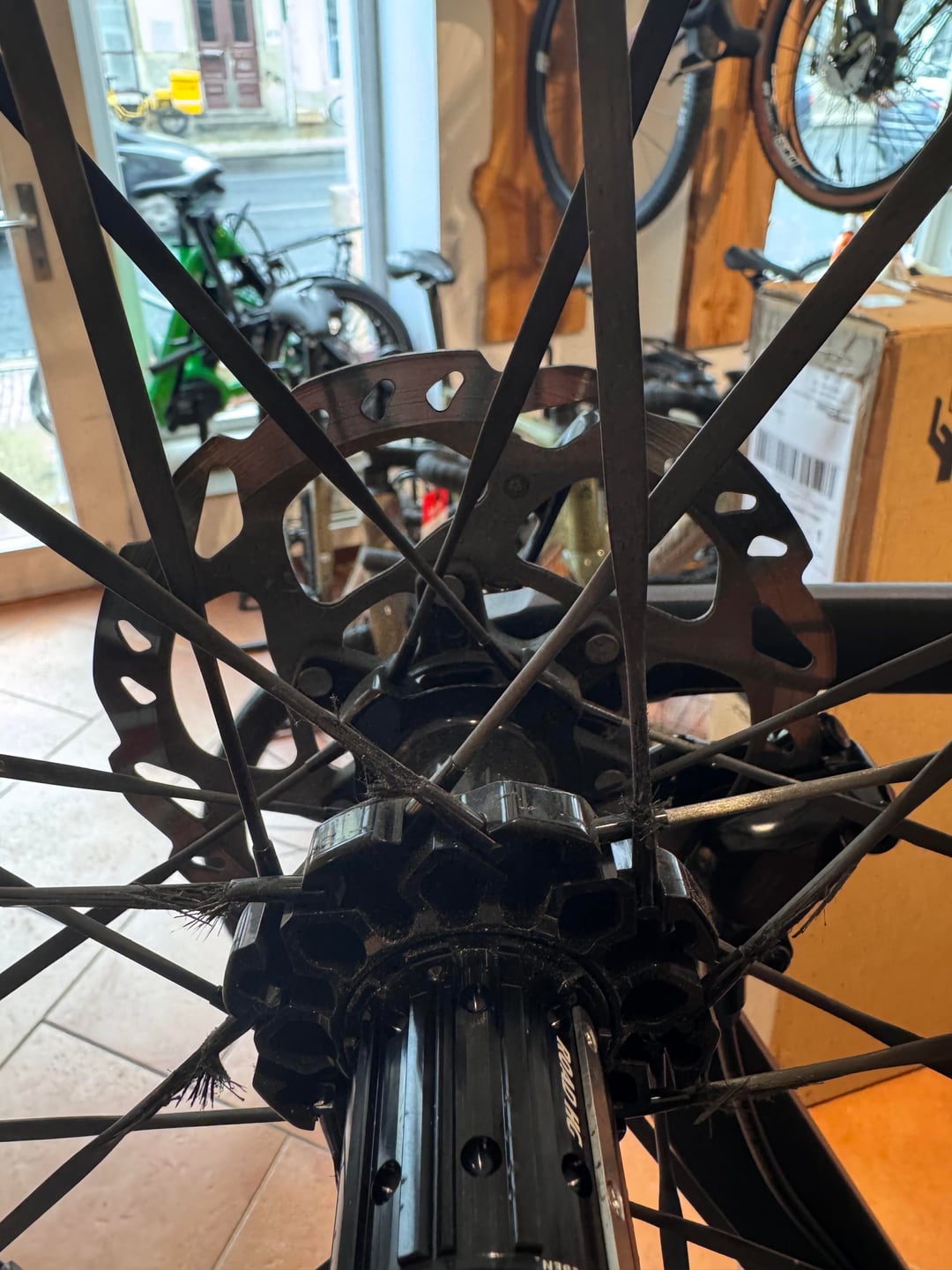
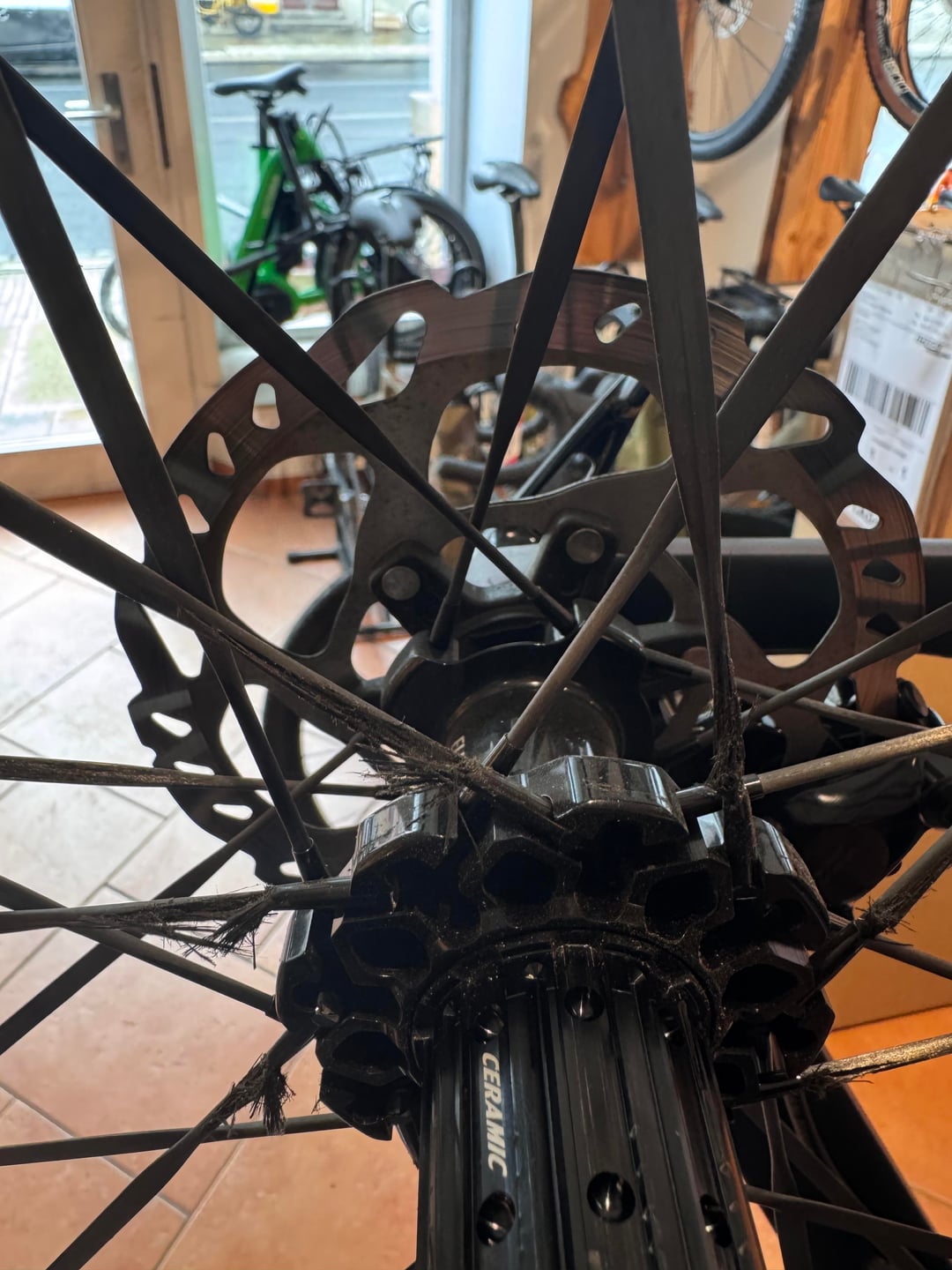
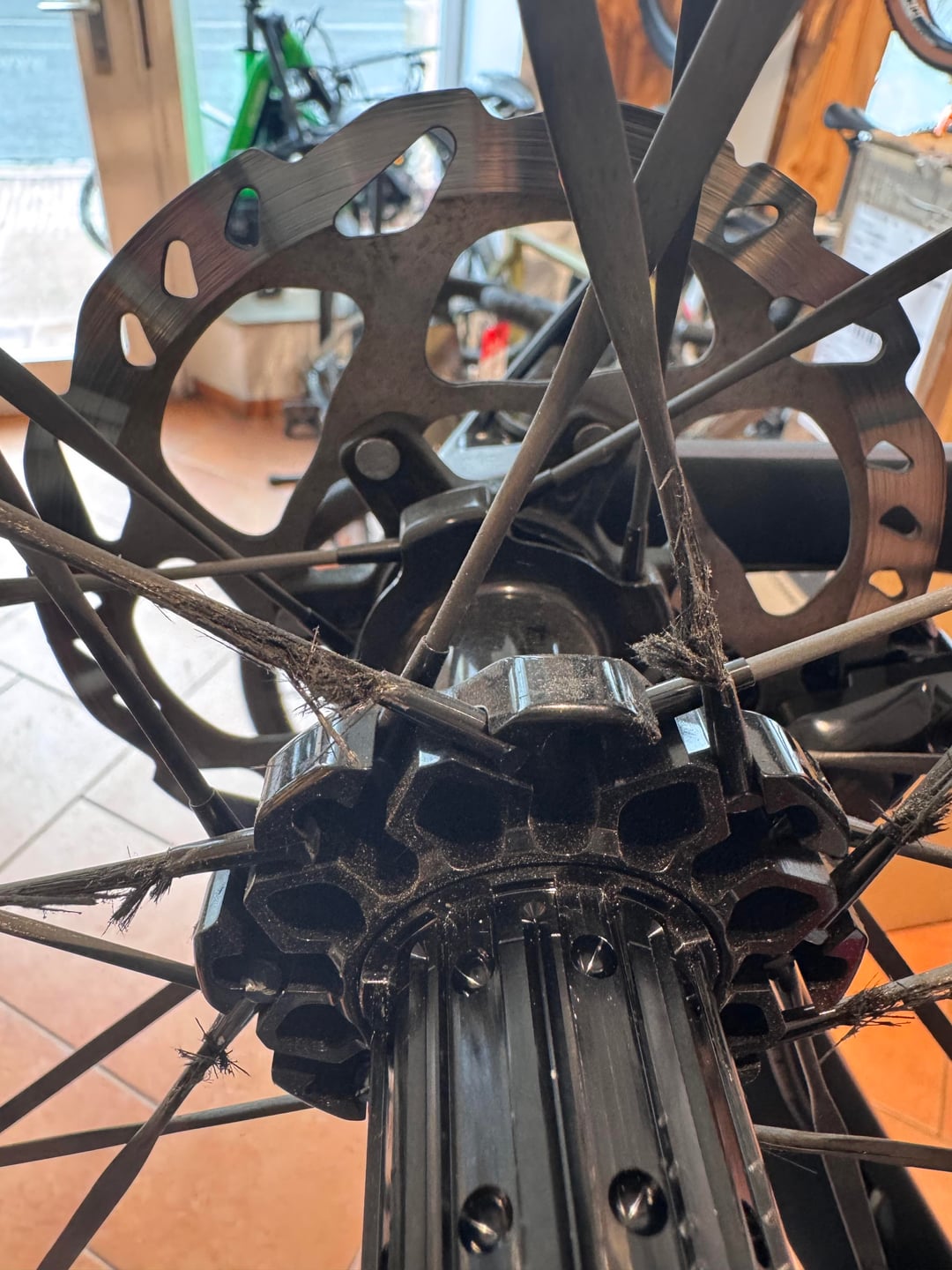
The damage: Multiple carbon spokes are heavily abraded right where they exit the hub flange. The resin matrix has worn through and individual carbon fibers are exposed and sticking out. Both leading and trailing spokes are affected, on both drive and non-drive side. Photos attached.
What it’s not:
• No crash, no impact damage. No fall, no transport mishap.
• My LBS mechanic floated the theory that the chain had dropped behind the cassette at some point and chewed up the spokes. I can rule that out – it never happened, and the damage pattern is also not consistent with a chain-on-spoke event (no single localized gouge; it’s symmetrical fiber abrasion at the hub interface, not the spoke center).
• Not braking-related (rotor side and non-rotor side both affected).
My current working theory:
This hub uses an open-flange design where the carbon spokes pass through cutouts in the flange. My guess is some combination of:
1. Spoke flexing against the flange edge under load (acceleration/braking torque), eventually wearing through the resin
2. Spoke-on-spoke contact right next to the hub at the crossing
3. Possibly insufficient spoke tension from the factory contributing to micro-movement
Noteworthy: Elitewheels has since moved away from this open-flange design on newer generations, which suggests they recognized something wasn’t right.
What I’m asking:
• Has anyone seen this exact failure mode before? On Elitewheels or any other carbon-spoke wheelset?
• Does my analysis above make sense, or am I missing something obvious?
• Anything else that could cause this pattern that I should consider?
Warranty claim is already in progress with the manufacturer. Mostly looking to understand the root cause better and sanity-check my reasoning before they come back with their assessment.
Thanks in advance!
by beenjamonn
19 Comments
Hey – glad to hear you didn’t crash. Can’t offer any suggestions but following the thread as a fellow carbon spokes owner
**The fibers being pushed rearward makes the answer obvious – something on the back of your cassette is rubbing on the spokes.** It could be a rivet or nut protruding, or maybe you got something caught in the cassette at somepoint – like a stiff twig or a pebble.
When you are coasting, whatever is rubbing would be pushing the fibers backwards as shown here (because the cassette would be stationary and the spokes/wheel rotating forwards.
While I will never defend Elitewheels on any topic, I would say that this is 99.9% likely to be a parts compatibility issue and/or something jammed in your cassette (neither of which are Elitewheels problem).
[Not all cassettes are identical, and some cassettes are held together by rivets, pins or bolts that have been known to come loose. Parts compatibility is a user issue, not a wheel manufacturer issue.]
Also, in case in needs to be said:
1. Steel spokes would be much more resistant to this kind of wear
2. Most wheels with steel spokes would probably offer more clearance between the cassette and spokes, meaning this damage may never have occurred at all depending on the root cause.
3. These spokes are absolutely unsafe to ride. You need to replace the spokes (likely at your cost). No they can’t be repaired. And once replaced, you should not ride this wheel until you have identified the root cause.
The hub is showing scrapes across the surface so something rubbing both the hub and spokes. Looks.like user / equipment error.
If you ride with earbuds or are hard of hearing I could see this happening. Something was rubbing for some time.
Looks like a chain has been there, as it’s only on the outside spokes.
Need a carbon dork disk to protect the carbon spokes?
That’s a use case for a pie plate
What HG freehub body is this and what type/speed casette was attatched to it? It might have been missing a cassette spacer behind the casette causing the casette to be pressed against the spokes (but then the casette should have been loose at some point after some wear).
Chain dropping behind the casette also still looks plausible.
The only spokes that look to be damaged in those photos appear to be the ones that pass closest to the back of the cassette, not both leading and trailing, and on drive side only. If these other spokes are damaged too post some photos of them. Otherwise almost certainly chain damage or some object that got wedged behind the cassette for a short while and wreaked havoc. Chain damage would happen near the hub because the gap gets tighter the closer to the hub.
Put your bike in a stand and try to push your derailleur off the cassette in your biggest gear, and see if the chain can make it off the cassette
If it climbs up off the cassette even slightly, you had your limit screws set up wrong and it was user error
Despite what you’re saying I would strongly suspect a chain dropping behind largest cog situation. Even just once, I could see that shredding the spokes if the rider applied power. I have shaved metal off stainless spokes by doing this before.
Did you ever let someone else ride your bike?
I’ll respond to (1.) with a pic:
https://preview.redd.it/v4k0jpo6za2h1.jpeg?width=824&format=pjpg&auto=webp&s=1519bbe6f971d2a35ebfb1ddeae2f4302badf364
If you’ve got this power in your legs [you don’t] you should stop buying any and all lightweight products that get installed in the path between your feet and the tire contact patch. Maybe I’ve misunderstood…
2. Idk if it’s just the perspective of the pic but the nipples look like they’re a mile away from each other (relative). And, it also looks like the hub nipple ends before the spokes cross (which I think is by design). These nipples are socketed into supporting holes that limit how much they can move away from cylindrical concentricity. To me, it doesn’t look like there’s enough clearance to make contact with one another or any part of the hub.
3. It can’t be _impossible_ for them to leave the manufacturer under-tensioned. Is it likely? Ehh…who knows? Will the manufacturer admit to it? Nope. FWIW, the amount of tension to make a truly rigid wheel assembly is “infinity”.
My hypothesis (from the pics; no direct experience but also am engineer): There’s a spoke bracing angle caused by the spokes terminating at the centerline of the bike while being splayed at the hub. The outboard nipples can’t accommodate that full angle so the spoke is being bent into something like a hockey stick (straight at the rim end and bending somewhere near the hub end to align itself to the nipple) . At that point, the fibers on inner half of the neutral axis have lower tension in the bend while the fibers on the outer half have to increase in tension in the bend to support the load. In the bend, the spokes become, effectively, half* the diameter and that’s enough to overload the outermost fibers under load. Since the highest stress will be somewhere in the bend (because that’s where their “effective” diameter is reduced), that’s where they break. Are all of the broken fibers on the outer half of the outboard spokes?
* I’m saying half for the sake of discussion. Fibers that are closer to the neutral axis will change tension in the bend less than fibers that are further away from the neutral axis of the bend.
I mean, you say “not a chain drop”, but it is *obviously* still a chain drop.
How much do you weigh? Are they too tight / not tight enough if no chain drop its a build issue for sure
Is that freehub 11 speed?
Looks like you used an 11 speed cassette on a 10 speed freehub which will cause the cassette to contact the spokes.
Why use AI to post what could have been asked in 5 human-written sentences?
FWIW, I don’t think it’s a chain drop either. It’d have done much more damage for starters.
If be looking at the back of the cassette and checking the freehub spacing etc.
Chain dropped behind the cassette?
I would say it’s almost certainly not due to spokes rubbing on the flange or each other due to where the damage is situated. My best guess is you’re using a wide ratio cassette which is dished and missing a spacer, causing it to rub against the spokes. If that’s the case then you’d likely hear that happening and that wouldn’t explain NDS spoke damage.