
Hi,
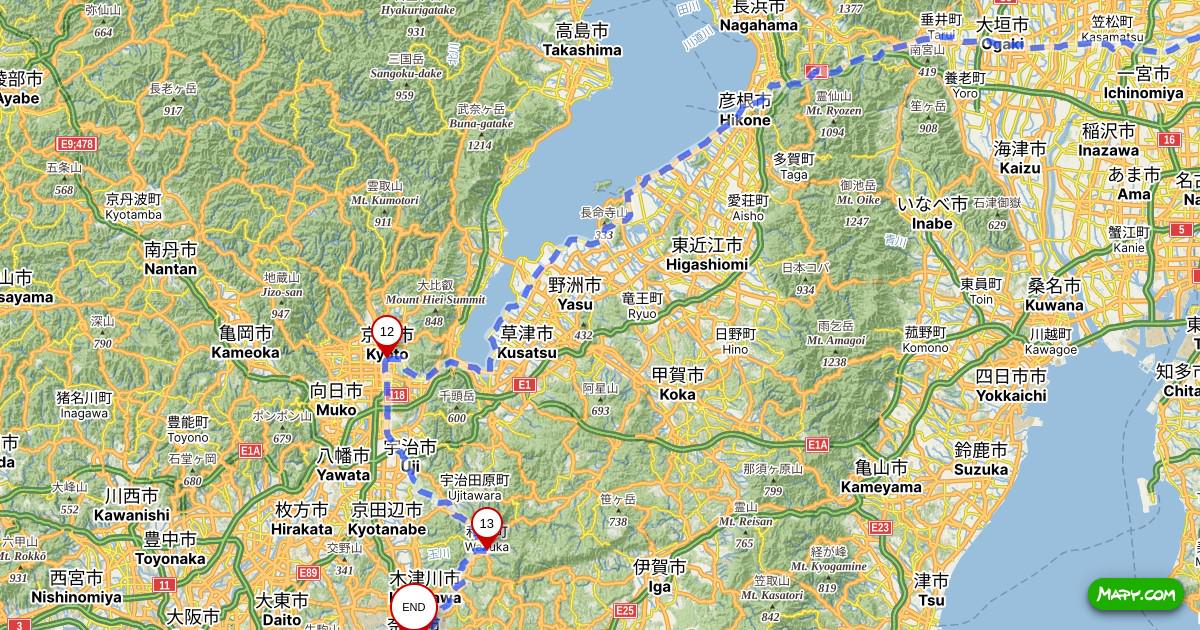
We’re planning a cycling trip in Japan and would appreciate some feedback on our planned route.
Some context:
- We’ll have around 10–11 days in total, so time is limited
- Tokyo is planned separately, and we’d like to start cycling from Tokyo on May 18 or 19. This route does not include time for Tokyo sightseeing
- We’d like to combine cycling with visiting major cities and landmarks along the way
- We’ll ride our own gravel bikes
- Typical daily distances around 70–100 km, with shorter days in mountainous areas, which we fully expect
Logistics-wise, we’re thinking about sending our bikes back via a courier service (e.g. JAL ABC) after finishing the ride, ideally from Nara to Narita Airport (Tokyo).
We ourselves would then travel back to Tokyo by train.
I’m mainly looking for feedback on:
- road quality and traffic
- just outside the city of Otsuki, there is an approximately three-kilometer-long road tunnel that has no sidewalk. Is it possible / safe to ride through such a tunnel?
- elevation and overall difficulty
- bike-friendly areas or roads worth avoiding
- whether the route is realistic within the time limit (we could add a few days)
One practical question as well:
Is it worth bringing a tent, or is it easier/better to rely on accommodation along the way (ryokans, guesthouses, hotels, etc.)?
Here’s the route: https://mapy.com/s/kudobacelu
Any tips or suggestions would be very welcome.
Thanks!!
by ComplaintOk5637
6 Comments
I can only give you one tip since I travelled in that area a lot but not by bike (yet): Skip Nara.
While I love Japan dearly and even as a non-city-person I can totally get the appeal of the big cities and such… Nara in 2025 has to be one of the worst places I have ever been to. The tourist crowds are insanely huge and disrespectful, the locals are so absolutely fed up with them and those deer… so, so many of them are visibly sick and also those tourists bother them with no mercy for a good shot. If you have even the slightest bit of love for animals you will hate Nara so so much.
The city itself has not much to it, there are so many similar sized cities which are more interesting.
I have been to Nara before in 2014 I think and it was still okay, not so overcrowded, locals were friendly, deer looked good. But last year was really awful. Especially since I did Nara at the very end of my trip, too it left a bitter taste about the whole trip. So I would strongly advise you against it.
I heard the same in lots of (real) travel blogs and podcasts (not those weird instagram travel influencers but real travellers) so I am pretty sure it’s not just me.
I can only comment on the last bit around lake Biwa. If you can find the time, it’s probably worthwhile to cycle the long way around it, so going north from Nagahama and ending in Otsu. I’d go the short way only if you’re running out of time or stamina.
I decided on booking accommodations for my trips and leaving the tent at home, but I think the decision depends more on how much you enjoy camping rather than cost or convenience.
Also, if you’re not scared of taking your bikes apart, you could buy rinko bags at a Montbell and use them to take your bikes back to the airport. I will buy and carry one with me so i can always hop onto a train if something goes wrong along the way. For the shinkansen, you will have to buy a bag that is designed for removing both wheels (if you want to adhere to the rules), while local trains will excuse bags for which you only need to take off the front wheel from what I could gather.
I recommend you to check out the collection of PA Cycling from Kyoto to Tokyo: [Komoot](https://www.komoot.com/collection/1958976/-japan-bikepacking-kyoto-to-tokio)
It’s a 10 day route. It’s probably doable also the other way around, maybe with some adaptations.
Takayama is worth checking out. I skipped the detour to Shirakawa-go but made one to Matsumoto, which is totally worth it imo.
– Road quality and traffic: can’t check it right now since i’m on mobile, but look via google street view and you’ll get an idea of the conditions. Overall road quality in Japan ist okay-ish (imo, depends where you come from).
– Tunnel depends on the traffic.
Low/no traffic: easy, but still kinda stressfull if you’re not used to it
Medium to high traffic: i’d definitely look for an alternative
Bring good lights and some reflective equipment.
– Time frame is realistic i would say
– Unless you really love to camp, i’d leave the camping gear at home and save the weight. I stayed in hotels without any problem. Other cyclists i met who brought their tents barely used it.
I live on the edge of Tokyo and have cycled the area of your route up to to and past Kofu extensively, so I’ll mainly give feedback on that part:
That tunnel by Otsuki is heavily trafficked. It’s not that dangerous as Japanese drivers are very courteous generally but it’s also deeply unpleasant. In my opinion, that entire road you have chosen from Tokyo through Otsuki to Fuefuki is a bad choice as it is urbanized along its entire distance and you will be coexisting with substantial traffic the entire way. Fortunately there are several good alternatives. For the least disruption to your planned route, instead you can swing north on 411 out of Tokyo through Ome, and continuing past Lake Okutama. This is a very popular cycling road with beautiful forested mountains and much lower traffic. Alternately, you can take the road to the south of your planned route (35) to Tsuru, then bend southwards towards Fujiyoshida. There is a stupendous frontage road that runs adjacent to the expressway (on its northern side) that you can use to dodge nearly all the traffic that entire distance. The tunnel from Fujiyoshida to Kawaguchiko is long but has a great sidewalk. Once reaching Kawaguchiko, you can snake along the north sides of Kawaguchiko, Saiko, Shojiko, and Motosuko before taking 300 (a superb descent) down to Motosu. From there you can turn north towards Fujikawa and continue north. I recommend sticking to the western side of the valley past Nirasaki and Hokuto as there’s a great low traffic line over there whose name escapes me at the moment but you can see it pretty clearly on Google Maps. As a tourist this route would be my recommendation as getting to see the Fuji 5 lakes by bike is really cool.
One other thing is that I included Matsumoto down to Nakatsugawa on a cycle tour I did. While the post towns are lovely the overall experience on that portion of the Nakasendo was not that pleasant as the road was fairly trafficky with a lot of large trucks in particular.
Definitely not worth carrying a tent, staying in cool and fun lodging in Japan is a great part of the experience. I’ll echo others in saying that buying a bike bag might be nicer than shipping your bikes. It could also allow you to hop on trains and skip some of the more tedious city slogging you’re going to have to do otherwise. If I was doing your route I would for sure take the train out of Tokyo, and again across Nagoya. Unless you really want to spend 3-4 hours in stop-and-go traffic at a million lights…
I would skip Nara, and do a loop of Lake Biwa as a finale. It is a beautiful ride, and the northern side is a very charming area with a great bike path.
This itinerary seems pretty ambitious for 10-11 days. Physically doable, but you are going to have to cover a lot of ground every day.
I didn’t bike around Tokyo (left bikes in Nikko and took the train there and back) but +1 to lake biwa. I’ll throw in a contrarian opinion and say camping was a super enjoyable part of Japan for me—it’s pretty easy to wild camp and means you don’t have to be as beholden to routes and timing with hotels. That said, also stayed in plenty of those when weather or comfort dictated.