
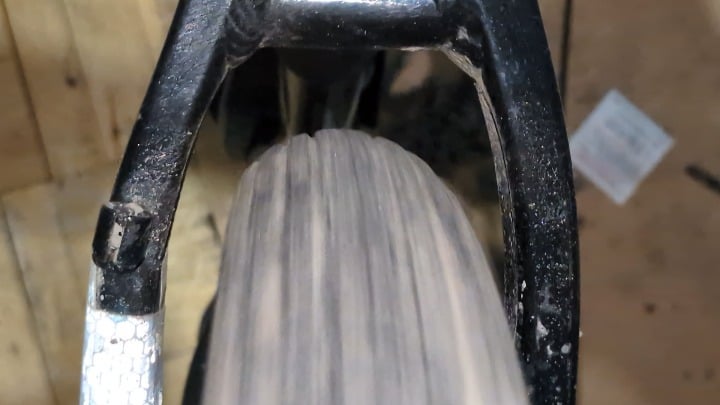
Spokes have 2 mm in diamter and have different lengths (cassete side is shorter).
Thats my first time truing and sorry for dirty wheel 😔
Hello everyone! I started truing a wheel, and after achieving some kind of aligned position, I noticed that the cassette-side spokes have a tension of 100–120 kgf, but my disc brake side has a range from 49 to 80 kgf. Is this normal, or should I be worried?
byu/ijuneso inbikewrench
by ijuneso
5 Comments
Spoke tension will never be the same on an asymmetrical wheel. I am not sure what you use to measure, but I usually just tap them with the wrench and check the sound.
Never try to true a bicycle wheel with the tire on.
It is unavoidable, as the cassette side spokes run at a different angle, because the cassette is needing so much space that the drive side hub flange is much closer to the centerline. On the front wheel you’ll see a smaller difference in the other direction, as there is no cassette, but the brake disc needs some space.
Rule of thumb is that spokes should be within 20% of each other, on the same side. Your drive side is within that (100-120), but see if you can bring the NDS spokes into closer tolerance of each other.
The tire movement does not mean anything. Use zip ties or a truing stand. Also take off the tire
120 and 80 kgf is an absolutely normal tension difference on a rear wheel. Because the wheel is not symmetric the cassette side needs higher tension.
However what is not good is having 49 to 80 kgf on the non-drive side. If the highest tension on that side is 80 kgf, then the lowest should be 65 kgf at a bare minimum.