
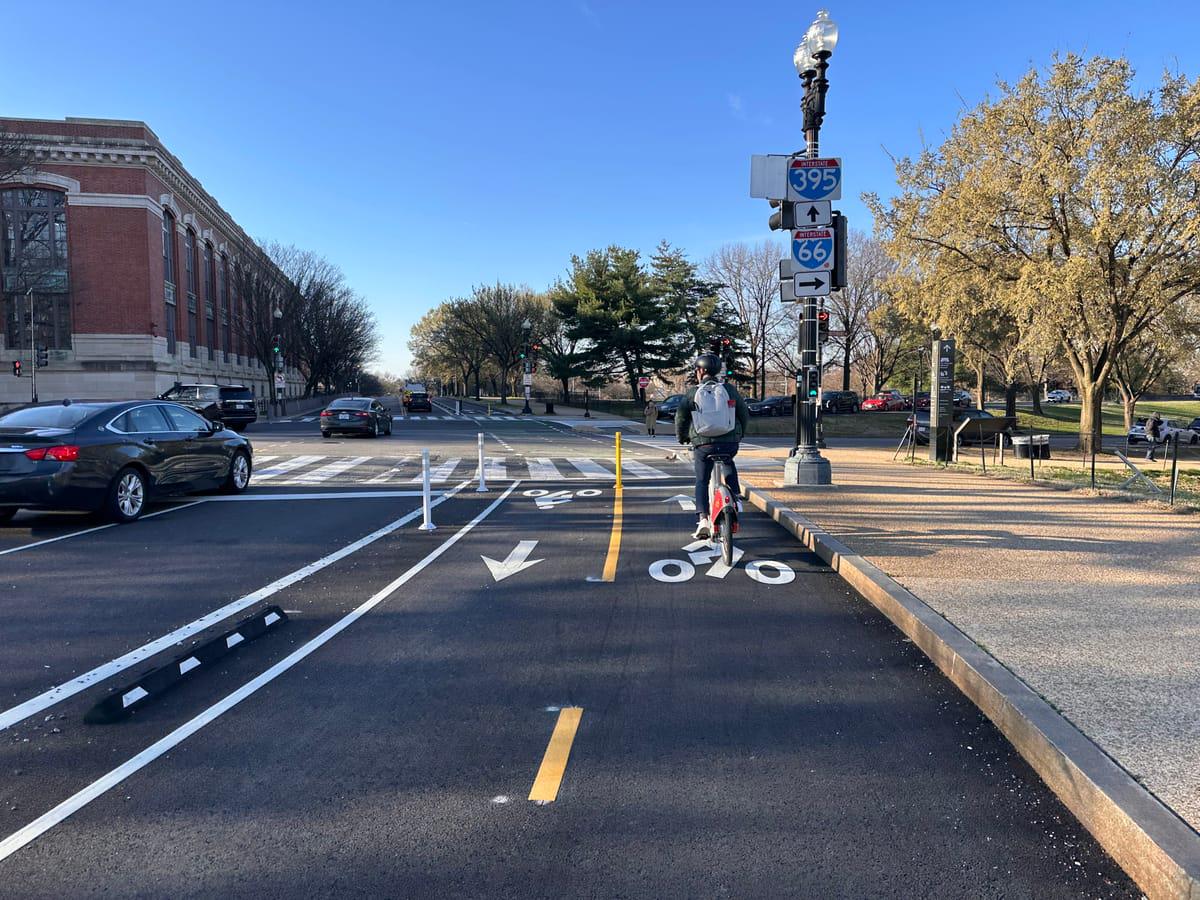
I read the piece and felt that familiar cold little twist in the gut, the one you get when people in power decide that something working too well for ordinary humans must be destroyed. A protected lane on 15th Street NW is being ripped out even though the numbers tell the whole story with brutal clarity: crashes down 46 percent, bicycle injury crashes down 91 percent, bicycle traffic up 3 percent, and, in one of the most infuriating twists of all, car speeds actually went up after the project was installed. So the project made the street safer for cyclists and faster for drivers, which makes tearing it out feel less like transportation policy and more like spite wearing a necktie.
That irony matters because it exposes the lie at the center of the argument. This was not some anti car scheme. It was a street that worked better for everyone, and it still got marked for destruction because it offended the wrong people and interrupted the wrong habits. The official excuse is cherry blossoms and event traffic, which is a lovely little lie if your definition of planning is removing one of the safest stretches of the route right when it matters most.
And this is not an isolated wound. The Trump administration has also been pulling back federal support for trails, bike lanes, and street safety projects in places like Connecticut, Albuquerque, Boston, San Diego, Illinois, Alabama, and Jacksonville, often by calling the projects adverse to motor vehicles or hostile to cars. In Connecticut, a grant tied to the Naugatuck River Greenway was pulled back, leaving a regional trail project stalled after local planners had already treated it like a serious investment in how people actually move between towns. In Albuquerque, the administration withdrew eleven point five million dollars for a downtown rail trail segment, a project meant to stitch the city together instead of letting traffic carve it apart. In Boston, a twenty million dollar streetscape project that also included electric vehicle charging got caught in the same machinery, which says a lot about how little patience this administration has for cities trying to build something better.
Then there is San Diego, where a road improvement project that included bike lanes was hit because it reduced lane capacity, as if taking a little space away from cars to make room for human life were some kind of ideological insult. In Illinois, McLean County lost funding for the final nine miles of a Route 66 bike and pedestrian path, even though local officials said it would improve safety without meaningfully slowing drivers, which is the sort of plain spoken civic logic that tends to die first when federal politics comes roaring through town. Alabama lost a project in Fairfield that would have converted street space into trail space, and Jacksonville had a major Emerald Trail grant rescinded even though that project was supposed to reconnect neighborhoods and restore creeks as part of a thirty mile urban trail system. More broadly, later reporting says the administration has slashed more than seven hundred fifty million dollars from bike and walking trail projects, which turns all the local fights into part of a much larger campaign.
What makes me angriest is how personal these projects are once you strip away the grant numbers and federal language. The D C lane is for the rider trying to get across downtown without white knuckles. The Connecticut trail is for the person in a smaller place who needs a safe corridor between communities that were never designed to connect. The Albuquerque trail is for a city trying to build a downtown that feels inhabited instead of conquered. The Boston project is for a neighborhood that wanted to get a little more humane. The San Diego project is for the block where safety should have mattered more than lane count. The Emerald Trail is for a city trying to heal. The Route 66 path is for the quiet, unglamorous work of letting people move without getting flattened by the wrong priorities.
So call it what it is. A tantrum with asphalt and paperwork. A government that looks at safer streets and sees an affront. A bureaucracy that sees ordinary mobility and decides it needs to be corrected, punished, erased. The part that should make people furious is not just that these projects are being canceled. It is that the cancellation itself feels so banal, so office bound, so bloodless, as if the loss of safer streets were just another line item instead of a decision that lands in the bodies and routines of real people.
by two2under
1 Comment
There is 0% chance Trump knows how to ride a bike. He hates what he doesn’t understand (which is A LOT). So, naturally, bikes gotta go.