
Moderately amateur cyclist here; I started last summer.
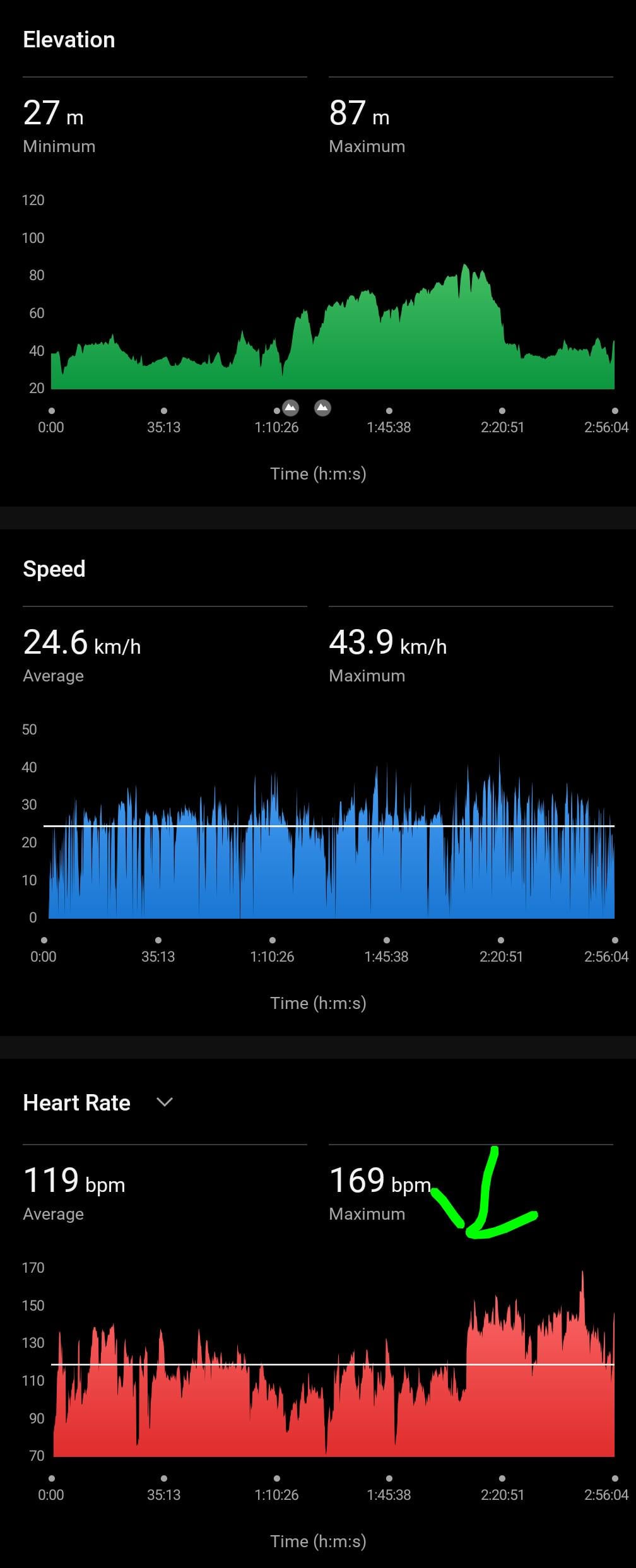
Today I hooked up my Garmin watch to stream my heart rate to my Garmin computer. And it was interesting seeing my heartrate feed.
It was quite a punchy ride. My legs (particularly quads) always start aching before I got anywhere near out of breath. Especially uphill. (I suck cycling uphill for more than one minute.)
I've been trying to take carb/calorie intake more seriously but I'm not quite fluent on that science yet. Most of the cycle was zone 1 or zone 2. I actually struggled to get it above 110 – right up until the highlighted point on the chart. That's when a took a good quality energy gel (giveaway from a popup kiosk). Anyway, that shot me up to 140bpm and I felt incredible. I wasn't gassing out; I felt like I could cycle to the moon and back! I thought I had managed my intake properly until that point but maybe I hadn't!
I guess, where I'm going with this is, what does this data reveal about me or what I am (or are not) doing? Any obvious advice points for me? I love it and want to get better – so that I can keep up on more interesting rides. I know off the bat that more saddle time uphill and losing weight will probably help. Hitting a ride like this every weekend for the past month is my consistency right now. I pretty much took the whole winter off.
Thanks!
by Visible_String_3775
21 Comments
Edit: distance of this one was 70km.
There’s not enough information/data provided to make any determinations. I don’t know your FTP, your LTHR, your HRmax, nothing. I doubt you know either. Ride your bike a little faster every day. Eat carbs regularly during the ride and hydrate yourself before you start to feel thirsty.
If your muscles were aching early in the ride before you felt you had done much of an effort then I would investigate your fit.
Don’t skip leg day.
Strength training will help.
Cycling alone won’t develop all the muscles needed to ride effectively. Take some days to do squats in addition to riding.
Also, find a nice route that puts you at your threshold for 20 minutes at a time. This will help build your pain tolerance and endurance quickest.
I think as long as you keep riding and pushing yourself, you’ll eventually get where you want. Without a strict plan, it just takes longer.
Be sure to have easy days so your muscles can recover after intense exercise.
And it is always the opposite for me. I should ride more I guess.
You need to develop your “logistics” side of power delivery – microvasculature (cappilarization) in the legs.
It takes a lot of time and training and unlike hypertrophy training you cannot see the results – but they are there and the difference between “high-troughput” trained legs and a novice is huge.
Btw, while strength training helps, too much *hypetrophy* actually detrimental cause thick muscular fibers cannot be fully perfused by cappilary domains and you’ll be able to sprint harder, but your ftp will not increase and maybe even decrease.
This is why “quadzilla” track sprinters will never win an hour record and hour record guys don’t have “impressive” looking legs.
Spin faster
So cadence is key. Many amateur cyclers try to go with high gears, which is high torque and low cadence. That will tire you out quickly. Try to target 100 cadence to help you with that. If you don’t have a cadence sensor, you can get them cheap and imho they are worth it.
Generally, if this is me, it’s 100% outside fatigue or over-training. Happens to me from time to time. Usually it’s either my quality or quantity of sleep. But like I said, it’s sometimes that I’ve just put too much other physically demanding stuff in my week.
Are you mashing big gears? Cadence frequently below 85-90 ?
Count “1 mississippi … 2 mississippi … 3 mississippi…” and you should be doing about 1.5 revolutions per second.
Not near enough data to really go on, but things that stood out to me:
* Bike fit – “My legs (particularly quads) always start aching” – saddle too low can over engage quads and under engage glutes and hamstrings.
* HRM – “I actually struggled to get it above 110” – make sure your watch is tight enough to accurately and consistently measure your HR. That’s some very inconsistent data there, and a large spike like that is pretty weird.
* Nutrition – “That’s when a took a good quality energy gel” – start your ride with carbs, and aim for at least 60g of carbs per hour, and go up from there depending on how many hours and intensity. I start most of my rides with a bar of some sort, and my bottles have two scoops of Skratch and a scoop of Karbolyn (carb mix), for well over 100g/hour combined with a bar. This may need to be something you work up to, and you might not need quite that amount depending on your fitness.
* Nutrition part two – Make sure you’re eating enough throughout the day. Getting a resting metabolic rate test and talking to a nutritionist nearly 10 years ago changed everything for me. Also the daily intake for various athletes in the book Racing Weight really changed how I looked at eating/fueling in general as well. You probably have a lot to unlearn around what is OK to eat between a sedentary person and someone who consistently exercises.
* Tired, possible overreaching or even overtraining – HR that won’t go up is often a sign that recovery is needed. Assuming fueling and equipment is good, consider when the last time you took a recovery week was. Most athletes go for 3-4 weeks “on” and one week “off”.
Food is critical for good legs. Pre and during
What’s your cadence? You might be pedaling to slow in too high of a gear.
I suspect your watch HRM isn’t working properly. Look at that jump at the end. The latter section it worked properly, the earlier section it wasn’t.
I’ve had this issue before with my forerunner 45, I don’t know what causes it. It will track low for a while then jump up.
The strap based HRMs are much more accurate. Buy one and connect it to your garmin and you’ll find your average HR is probably closer to 145-150 for that ride.
In my own experience, optical wrist sensors aren’t great on the bike and tend to give wrong readings, which is probably what’s happening here. Your HR isn’t responding how it should on climbs and the sudden jumps aren’t normal HR behaviour. I’d check against an arm band or chest HR sensor to validate, but perhaps the next time you’re out spot check by manually checking your HR and compare it to your watch, because your HR isn’t responding the way it should when you’re climbing around the 1:10 mark. Otherwise, it’s possible your cardio endurance is better than your muscular endurance, and your legs can’t keep up with your heart, but it’s likelier a sensor issue based on the charts.
Too many missing variables to give a proper opinion.
But usually when your heart rate is low on a hard ride, it suggests fatigue.
Keep going. It will get easier the fitter you get
Was there caffeine in your gel?
Also you might have just reached your endurance limit.
My heartrate for the wattage stays stable until my body reaches a point where the endurance just isn’t there and then it shoots up and doesn’t come down anymore…
When I was at my best this point came after 4-5 hours, now very much not at my best it’s inbetween 2-3.
This improves by time on the bike and consistency, and in my opinion will continue to happen for the rest of your life. The fact that the heartrate couldn’t follow anymore means you gave your body a stressimpuls which it will use to improve. That’s what training is, you just happen to reach that point later and later timewise as you get better.
Also your heartrate can go up when you get dehydrated. So make sure to be drinking about 500ml/hour.
You’re likely not Utilizing your gears properly. You’re pushing too hard instead of cycling.
Pick easier gears and try to increase your rotations per minute for your pedaling. This is called your cadence.
If your cadence is 60 rpm going uphill, you’ll have a bad time.
If your cadence is 90 rpm going uphill, you’ll have an easier time.
Right now, you’re using your muscles to try and power your rides. This is the wrong approach. You need to use your cardio engine power your rides. This means you need lower efforts at higher cadence.
It will feel like you’re not working hard enough at first. And! Every hill should feel easy for the first 1/3 to 1/2 of it. You gotta save that energy for the last part of the climb.
Do the same ride, but stay in easy gears and try to keep your RPM closer to 90.
Wrist based HRMs don’t work very well for cycling. It’s the angle of your wrist make it difficult to read pulse. Get a chest strap or arm band.