
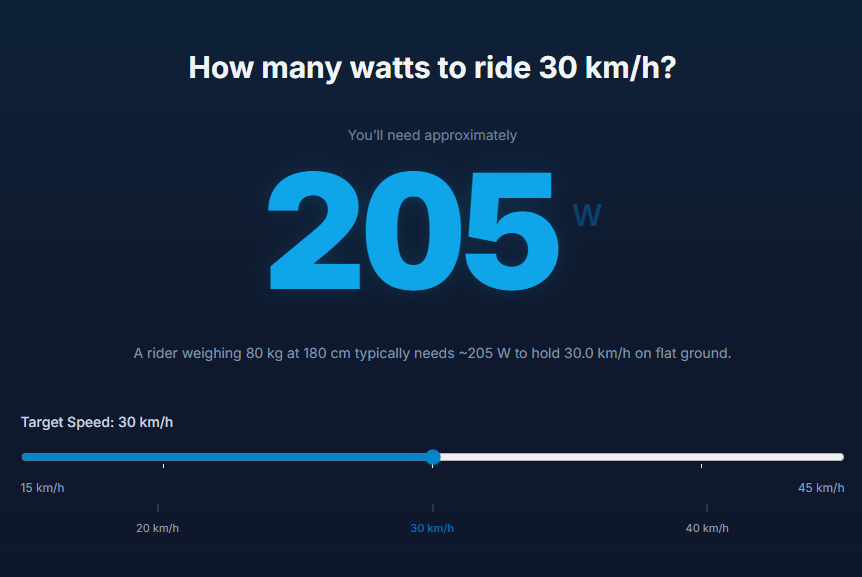
According to this calculator I should be getting ~205w for 30 km/h at 80kg, but in reality I’m finding it’s more like 240w solo.
Curious what others see for steady 30 km/h efforts?
by murdocsvan
According to this calculator I should be getting ~205w for 30 km/h at 80kg, but in reality I’m finding it’s more like 240w solo.
Curious what others see for steady 30 km/h efforts?
by murdocsvan
14 Comments
Does your calculation take into account all the drag and friction? See how that affects the result.
0,5 m/s headwind could already make that difference.
This is the best one speed/power calculator I know: [https://www.gribble.org/cycling/power_v_speed.html](https://www.gribble.org/cycling/power_v_speed.html)
But you need CdA and Crr estimates (of course).
Crr can be found (if it was tested) on bicyclerollingresistance, while CdA is way trickier.
It can vary of 0.5 (m^(2)) for an upright cruiser to 0.12 for a recumbent lowracer to 0.05 of a top-tier velomobile.
My lwb recumbent, despite upright position, is about 0.28 CdA and 0.005 Crr for instace, estimated from lots of miles of data collection and a power meter.
It allows me to cruise at about 33kmh at 200w – my LTP (multi hour power) is about 190w, so my multi-hour rides on flat terrain end up with about 31kmh average speed.
I’d be faster, but I’m a bit of an oxymoron (an obese ultracyclist)
https://preview.redd.it/t8wld2k2d9ng1.jpeg?width=1439&format=pjpg&auto=webp&s=cd7c76d48a2e16dea0d09bab2028d106ed65b96a
On a very windless day on a relatively flat route that sounds about right if you’re riding a newish bike with good tires. There’s too many factors really to calculate this accurately.
Your position on the bike makes a hughe difference. I estimate hood vs drop position can make 20W difference.
240W in the flat for 30km/h avg seems a bit too high for me. Out of my stats, this is the nearest I can find since I haven’t had my power meter for very long. Roadbike, 85 kg, but with ascent…
https://preview.redd.it/kwgfzroxd9ng1.png?width=1462&format=png&auto=webp&s=3cf29f74d4f6d15b91a0f713b943d12d6e82d134
A lot of factors like bike, tires, position on the bike, clothing etc.
220ish is about right for me but can get that down to 200 when I get aero.
205 VS 240 is actually extremely close considering the huge number of variables at play.
Even altitude and the weather (even ignoring wind, which is the biggest factor) could lead to this much error easily.
The primary force you’re doing work against (requiring work from you to maintain speed) is drag. Drag is related to 0.5 * density of air * your drag coefficient (must be measured in a wind tunnel in your exact outfit, body position, and wind direction) * speed ^2.
If you’re going uphill or downhill, you’d add or subtract the power required for the change in potential energy as well.
If this sounds really complicated, it is. Aerodynamics is an extremely complex field and “solving it” is only possible for very high budget projects like F1 or the commercial airline industry.
Like 185 watts, relatively flat 50 miles with 900 ascent/descent. My 210 watt gets me 20.1 mph
I love math and all.
But there is a reason why we have people who sit around in an office and calculate the math behind the physical world, and a whole other group of people who actually test it to see if it works in real life.
Often, it doesn’t. Science!
My gravel bike and my road bike both require different wattages for the same speeds.
With good (race) clothing / bike / positioning I could comfortably do 20mph (32kph) @ 200w … commuter gear / hybrid bike / sat more upright will all cost significant wattage to hit the same speed.
I’m 92kg and 30kph on flat road is about 155-175watts. Riding on the hoods with pretty straight arms on a road bike with round, non-aero tubes.
What type of bike are you riding if it’s taking you 240 watts? At 240watts I’m going 35.5kph.
I averaged 32.7 on a flat route yesterday (round trip) Was a ride of 2 hours and I needed to push for 202 watts on average. And I weigh about 80/82
Last sunday 80km. Average 30,2 km/h. 203 watt average power. 178 cm. 80kg.
There’s a 10 mile segment near me that’s nearly flat overall, and the times I’ve averaged around 19 mph were in the neighborhood of 160 to 180 watts. My best effort was 196 W and 22.0 mph.
I weigh about 72 kg/165 pounds and this is on a road bike with 25mm GP5000 tubeless tires. Measured power on Assioma pedals.
Things to check: rolling resistance of your tyres, the surface you’re riding on, headwind, your position on the bike.