
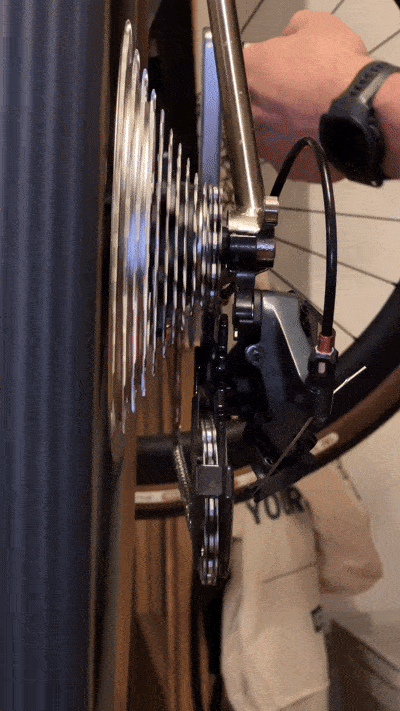
Help much appreciated!
As you can see in the video, there's this inconsistency: shifting down is as expected, but when shifting back up, the chain gets caught in between gears. In my observation, this only occurs when the derailleur mech is collapsing and virtually never when its expanding. As if the mech's spring tension wasn't enough to pull back the mech after the cable is protracted from the shifter. If I give it a manual pull, it lands the right gear and stays in place after. You can see how the chain doesn't land in the same spot on that same gear when coming down the cassette.
What has been done: new rear mech – the problem persists. Thin brass washer between the derailleur and the hanger to alleviate any play, different variations of b-gap, different chain with similar wear, greasing the cables and housing, inspecting guides. The hanger appears healthy, it's a very chunky alloy slab – can't really imagine it could be bent without absolutely destroying the mech first.
What has't been yet excluded is the inline barrel adjuster (seems solid, no wanky-wanky), and the brifters (I don't want it to be them and don't know how to inspect em).
The problem first appeared on an uphill when i couldn't quite shift to the biggest sprocket.
What am I missing here?
NOTE: It's not about the cable tension. Lowering the tension to help the mech land the smaller sprockets leads to mech not being able to climb bigger sprockets.
by dlgvvv
7 Comments
This looks like excessive cable tension to me. Try lowering it about a half turn and see if it’s better
Edit: to decrease cable tension, you need to turn the barrel adjuster clockwise
Barrel adjuster in 1/4 turn
Usually when I can’t adjust both ways properly, it means I have a slightly bent derailleur hanger. Have you tried straightening it?
i dunno the issue but will help to upvote. curious too.
You’ve already eliminated cable tension adjustment/indexing as an issue. So here are the most likely causes.
1. A shitty model rear derailleur. Some rear derailleurs are crap due to bad design or shitty tolerances. I once bought cheap a 1×11 (or maybe it was 1×10) drivetrain made by SRAM many years back, maybe the NX version; no matter what I did, it sucked like in your video. So confirm whether your rear derailleur model has any known issues. [I’ve been tuning and installing rear derailleurs for 3 decades and am 100 percent able to tune them perfectly…this specific SRAM rear derailleur is the only exception I had.]
2. Shifting from larger cogs to smaller cogs is inconstent and rough because something along your cable/housing sistem isn’t allowing for derailleur’s spring to move the derailleur smoothly. Could be a kink or sharp bend on the cable; maybe corrosion or dirt; maybe strands in the housing are pulling through the housing sheath; maybe cuts on housing ends aren’t square or the ferrules flex. Replace cable, housing, and ferrules and make sure all the cuts of the housing are clean and square.
3. Use a derailleur hanger tool to confirm correct alignment. Believing “the hanger appears healthy” based on a visual inspection isn’t enough.
Usually when a derailleur does not shift to a harder gear, but does shift to an easier gear, it has nothing to do with cable tension. Could be a bent cable in the housing or grit in the housing, but it looks all new-ish to me. The most usual culprit is the B limit. If the B limit is screwed too far into the rear derailleur, it pulls the derailleur back towards the back of the bike, and away from the gears. If it is screwed too far out of the rear derailleur, it allows the derailleur to be closer to the gears, and when you get into the larger cogs, the derailleur will pinch the chain between the easiest gear and the upper pully of the rear derailleur. So, screw the B limit out until it makes a ratcheting sound going into the easiest gear. Then shift one harder and screw the B limit into the derailleur just a bit, and shift back up into the easiest gear. You want the derailleur to be as close the the easiest cog as possible without pinching the chain and making the ratcheting sound.
Hangers are designed to bend so they save the mech, they bend quite easily without any damage elsewhere. This is the first thing I check when there’s shifting issues, as it’s out of alignment a majority of the time.