
Hi everyone!
I need your advice on a project that's very important to me.
Almost 20 years ago, I cycled through 9 countries. It was an incredible experience, but I mostly remember the constant exhaustion and a memorable sore bum that sometimes spoiled the fun.
Since then, I've only done short trips of a few days.
My conclusion is clear: I don't have great endurance.
I generally cycle about 50 km a day.
The first day is fine, but the fatigue quickly builds up in the following days, and I end up physically "enduring" the trip.
The first day is fine, but the fatigue accumulates quickly in the following days, and I end up physically "enduring" the journey. Today, I want to go back to long trips in France with a content creation project (audio equipment, iPad, etc.), but I want to change my approach.
I've heard that recumbent bikes (or trikes) are the miracle solution for traveling further with less fatigue.
My questions for recumbent cyclists:
- Recovery and endurance:
Do you really get less tired on a recumbent bike? Does being supported by a full seat (rather than relying on a saddle and wrists) make it easier to complete 50 km days without accumulating that "body fatigue"?
- Trike (3 wheels) vs. 2-wheel recumbent:
For someone who tires easily, isn't a trike too heavy to carry? Or, on the contrary, does never having to worry about balance save energy?
- Transportation (the biggest problem):
I'm worried about the hassle with the train or buses. Can a folding trike be considered luggage if it's covered, or is it always a battle with the ticket inspectors?
- Tight budget:
I'm looking at used models. Any recommendations for sturdy and "economical" models to get me back into business?
My goal isn't performance, but to be able to ride every day with pleasure, while protecting my creative equipment.
Thank you for your advice and feedback! 🚲🛋️
by NuitSauvage
9 Comments
No. Going up hill on those, with added weight of travel gear will be much harder.
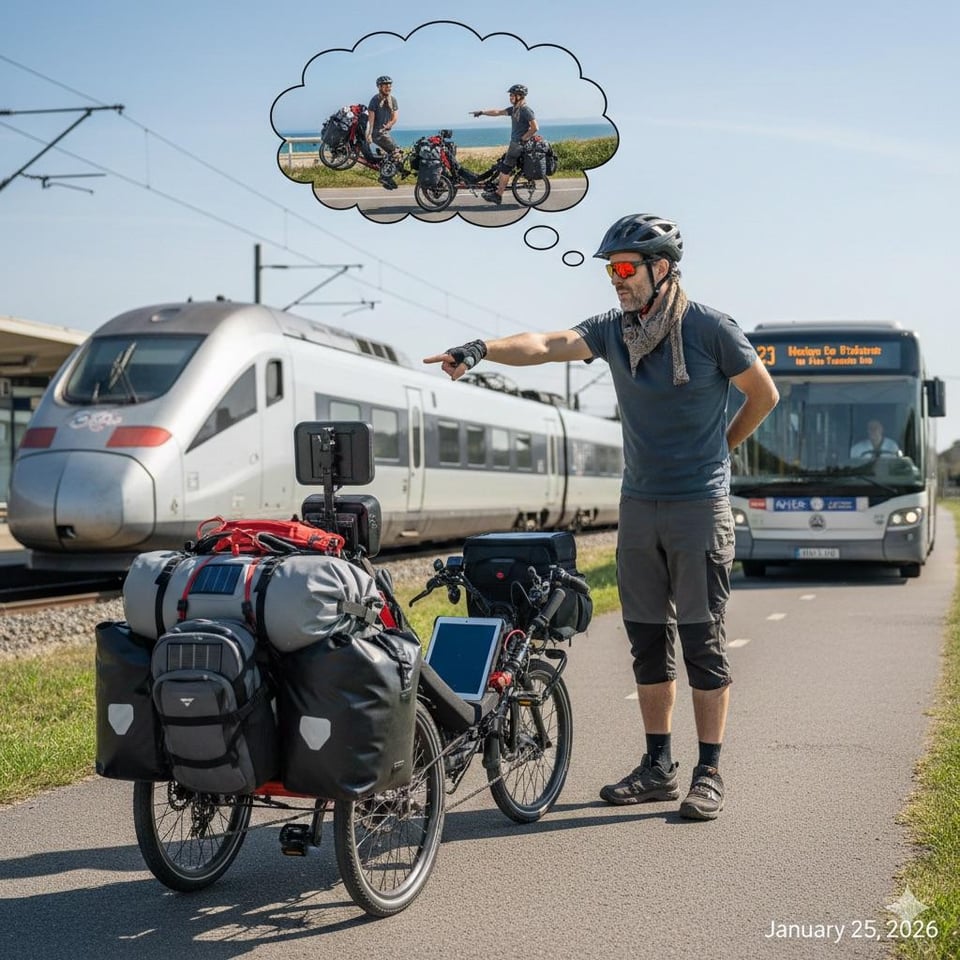
What is the guy in the second picture imagining?
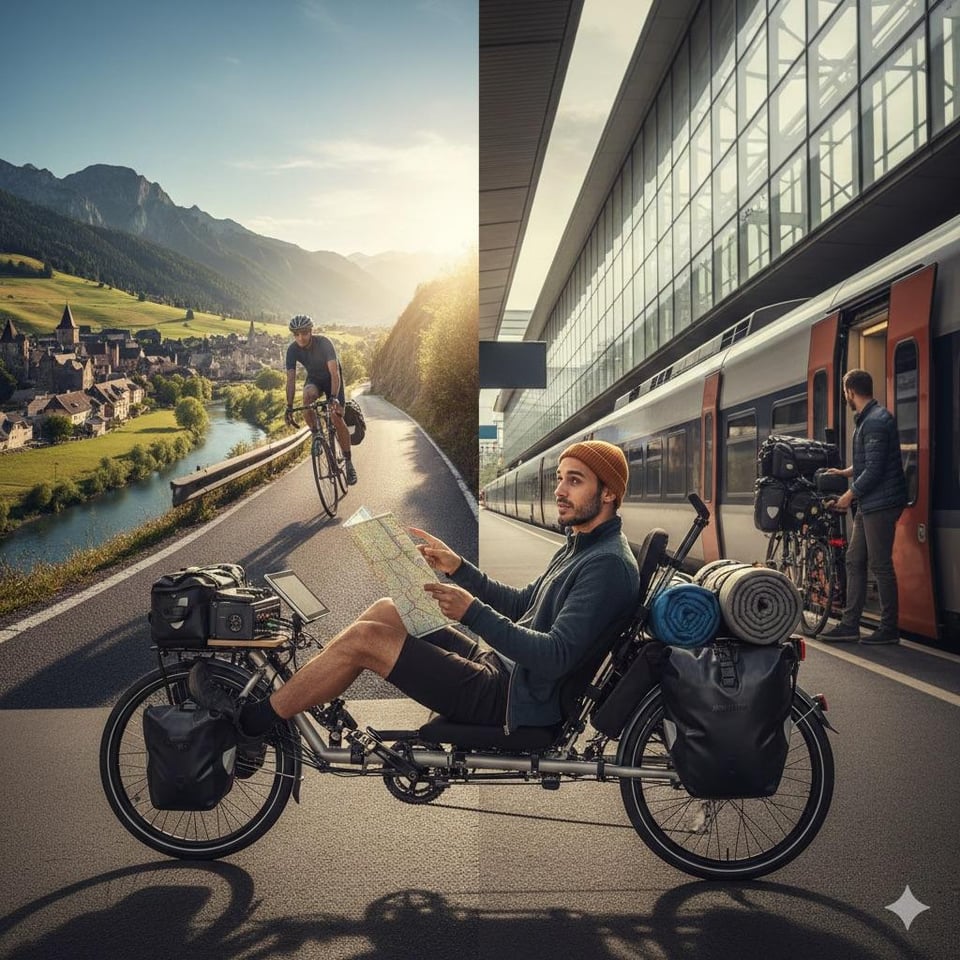
AI slop is horrible and unnecessary. You traveled through 9 countries….how about a pic or two from your trip? Way better than this. Just my 2 cents
Try one and see what you think. A recumbent bike is more efficient because you have less air resistance but I think you’ll still be tired if you spend all day cycling one.
A seat does put less pressure on your bum than a saddle and no pressure on your wrists. However you can also improve your experience on a regular bike by adjusting your fit, different saddle, different clothing, different handlebars.
I absolutely think recumbents are underrated, and if I was considering a long tour where I knew I wouldn’t want to do any off road I would consider one. However, this won’t be a magic bullet at all.
If you get too tired while touring I’d recommend dramatically reducing how much mileage you expect to do. Getting too attached to going further or achieving a certain distance is the most common ruiner of trips I think.
Finally, did you really have to use this AI slop to illustrate your post?
This sound odd. If you have a suitable saddle, correct body position on the bike and use cycling shorts, your buttocks should get used to the load in relative short time if you ride daily.
A classic mistake is also to have a saddle which is too soft and too much padding in the shorts.
Did you ever analysed this things with someone?
20 years ago I did a 12,000km bikepacking trip on a recumbent. No saddle sores, no wrist pain, no back pain, no neck pain. For that part, the recumbent was great. Much more comfortable to ride. Some other benefits:
– less wind resistance
– great conversation stater with locals
– much easier to eat while cycling
– better all-round view
Some negative aspects I experienced:
– less visible in traffic
– less agile, especially in rougher terrain
– no ventilation of your back, more sweating
– no changing of body position when pedaling
– going uphill feels harder since you look into the distance, not onto the ground, and can’t use your body weight to assist
– in rainy conditions you feel more exposed
– some parts may be proprietary and harder to replace/service in remote areas
– harder to pack/transport
Nowadays I am bikepacking on a regular bike. More discomfort, but I prefer to not stand out too much and for me it’s much easier to do everyday group riding, racing, commuting, and bikepacking on the same type of bike. When on the road I do 120-250km days and just deal with the discomfort and include enough rest days. I’m in my mid 40s.
I ride a surly L H T (diamond frame tour bike); a Fuji 2.1 (carbon diamond frame road bike), a Bachetta Giro ( two wheel recumbent) and just recently sold my Catrike Pocket. (Recumbent trike)
They’ve all been good to ride. I’m not young…and I have arthritis… so I accessorize with comfort as a high priority.
My Diamond frame bikes both have the redshift kitchen sink handlebars with the nice wide platforms for hand position. I also got their shock absorber stems, as my hands are my most problematic contact and I want to minimize the vibrations for them. I’ve also put brooks saddles on both. Brooks saddles LOOK like they’d be axehead seats…but the leather molds to your ischium tuberosa “sit bones” over the first 300 miles or so of riding, and basically give your butt a custom leather hammock. I’ll never buy another type of seat. They’re the best seat I’ve ever ridden on.
Recumbent trikes are great for balance and comfort…and are amazing on flat and downhill…but totally SUCK going uphill. More weight, more rolling resistance… so terrain will definitely affect your overall enjoyment.
Recumbent two wheels is like learning to ride all over again. Balance takes time to get used to…and if you have a smaller front wheel, steering can be squirrelly. Getting a good bike fit on them can be finicky. But wow….they ARE comfy. They’re better uphill than trikes…and some styles ( Cruzbike) can be very good uphill and rival diamond frame climbing. ( but be advised they attract attention and comments )
Another consideration is that parts and repairs for recumbents tend to be expensive and difficult to find.
Fatigue is something you can train and prepare for regardless of your riding platform. Ramp up your training ride miles and weight over several months prior to a tour to ease your self into the higher physical demands so you can enjoy the journey.
Buddy in the second photo has bigger things to worry about, he’s about to be flattened by a bus driving illegally in the bike path.
But yeah, maybe? I’ve not tried a recumbent and have only done a couple small bike tours. My first one, the warmshowers host I stayed with had swapped his bicycles with recumbent and quite liked it for its comfort. However, I’ve heard tough hills and “sprinting” can be hard, as you can’t get out of the seat to put your full weight into the pedal.
Why are you posting AI slop here?