
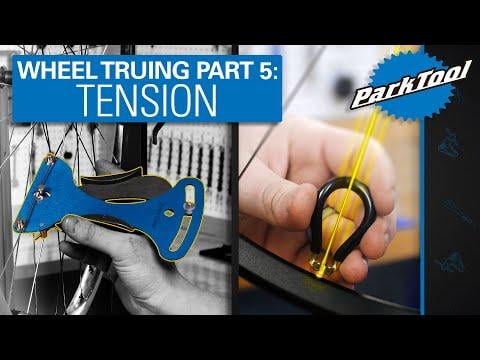
Spokes tension is important
https://youtu.be/aYfL2wzkV4M?si=cQ9ezAGxH0WGTeoo
often unnoticed, probably many casual cyclists didn't pay attention about it
But I'm not (yet) quite ready to get a formal spokes tension meter
inspired by attempts like such
https://youtu.be/futB4OlIQdY?si=sA_v3Ft16yo6pTJM
I made an attempt to estimate / predict the vibration frequency of a spoke.
I noted that many (quite a few of those I reviewed) stated the string vibration equation
https://en.wikipedia.org/wiki/String_vibration
however, a spoke isn't quite a string, it is more correctly a slender rod
Hence I attempted to model it using the Euler–Bernoulli beam theory
https://en.wikipedia.org/wiki/Euler%E2%80%93Bernoulli_beam_theory
The physics can be quite involved, but I did the calcs using a jupyter notebook and shared it on kaggle and google collab as such:
https://colab.research.google.com/drive/1WbGC_aURD2SItVpdviP9bwIXaxl-fMSC?usp=sharing
https://www.kaggle.com/code/ag1235/spokes-axial-loaded-long-rod?scriptVersionId=286902014
Note that these are *NOT* measured against real world conditions but are idealized (physics) models, hence they'd likely not be accurate as against what you are measuring. It is just a 'guess' to get a feel of what it *may* look like.
In my model, I used a 26" wheel and estimate the spoke length to be that dividing by 2, giving about 279mm (about 10.98 ~11"), and I used a 2mm (diameter) steel spoke as the model.
The results of the run looks quite interesting. 100 kgf runs to around 360 hz.
In the last cell at the bottom (of the notebook), I tabulate the tension in kgf against the frequency. I've tabulated values for spoke diameter 2mm, 1.8mm, 1.7mm and 1.5mm
These are idealized and the parameters you change / use changes the outputs, they need not equal real world conditions.
However, when I play with the model e.g. reduce the spoke diameter to 1.5mm (radius 0.75mm), 100 kgf would run to around 477 hz
by ag789
10 Comments
The formulas from a Google search
[https://www.vibrationdata.com/tutorials/beam_axial_load.pdf](https://www.vibrationdata.com/tutorials/beam_axial_load.pdf)
If any of you have a spokes tension meter, could you try to verify that?
There are apps like Spectroid (Android) , not sure about the same on iPhone
[https://play.google.com/store/apps/details?id=org.intoorbit.spectrum](https://play.google.com/store/apps/details?id=org.intoorbit.spectrum)
which can do an FFT from the mic and plot the frequency spectrum. Knock / pluck the spoke and place it near the phone mic running the app. The spoke vibration should be one of the peaks on the spectrogram.
The frequency may be around that predicted
I’ve made a table at the last cell at the bottom
[https://colab.research.google.com/drive/1WbGC_aURD2SItVpdviP9bwIXaxl-fMSC?usp=sharing](https://colab.research.google.com/drive/1WbGC_aURD2SItVpdviP9bwIXaxl-fMSC?usp=sharing)
[https://www.kaggle.com/code/ag1235/spokes-axial-loaded-long-rod?scriptVersionId=286902014](https://www.kaggle.com/code/ag1235/spokes-axial-loaded-long-rod?scriptVersionId=286902014)
you can download that notebook and perhaps run it yourself using Jupyter notebook
[https://jupyter.org/](https://jupyter.org/)
or perhaps clone the notebook on google collab, kaggle.
there is also google collab which you can use to run the notebook
[https://colab.google/](https://colab.google/)
varying the parameters and re-running produce different results.
Sounds like you need to build a tension fixture with an accurate force gauge and test your hypothesis
This post is not a repair question, and as such will likely be removed.
Consider /r/BicycleEngineering or /r/BikeMechanics
All that said:
> 100 kgf runs to around 360 hz.
seems really low based on my experience. Then again, I have a tin ear.
This looks interesting but I don’t have time to investigate and can’t afford a spoke meter rn. Could you dm me in a couple months?
Just anecdotally the spokes on a wheel vibrate at wildly different frequencies even when the wheel is true (source – plucked them myself because theoretically, if a wheel is true and unbent then all spokes on the same side of the wheel should ring at the same note right?)
Though, depending on the lacing pattern spokes do contact each other. This would reduce the effective length of your rod, right? Guess you’d have to test with a wheel where no spokes cross each other (which would not be super stable)
r/bikewheelbuild would love this and has many members with a spoke tension meter
Doesn’t the crossing point alter the pitch of the spoke? Or has this been accounted for?
I think this is fundamentally flawed because the spoke crossing will affect the pitch heard. Radial vs 3x would sound completely different even with the same length spoke. Truing by tone is extremely useful and accurate for relative tension, but trying to determine an absolute value for a given tone seems more trouble than it’s worth given the many factors at play. I’ve got a Wheel Fanatyk tensiometer I could test the theory out with, but due to the spoke crossing issue I don’t think my results would really offer much useful to you.
A couple of comments based on the experience of building closer to a hundred wheels, and also as someone who is at least moderately musical.
Butted spokes vary in terms of how long the butted section is. Thin spokes like DT Revolution have very short 2.0 mm sections near the nipple thread and the J bend, but in thicker spokes like DT Competition the section is much longer.
I’m saying this because if you try to calculate the frequency from the spoke length and thickness, you cannot assume that the spoke has even thickness.
Another thing is that in a cross-laced wheel it’s common that the crossing spokes rest against other, which prevents them from vibrating freely. That’s one of the reasons why I like to build cross-laced wheels so that the spokes don’t touch, because it’s then easier to check the relative tensions of the spokes by plucking them.
…but with all this said, I still use a tensiometer.
There was an app for iPhone for many years called “Tensioner” that put this concept into practice. You entered the dimensions of the spoke (length + profile) into the app, and then plucked the spoke next to the mic on the phone. While it wasn’t as accurate as a calibrated tensiometer, I verified it to be within 10% in most circumstances – certainly good enough for most wheelbuilding purposes.
I mostly played with it out of curiosity, but it came in handy when building some 16″ IGH wheels that had spokes too short to get a tensiometer on – I knew I could trust it to be reasonably close.
The same app developer also published a great spoke calc app called “Quick Spoke” that allowed you to save a workbench of components and completed builds for future reference.
Both gone from the app store now, and won’t install on my more recent iPhone …