
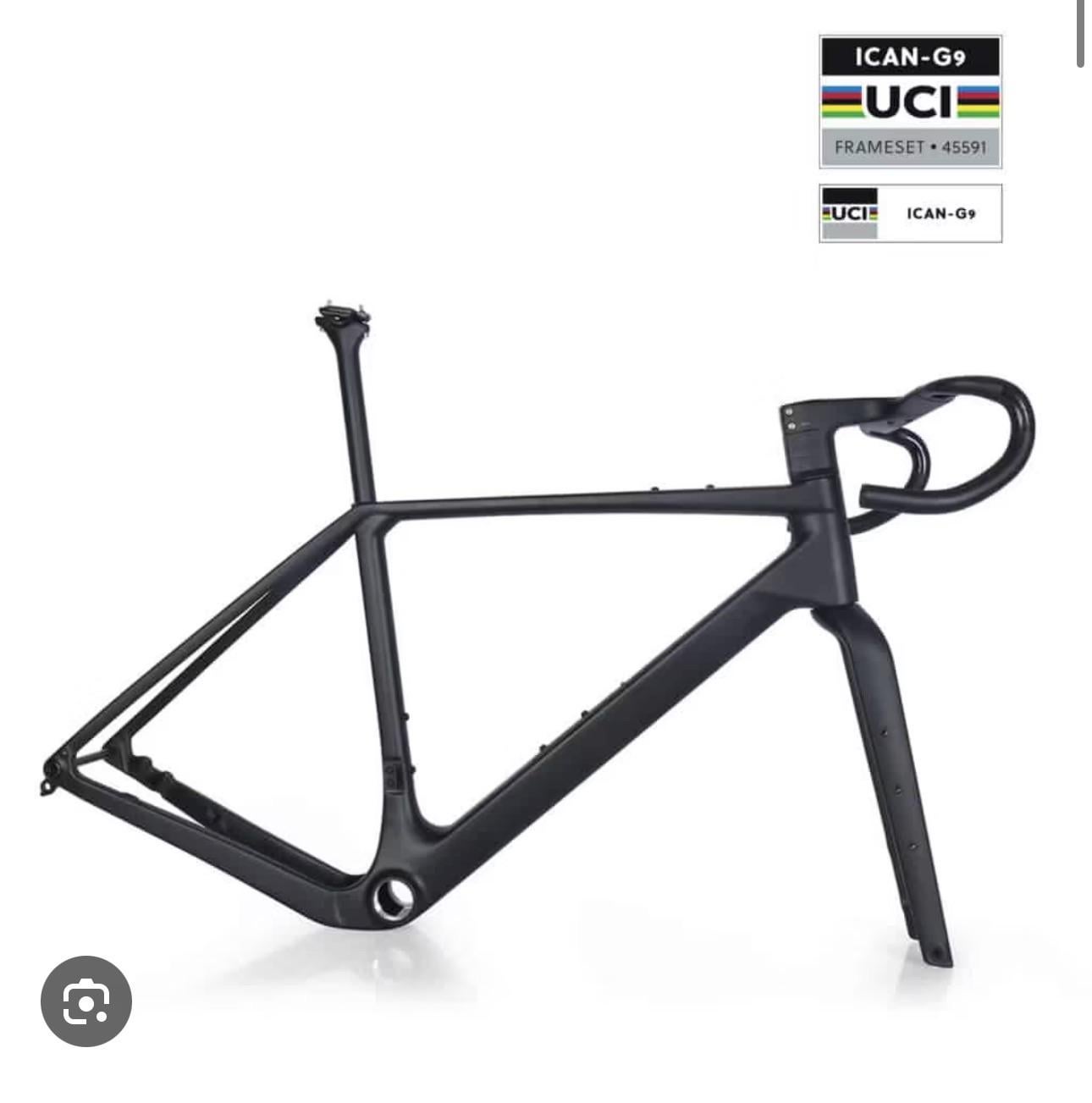
I have been looking for some gravel frames to build up my own gravel bike.
I found this frame on said search and I’m curious about these forks – is anyone able to explain why they are like this, why they protrude forward? Is it advantageous for gravel cycling? Compliance? Wheel clearance? And is there any disadvantage?
Any advice is appreciated, thanks!
by Reasonable-Horse-305
10 Comments
Tire clearance, while trying to preserve some other aspect of the geometry. Same reason why you might see dropped chainstays.
It probably is a visual choice for a geometry thing. Bikes usually have offset on the fork. Moving the axle in front of the the steering axis makes a bike handle more stable.
Usually that also happens down at the axle. MTB suspension forks for example have offset both at the crown below the headset, and at the axle. So if you exaggerate the shape you get an L. This fork just flips it, having the offset in the crown. It is probably a visual thing, straight lines down to the wheel vs. a bend.at the hub.
That fork is going to be stiff AF in the vertical direction. Most forks are angled if you go and look, and the reason they do that is for compliance as well as weight. All forks need reach forward in order to hit the desired trail, but the more angled the fork is the more ability it will have for bending when you hit bumps, ie compliance. This reaches forward only with the upper part which is obviously a ver strong/stiff part of the fork, and then is near vertical which means it will have very little compliance over bumps.
That company makes pretty good Frames,I have one of their bikes it’s good but heavier than leading brands. But it’s a e-bike so might be part of it.
Orbea’s bike had that fork kink for a few generations. I always wondered about it too. Thought it was a design choice. Never liked it.
Trail improves control and stability. Traditionally, bike builders put rake at the bottom of the fork but modern manufacturing allows them to put it wherever they want. In this case, putting it at the top allows them to have a very long flat section for mounting storage.
They hold the front wheel for you and steer left and even right 👍
Tradidiotnal forks bend forward at the bottom, which is called “rake”, which induces more “trail” and also allows more clearance for the wheel. Back when bikes were made from steel tubes, it was easiest to put the rake at the bottom, but with carbon you can be more creative with the shapes.
Putting at the top probably increases stiffness, although they can probably make a traditional shape just as stiff. But there’s no denying it looks cool.
Fifty-One Seka has something similar. I think they’re hideous
On a rigid carbon fork, it’s merely a design choice. Look at the wacky Pinarello Dogma forks for another example. Carbon forks are pretty rigid vertically, no matter what. The carbon layers dissipate road buzz pretty effectively compared to steel. Steel forks have used curved stays since forever to get vertical compliance built into it since steel is a good spring material. The trade-off is a springy fork.
Bicycle forks need a certain amount of forward offset to get proper trail. You can put that offset anywhere on the fork. I prefer the cleanest looking method of having the offset within the length of the fork leg to make it look invisible.