
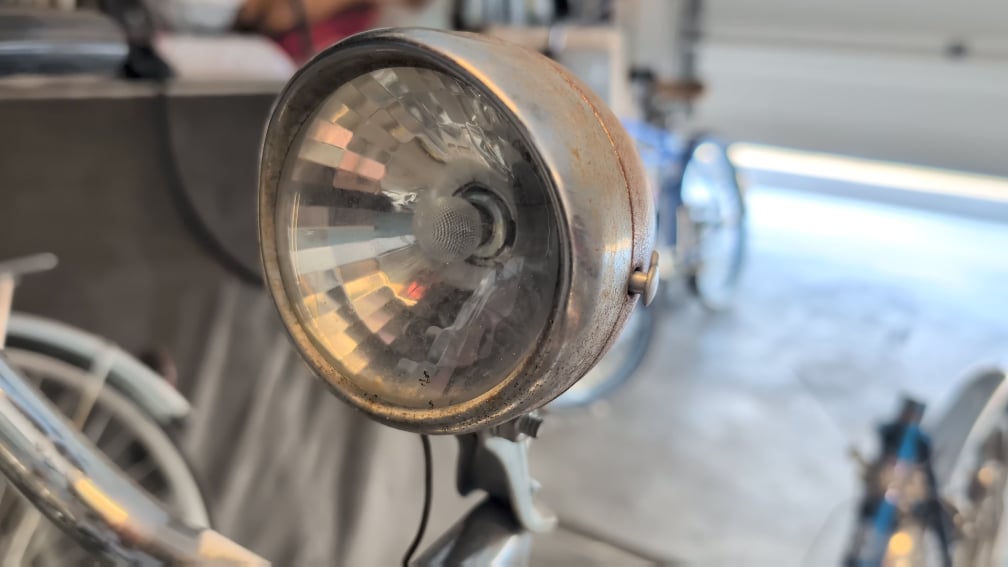
I am not even sure how to start troubleshooting this, and if the work is worth the reward for this old gal I'm trying to get roadworthy.
This bike will be used around downtown Las Vegas on the Hump Day Rides, so looking cool is more important than being perfect.
Should I just keep the gear on for nostalgia purposes? How did they route the cables originally?
How hard would it be to get this old school generator to work?
byu/702Downtowner inbikewrench
by 702Downtowner
14 Comments
Do you have a multimeter and do you know how to test for current I would start by manually spinning the generator to see if there’s any current coming out of it which they’re most likely is and then work your way up to the bulb for my experience that bulb is probably just dead and or those wires are brokennew wires, new headlight those things run forever
If you want to keep the look I’d just take the generator apart, put a 18650 cell in it to power the light instead and just have it freewheel. Those things never worked well and were a real drag.
Well whats happening when you put that generator on to the wheel and start spinning?
A bit oil could help to get those spinning parts in motion. Then see if the light buld does something when you spin the wheel. If not first check the bulb. And/or grab a voltmeter and check if there is some voltage generated.
That is an alternator and it’s simple: just a permanent magnet and a coil. The bearing is usually a sleeve bearing there.
Try cleaning, lubricating the bearing and chances are that it will just work.
You’ll need a pair of E10 6V incandescent bulbs: 2.4W front and 0.6W rear.
Nice, reminds me of the 70’s. Just got to give it a ride and see what it does. check the bulbs, maybe wire is cracked and weathered out and needs to be replaced. I have seen some of these on ebay. Those were so cool. Now I am all usb charge on my lights on the bike. Much easier and brighter.
Oh hell, I had one of those
The generator has a hot wire, the ground is via a pointed screw into bare frame metal.
Give it a shot of wd 40
First thing you should do is put a multimeter to the generator output. These things are VERY simple and there ain’t much to rebuild. Many of them don’t even have bearings.
I notice there is only a single wire and it depends on the frame for a ground. But paint insulates the ground. So first thing is to see if it is outputting about 6-12vac (most of them put out AC) at the back of the generator. Second is to make sure the bulb is good. These things are not regulated. The faster you go, the higher the voltage climbs. If you go down a steep hill, it will burn the light right out.
If everything checks out, the next thing I would do is replace the bulb with an led and put a diode (better a rectifier) in line with the power.
Finally, these things do generate a lot of friction. You can feel the difference. also, most people put them on the front wheel.
Almost all old generator lights on bikes worked after making sure the connections are good. It probably doesn’t need anything
If you really want to troubleshoot here are the steps:
Check if the bulb is okay unscrew it and do a visual inspection. The wire shouldn’t be detached. Shaking a little helps a lot. Try it on a 9v battery.
To test the dynamo unplug the leads attached. This is done to rule out a potential short. If the wires are shorted somewhere you can’t test the dynamo.
Use a multimeter to test if the dynamo creates an electrical potential. Put the multimeter in AC Voltage mode (V) at 20V. Fixate one probe to where the leads were attached and the other to its casing (somewhere not clear coated) or better where it is mounted to the frame and spin the dynamo. There should be a reading. If not you can try to go to a lower scale on your multimeter 2V. You should spin the dynamo with the wheel. If you are spinning it with your hand you might need to stepp even lower to 200mV.
If you don’t have a multimeter or voltmeter you can use a know good bulb (with a piece of wire) or led.
I saw a small piece of electrical tape, remove and check if the wires make a good contact.
Check continuity of the cables for that put your multimeter into continuity mode and probe between both ends. It should beep. Or go into resistance mode it should read a low number ideally under 5 ohm.
Check for shorts between cable and frame. Both cables are your line L (cable that carries the current) and the frame is your neutral N (return path of current). Probe one cable at a time to the frame on a clean, bare metal surface. Your multimeter should read 0L in continuity/resistance mode. High mega ohm could be sufficient but also could mean problems.
You can also put a 9 volt battery to one of the leads and and hold the negative side agains a bare metal part of your frame. If wiring and bulbs are okay they should glow.
I have one of those on an old Schwinn. I just keep it on there because it’s era correct. They don’t work well even when they do work and remember when you stop there’s no light.
To test it out step a couple of different size rubber hoses together if you have any laying around -over the generator wheel onto a cordless drill. Sometimes that generator wheel comes off with a screw and then you just left with the shaft. You can put a rubber hose over and connect to a cordless drill.
Sometimes, if you just spin them for quite a while, they start to work again. Spinning them with a drill is faster than the actual wheel will turn them.
I had one of these off my mom’s schwinn and from experience – it just depends what you mean by “work.” Huge drag and a loud whirring sound when clicked on, brighter the faster you go and dark at stops. I wouldn’t make it my only light since just about anything is more effective, but they’re fun!
That length of wire – looks needlessly dangerous.
Afair the dynamo used to be mounted on the front wheel, not the back. To avoid that.
Anyway I wouldn’t bother. Why not just get a $5 front light? Better light. Less hassle. ?
I had one of these on my front fork in the 70s. I was going fast down a steep hill and hit a bump. The fork was tapered and the generator slid down a bit, which meant it was suddenly very loose. It spun into the spokes and hit the other side of the fork. I went endo but somehow didn’t hit my head (no helmets in those days). Trashed the wheel though and had to hitch home.
All that to say make sure that clamp is tight!