
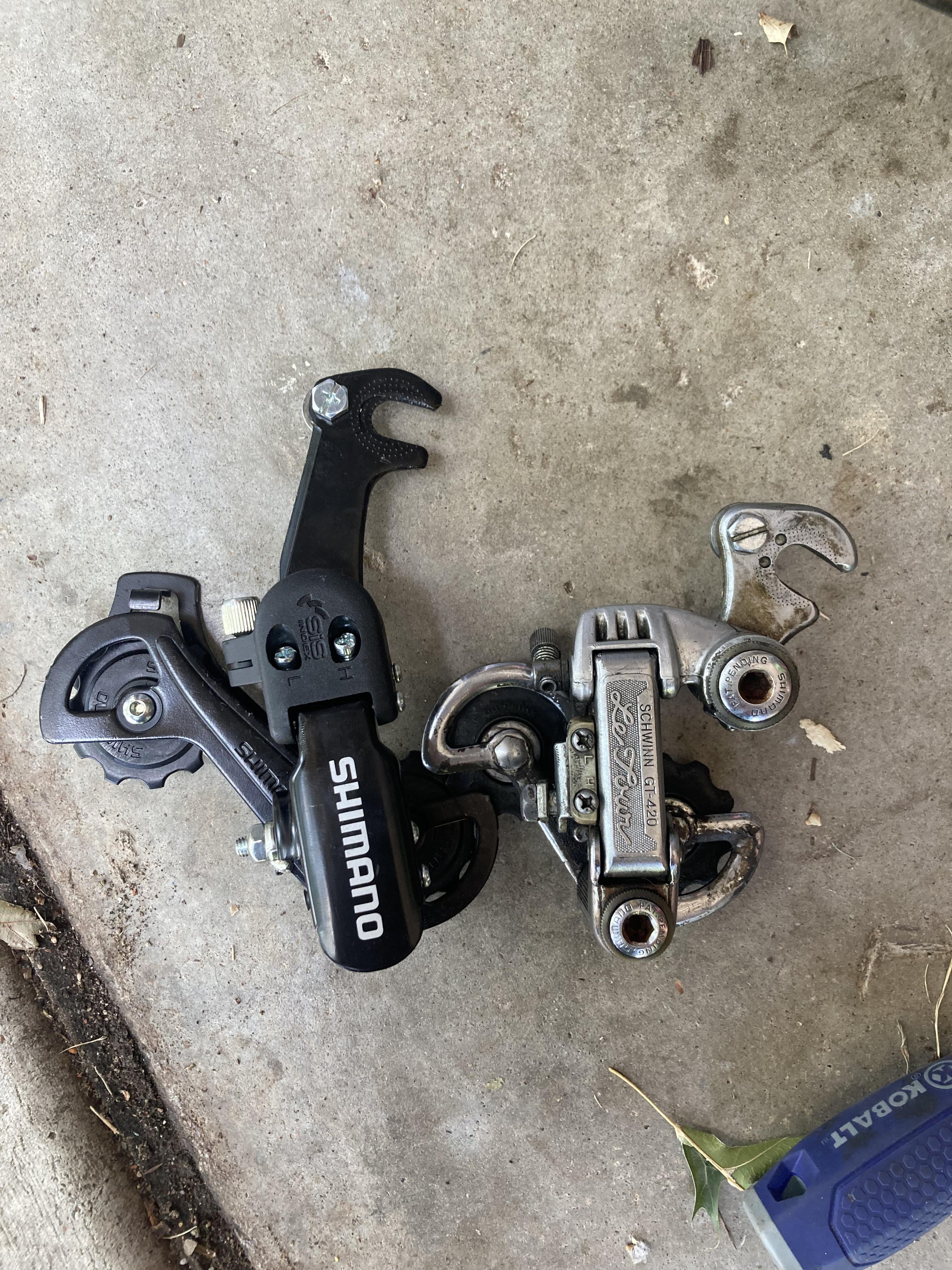
I have a late 70s Le Tour with a Shimano 420. The cage on the 420 is twisted and basically ruined. I was gifted (completely free) this never used black long cage but the claw is really long. I’m guessing this is going to be a problem even with friction shifters? Should I bother installing this or just keep it in the parts bin? Any words I’d appreciate.
by LowInternet4726
7 Comments
*given
Handle a larger tooth count on your cassette (road vs mtb)
My guess is bigger range.
Older freewheels had a smaller tooth range, even on 6 speeds.
With this rd you could install a modern freewheel 5,6,7 speed and have no issues.
> I’m guessing this is going to be a problem even with friction shifters?
No. That should friction shift fine. Maybe even better than the Le Tour did.
There are two variables in cog clearance: Offset and Ramp. A derailleur that hangs lower has more offset – it *starts* further from the axle. A derailleur with a larger parallelogram (that portion of the derailleur connecting the mount to the cage, the portion with the spring that forms a “box” with two parallel sides and the main spring inside) ramps more – it gets further from the axle each shift at a faster rate than a derailleur with a smaller parallelogram.
In a perfect world, both the offset and the ramp of a rear derailleur would be perfectly matched to the cassette you have so that the upper jockey wheel perfectly tracks each cog and remains a constant distance from the cogs regardless of what gear you are in. In the real world, especially with friction shifting, it doesn’t matter a ton, so long as the offset+ramp is sufficient to clear the biggest cog you have.
Your black derailleur just happens to have a large offset and a (relatively) small ramp, because of this it MIGHT shift a little less crisply in the small cogs than an ideal RD.
EDIT: spelling
The cage is longer to make it compatible with a larger cassette. Usually people have questions about going the other way — installing a larger cassette with a derailleur designed for the smaller cassette that came with their bike. That’s usually a no-go.
Give it a try — you have nothing to lose. If it doesn’t work there are used Schwinn GT-420 derailleurs available on eBay that look exactly like yours. Prices today are in the $15 to $35 range.
The actual OEM application differences of both of these (today, and “yesteryear”) have to do with :
1)the front chain ring “set” (two versus three )
2) and the largest diameter gear on the rear free wheel / cassette.
Edit:
That cheap black Shimano (entry level for Walmart bikes ) was made for triple sprockets upfront. …and a larger diameter granny gear in the back . Which is a very wide ratio gear set vs your schwinn. (so this accommodates both differences.)
The silver metal older Shimano (mid level bike shop quality) was made for a double front crank sprocket set up, which was not a very wide ratio back in the day. And also for a smaller size diameter granny gear on the free- wheel or cassette gear.
The longer the arm, the more sweep. The more sweep, the wider range of gears the derailer can handle.
Its all about the front. That black Shimano is the cheap derailer on Walmart bikes with triple gear crank set. So three gears up front equals the widest range.
What you want to know : In order to use the longer black derailure on your retro Schwinn you’ll need a longer chain . The stock chain length will pull this derailer forward too far throughout all of the gears.
This will work with friction shifters. But before warned : that flimsy black derailer is nothing but problems. I have replaced many of them on cheap Walmart bikes. The spring is weak on these as well, sometimes will not go into the smallest rear gear, even with the cable off and the limiter screw out , which is how you test this. A lot of bike mechanics call this derailer the Shimano “flat face”.
The black one was made for use with “mega range” freewheels or cassettes. 34 tooth largest cog minimum, up to 38.