
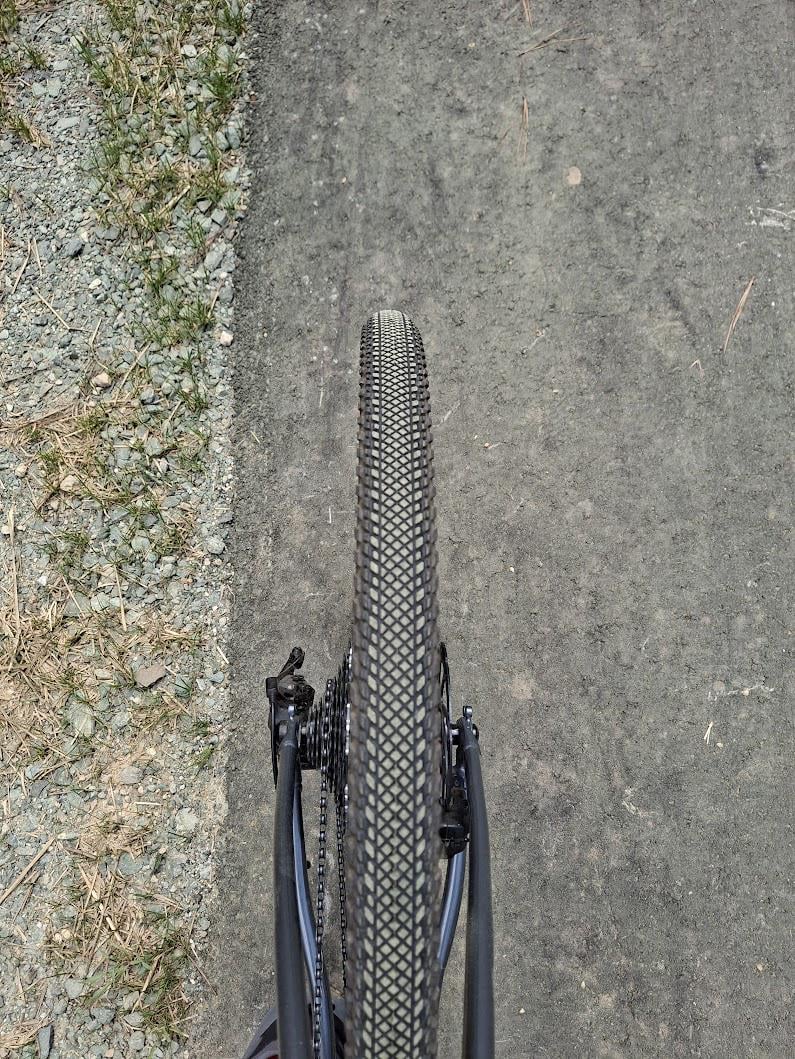
tl;dr I use tire contact patch now to set my tire pressure. Is this flawed?
I've used the various online tire pressure calculators to find "starting points" for my tires, and adjust from there. Lately I've become interested in the actual tire contact patch for both road and gravel/dirt riding.
None of the mfgrs I've found ever discuss this, and their pressure ranges are high (assuming it's for tubes; I run tubeless) – so I kind of guess they intend for the tire to have a narrow contact patch? However, it's accepted that lower pressure == more comfort and generally less (or no) impact on rolling resistance.
This picture is of a 40mm Tufo Thundero coated in pine pollen, and it felt and rode great with this much tread on the riding surface. I run semislicks (Pathfinder Pro, Teravail Washburn) in 650bx47mm on my bikes now, and find that about 7mm of tread, each direction off the center slick, gives me the comfort and traction I prefer. The transition to the larger side knobs is more predictable as an added bonus.
Anyone else prioritize contact patch over other considerations? or am I the lone soul staring at my front tire for hours, pondering this inane topic?
by shizzletov
6 Comments
I think you have too much time on your hands.
But in all seriousness the silca tyre pressure calculator for me is near enough perfect.
But having said that, if you’ve further adjusted that and are happy with the ride and don’t suffer any issues, then more power to you.
You are alone.
Actually not, I set pressure at the upper end of various recommendations and then back off until I get a decent sized contact patch and comfy enough ride considering bike/tire purpose and the actual conditions. I’ll buy tires considering contact patch character and changes with leaning. For example, have decided that aggressive side knobs are as likely to interfere with traction as to help it, so I avoid them. That’s a contact patch character assessment.
Have fun! Don’t hit anything while staring at your front tire.
No, I pressurize my tires by vibration. Legs can make up for rolling resistance, but nothing can make up for constant jittering.
No
While I do think about the section of tread that is in contact with the surface I’m on. I don’t look at where the dust and dirt shows in a straight line test. I do sometimes look at how deep I have learned the bike into a turn, of what part of the tyre is in contact when turning. When I play with pressure on my tires, I pay close attention to the sidewalls, and if they balloon out or fold. In my experience with Cycle Cross the higher quality casings on like high end Challenge Open Tubulars handle the lower and lower pressures of cross better, as they seam to balloon rather than fold or crease at lower PSI. Second, I do pay close attention on gravel to hitting that sweet spot of good contact for grip and ride quality, but not so low that Impacts or soft sidewalls collapse.
Also, Love a good smooth minimal center tread, with more aggressive side knobs both on gravel and Mountain biking… Rode the OR Ritchey Speed Max tires back in the late 90’s, for years and years…..
So much of this is a personal preference, You be You and have great rides, just make sure you don hit anything staring at your front tire…
All fun an games till your contact patch gets full of moisture. Next thing you know you’re fist deep in thick mud.
You should change your tire pressure based on terrain conditions, speed, weather. My tire pressure isn’t also good for your setup because might weigh less/more. It always depends per rider/bike total weight
Cyclocross answered your question like 40 years ago.
I ran tufo swampero 40mm at 19f/22r psi for cyclocross this year loved it. I run the same tire on road at 27f/30r at 200lbs an 21lbs cx bike.