
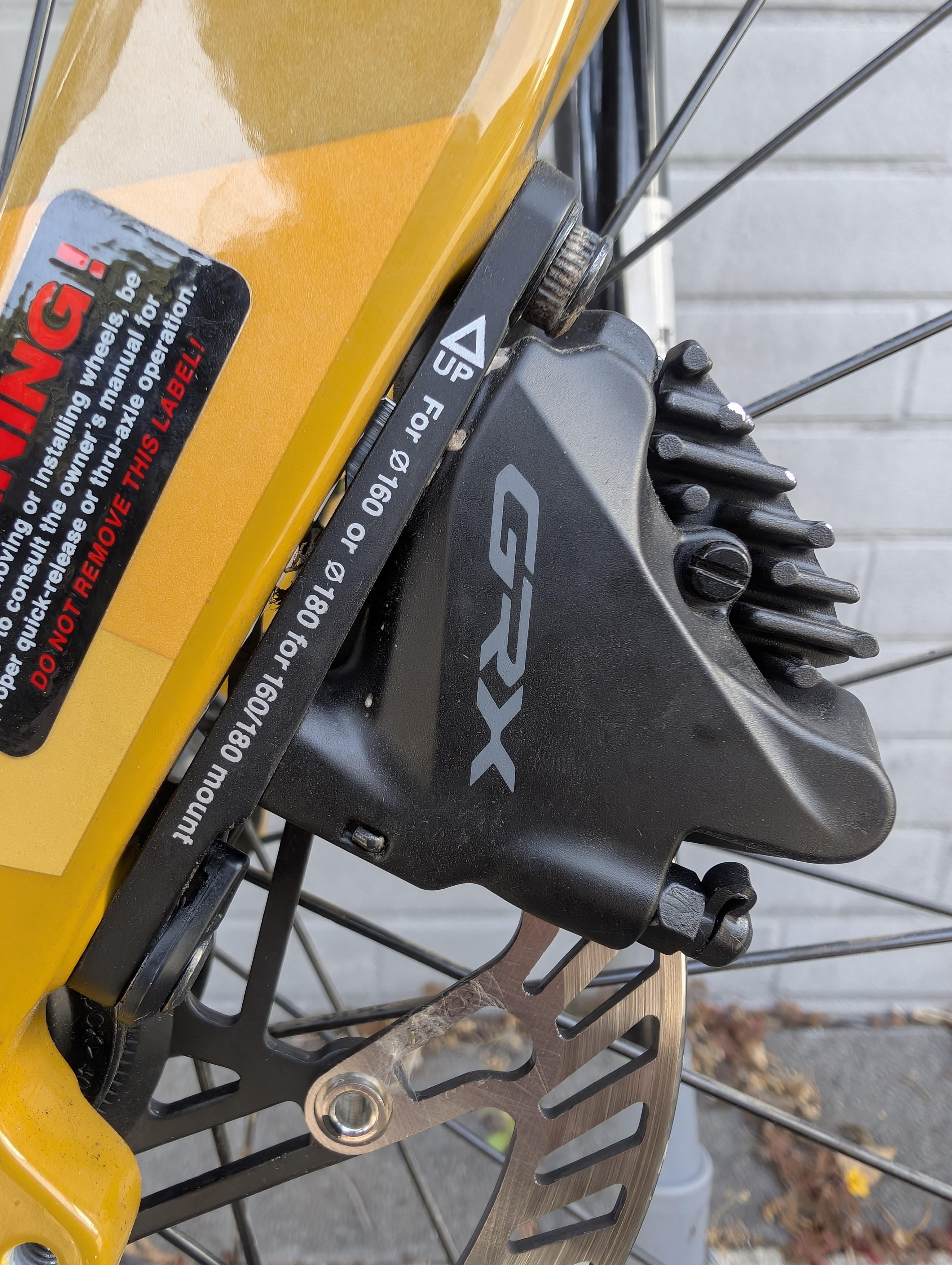
I'm a bit confused. If I want to convert from a 160 to a 180 brake disk, do I need a new adapter plate or do I just have to turn it around or does it just stay as it is?
by drehventil
I'm a bit confused. If I want to convert from a 160 to a 180 brake disk, do I need a new adapter plate or do I just have to turn it around or does it just stay as it is?
by drehventil
13 Comments
It should just take a 180 providing the frame allows for a 180?
Im fairly certain that your fork mount is designed around 140mm rotors. That adapter gives you +20mm. On your mount that’s a 160 and on a mount designed for 160mm that would be 180mm. So if there aren’t any adapters that give you +40mm I don’t see a way to do this with your fork.
If you currently have a 160mm, the bike is designed for 140/160 and the adapter functions for these two sizes. There may be adapters to fit 180mm on there but nothing from Shimano afaik. Wouldn’t do it honestly.
Flat mount brakes aren’t usually meant to work with 180mm rotors. The adapter you have will work for 180mm *if* your fork is made for 160/180 rotors. It appears that the fork is only made for 140/160 though, so 180mm rotors aren’t really compatible.
I believe there are adapters out there to make it happen, but it likely voids the warranty on the fork and is outside of what the fork is engineered to work with.
You need another adapter. Peak Torque sells one.
What is the advantage of bigger rotors? Just curious i guess. Ive never had any issues with the 160
Peak torque
https://peak-torque.com/collections/road-tt/products/180mm-flat-mount-adaptor-for-road-gravel-bikes
I run 180 rotors on my road bike and they are a superior choice in every way, better heat management, better modulation, better peak power (you can break later into corners) improved pad life, and less rotor warp from heating. The frames/forks are tested for 160s but they have a safety factor that you’re well within using a 180. Get the Peak Torque adapters, you will love the overall breaking performance improvement.
If you flip it, it will say 140/160. You’re fork is not officially compatible with 180 rotors and you will loose the warranty, but 140 to 180 flatmount adapters do exist.
https://www.amazon.de/-/en/XLC-Flatmount-Adaptor-Brake-Diameter/dp/B086DW564K
https://preview.redd.it/l3dbk19uzdxe1.jpeg?width=4284&format=pjpg&auto=webp&s=c6e24539197594a23d7f9838b10fc759d6ad9323
Just wanted to say the peak-torque and uberbike adapters ship from europe, while the analog cycles and assolutions adapters ship from north america. I just got the assolutions one because it looks like a little dude carrying my caliper like a backpack. For anyone else in the US the shipping will be a lot cheaper.
Before talking about adaptors etc your first move should be finding out what size rotors your frame/fork is rated for. Every frame has a maximum size rotor they are designed to take, its never a case of if you can fit them it’s OK and most importantly if you fit rotors beyond the spec of the frame not only will you invalidate all warranty for the bike but I have seen failures due to over spec rotors.
Why do you want to change rotor size? If it’s because you want more powerful braking this can normally be achieved by staying the same size and changing the calipers to more powerful ones, often meaning going from single piston to multi piston calipers.
Thanks to all the replies so far and all still to come, I think I now understand why it says 160/180 on the plate. To explain, I was on tour with a friend today, he was on a MTB. We also rode some single trails, which I would probably like to do more often. We swapped bikes for a few kilometers and I was surprised how much stronger his brakes were and I thought about how I could possibly easy pimp my brakes.