
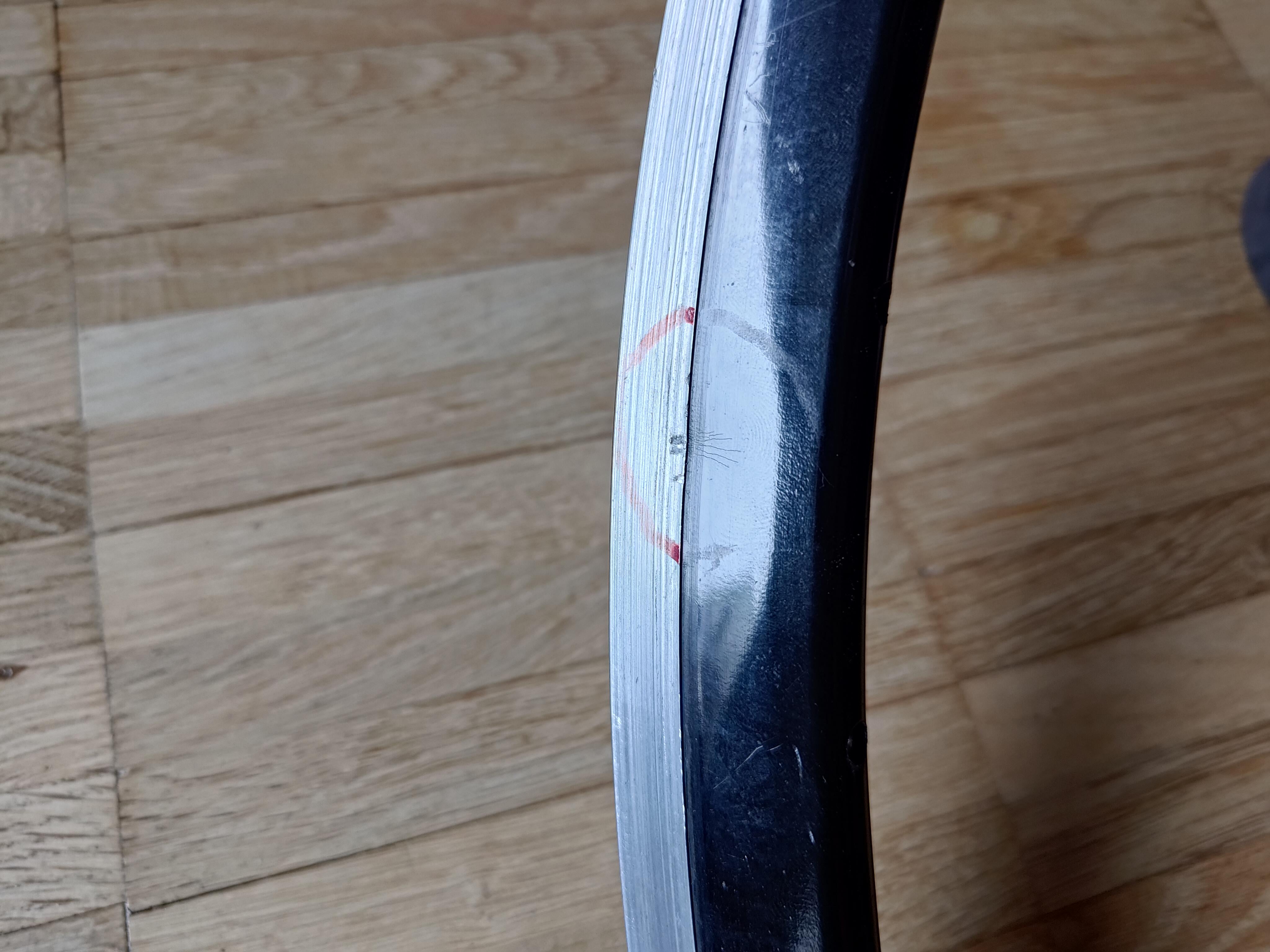
I was ready to write this rim off and then I saw this video https://m.youtube.com/watch?v=f9f0SulxQdM of this ultrabent rim being straightened, and I made me even more confused about what to so.
From what I've learned about Aluminium, you can't bend it that much because it will eventually start cracking, with not many bends back and forth actually. My rim is maybe just half to 1cm off but it has a clear blunt force hit showing airline cracks, so I am wondering whether despite the light bend, this rim is actually a write off and in a uncompareable situation to the one in the video.
I got a new bike and I just want to asseble the wheel and sell or give away the bike, but I don't want to pass something dangerous or do any work that will have to be undone and redone by someone else later. When I am unsure I'd rather let the next person decide whether they want the wheel assembled, but if I can be sure that it's a write off then I'll break the rim and remove that problem for good.
Even the guy in the video made it clear, even the ultrabent rim is a write off, but it's ok if you are aware of what you are doing and the wheels is for you.
QUESTION: Should I consider this rim's destiny bound to me? Or would you try to give the rim away just as it is in the chance there is someone out there that knows what to do with it and wants to give it a future?
by Substantial_Bidet
2 Comments
RIM ANAMNESIS (long history for diagnosis): It’s from a rear wheel of my old road bike; I bought the bike used about 10 years ago, the rear wheel wasn’t true but “I knew I could fix it”, symptoms were typical of a broken spoke and indeed one was broken, but the bike was worth it and I had replaced spokes before; when I went to change the spoke turned out the spoke wasn’t broken, the hole in the hub (Shimano Sora) was broken, so I sucked it up and “trued” the wheel with the rest of the spokes; it was never perfect of course, and went out of true regularly but I just lived with it and kept adjusting when felt like it; years later I eventually got more money and decided I could buy a hub (Shimano Deore), but I didn’t check the rim because I assumed the problem was always the missing spoke; I assembled and trued the wheel and the problem got worse, it was harder to true and would go out of true faster; eventually I felt the rim wasn’t braking very well, even with new and aofter brake pads; I decided that the rim was worth changing so last year I looked at buying some used wheels or a rim; eventually I found a nice set of got tired enough and got enough money that I bought a new set of wheels and the these old ones became a fixing-wheels experiment/project/practice; I disassemble it completely and tried to straighten it unsuccessfully, without a particular strategy or technique, but eventually realizing I was dealing with the blunt force hit; I again left it behind as project waiting for ideas while I instead assembled the front rim with the rear hub to make at least one wheel with the best parts. I finally went back to fixing and maybe assembling this rim as front wheel and finally saw the hairline cracks.
I don’t know how long the cracks have been there, whether they were there when I bought it 10 years ago or if I cause them trying to straighten the rim last year or if they appeared sometime in between.
All I know I have ridden this rim for years, all year around, all weather in the city and out, crashed multiple times, etc, it worked harder than a mule and that it should have (kind of sad letting go of this bike actually).
OWNER ANAMNESIS: I am an idiot who likes fixing things and hates being an idiot
Saw it up and recycle it. Aluminium is easily recyclable. It isn’t worth anyone’s neck for you to keep it in circulation as a bicycle component.
In the global north aluminium rims like this are inexpensive.
Recovering the rim like in your video can be a useful skill for emergency situations like if you’re on a tour and getting a replacement wheel is not possible, and your only alternative is a 100km push-walk.