
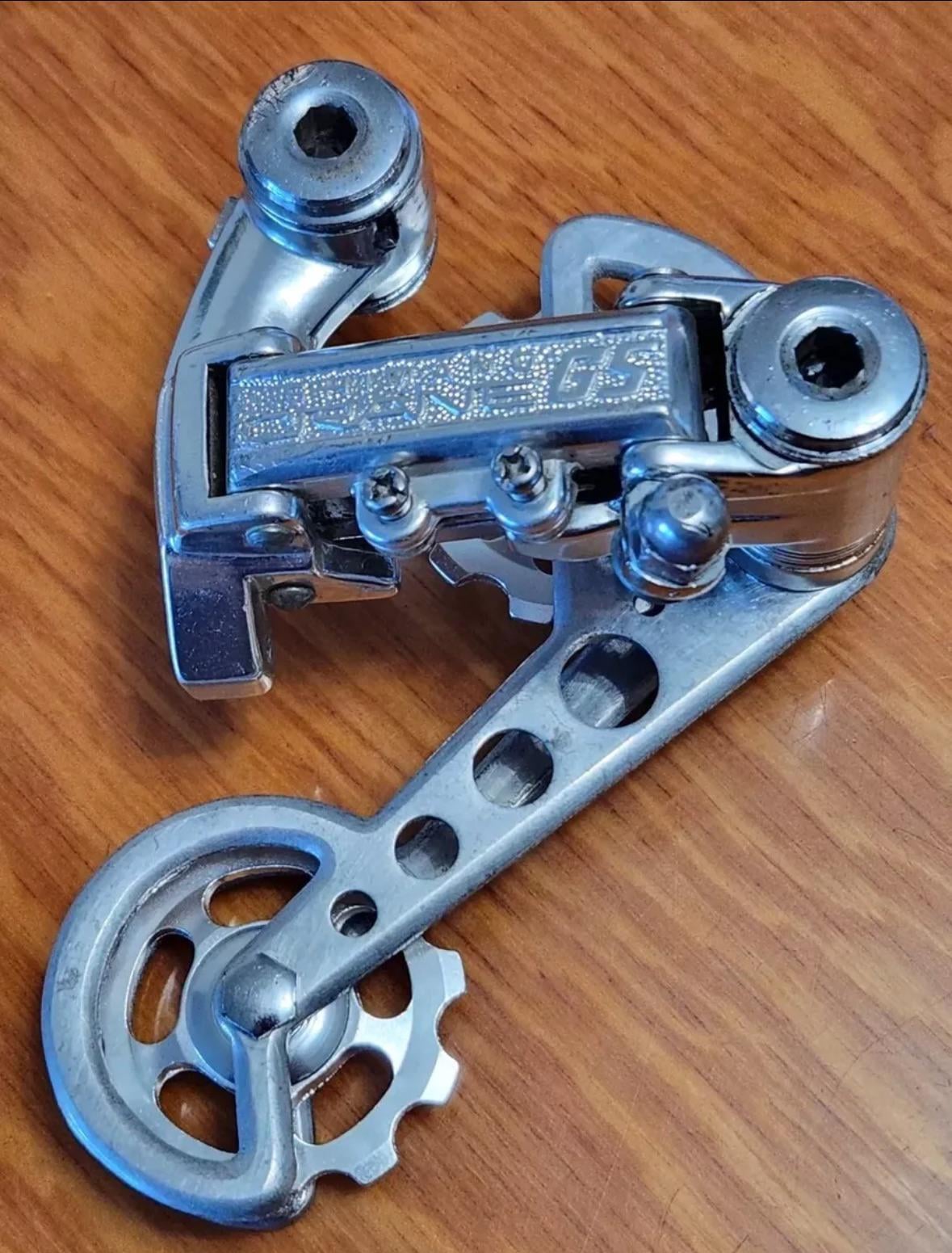
I am wondering in a friction shifting scenario, what are the most important factors to determine if a certain derailleur can shift a certain cassette.
Specifically, I am resto modding a bike with a 2×9 friction shifting setup. For aesthetic reasons I would really love a vintage silver derailleur like this Shimano Crane GS long cage but can’t determine if it would shift a 9sp 11-34 cassette.
Is the long cage the most important factor to keep in mind? Chain wrap? Max tooth capacity?
by Cobbythecorn
5 Comments
I would think the angle of the parallelogram would determine the ideal range of the cassette. You might have to run a sub-optimal b-limit to get an old king cage to work with a wide range cassette. There are some aftermarket range extension bits (wolf tooth might make one) you could also try.
To shift an 11-34, you’ll want a long cage for sure, max sprocket equal to 34, and the ability to wrap at least 33 teeth worth of chain. 39 teeth would be better.
Probably more chain wrap capacity I think, because you can use a derailleur hanger to get more tooth capacity (I think).
Consult this: https://www.disraeligears.co.uk/site/shimano_crane_gs_dr102_derailleur.html
Edit: 34 should be fine, just make sure your chain wrap calcs make sense with your front cogs.
Many of the Suntour V derailleurs have a similar aesthetic, as well. I personally love how the Cyclone GT looks, too, I have one on a vintage touring bike which would be a lot better as a Touring Bike if replaced with a more modern derailleur, but I resist because it looks so *good*. Campagnolo Rally was also used often back in the days for its wide range, but those are quite pricey.
My very basic understanding is that in for example a 1x scenario, you shouldn’t have to worry about chainwrap, but it becomes an important factor when trying to figure out how large of a difference you can get away with for the front rings. And of course max cog just refers to the largest cog you can run in the rear.
I would say that chainwrap and max cog are of essentially equal importance. You aren’t going to be able to make a setup that works without being within the limits of both of these. What a “long cage” means has changed over time so looking for this is pretty meaningless – and it’s really just a proxy for chainwrap capacity.
Chainwrap: If the derailleur doesn’t have enough chainwrap for the setup you want to run, you need to be extra extra careful to never crosschain in one or both directions and someday you’ll quit paying attention and then have a very bad time. You can usually push the chainwrap by 2-4T before entering the bad times zone but very rarely any further than that
Max cog. No point in using a cassette that the derailleur can’t actually shift across. Again, you can often push past the spec by 2-4T, but rarely further.
There are a very small number of derailleurs that have real-world capabilities far in excess of the spec sheets that the company published, but they’re rare.
That specific Crane GS: Sutherland’s claimed these had a max cog of 34T and a chainwrap capacity of 34T as well. So you should be able to run an 11-34 cassette, and you’ll be left with enough chainwrap capacity to run a double crankset with 11T difference between the chainrings.