
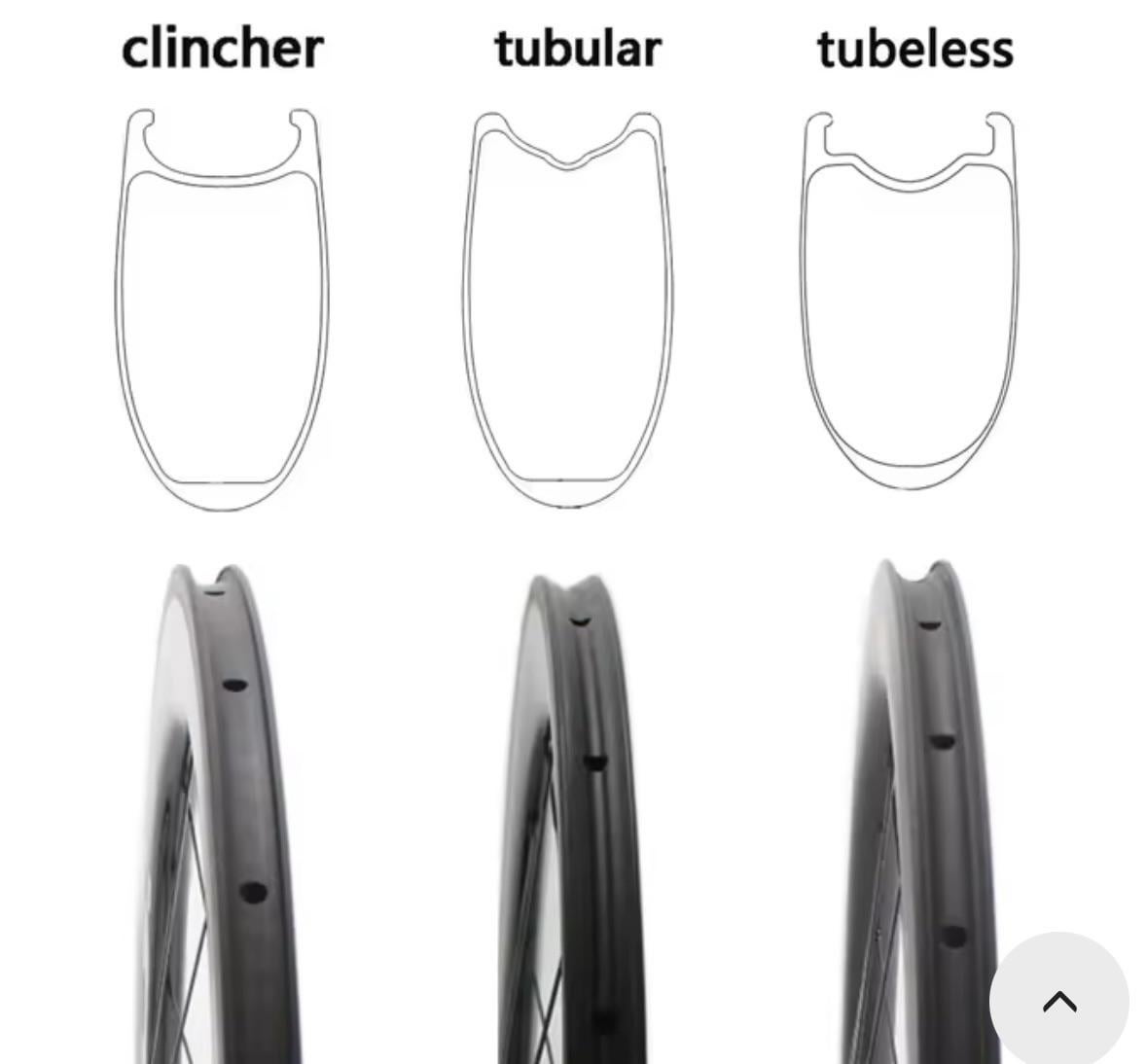
What are the differences between these 2 rim types ? I knew that tubeless rims can be used with traditional tires and tubes but it seems to me that clincher is basically the same with the absent of the concave profile? Do i need clincher-specific tires and tubes or could I just install traditional tires and tubes on them ?
by lekhoi_trym_to
9 Comments
Clincher is standard tire n tube.
The rim may not be sealed as a tubeless would be to hold on the sealant. Could tubeless work on a clincher rim…maybe. Tends to be 50/50 in my experience.
You’re missing hookless rims… that’s totally different
I’ve got a non-tubeless clincher that totally looks like the third section, so I do not think that the difference between clincher and tubeless is that shown in the picture.
The concave profile is there to ease the mounting of tubeless tyres, which typically have a tighter fit.
I’ve run non tubeless rims tubeless and tubeless with tubes. You may find the tubeless rims tighter/generally less user friendly to do tire work on but not a ton of real world difference going down the road. Tire choice is a huge factor for overall tightness as well.
I could go into the technical design details of the bead shelf, bead hooks, and the mounting channel and why they’re designed that way, but it sounds like you’re not interested in that and just want to know what tires you can use with each.
In short:
Clincher profile: Compatible with both non-tubeless and tubeless tires, needs a tube for both.*
Tubeless profile: Compatible with both non-tubeless and tubeless tires. Non-tubeless tires need a tube. Tubeless tires can be set up with or without a tube.
Tubeless *hookless* profile (not pictured): Compatible with tubeless, hookless-rated tires only. Can be set up with or without a tube.
^(*Yes, some people do jury-rigged tubeless with clincher profiles. It typically only works with low-pressure MTB tires and isn’t as reliable as using a proper tubeless profiled rim.)
The word “traditional” with bicycle tires has almost no meaning. The tech is slowly but constantly changing.
You can only run tubular tires on tubular specific rims, but those are race specific and not at all common. These are glued on.
Clincher tires and tubes can easily work on rims designed for tubeless set ups, but the fit is often much tighter, making it harder to get them on and off.
Tubeless tires can sometimes work on rims designed for tubes, but the fit between the two is often much looser than tubeless specific set ups, making it difficult to get the tubless tire to seal to the rim and hold air.
Lastly, there are many sizes of tires, from different eras, meaning not all 26” tires (or 27” or 28” etc) are actually the same size tire. The metric size listed on the sidewall of the tire is a more accurate way of purchasing the correct replacement tire for any specific rim. The tricky part, especially when fixing up older bikes is that not all rims list their size on them, and might need to be measured by hand.
Bead shelf locks the tire in place…
Clincher is the standard for most bikes. Tubeless as shown above is just an improvement. You can run tubeless on clincher wheels. It’s not a guarantee it will work, and some people will tell you that it’s impossible. But it’s not!
There’s also hookless. Which is still tubes, but the walls of the rim are smooth. No hooks! You can only run tubeless tyres with these. As the tyre side wall is shaped slightly differently to grip it.
Some people are against hookless.. mostly because manufacturers don’t have two different pressure rates on tyres. So people over inflate the tyre (but still within the tyres recommended pressure) and it blows off the rim.
Personally never had an issue. Been hookless for years on 2 bikes.