
TL;DR: There is no TL;DR. Either you read my rant, or you move on as a happier person…
A few days ago, the test results from Dylan Johnson’s visit to the Silverstone Sports Engineering Hub set this sub on fire.
His findings, as I recall, showed that the widest tyres, Race Kings 2.2, carried a quite substantial watt penalty on tarmac compared to the benchmark 35mm Cinturatos. And vice versa, the Race Kings proved to be… the King… of the cobbles (Silverstone test labs gravel substitute).
Personally, as a mixed-surface gravel rider, the test reassured me. I’m currently on 45mm tyres, which appeared to be the sweet spot in terms of rolling resistance when switching between gravel and pavement.
Nice to finally get some sleep after all those years of living in uncertainty. However, my peace of mind didn’t last long…
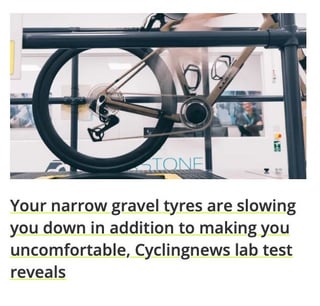
Recently, Cycling News went to the Silverstone test lab, bringing along a van full of gravel tyres.
Their test focused on finding performance (watt) differences between variations in tread, width, and casing. The testing is deep and complex—and hidden behind a paywall. Sharing everything here would be plain info overload on what is considered a regular working day.
What I found to be the most confusing/surprising element of the test was the rolling resistance vs. tyre width results.
From my reading, the Cycling News test results are completely opposite to those of Dylan Johnson!
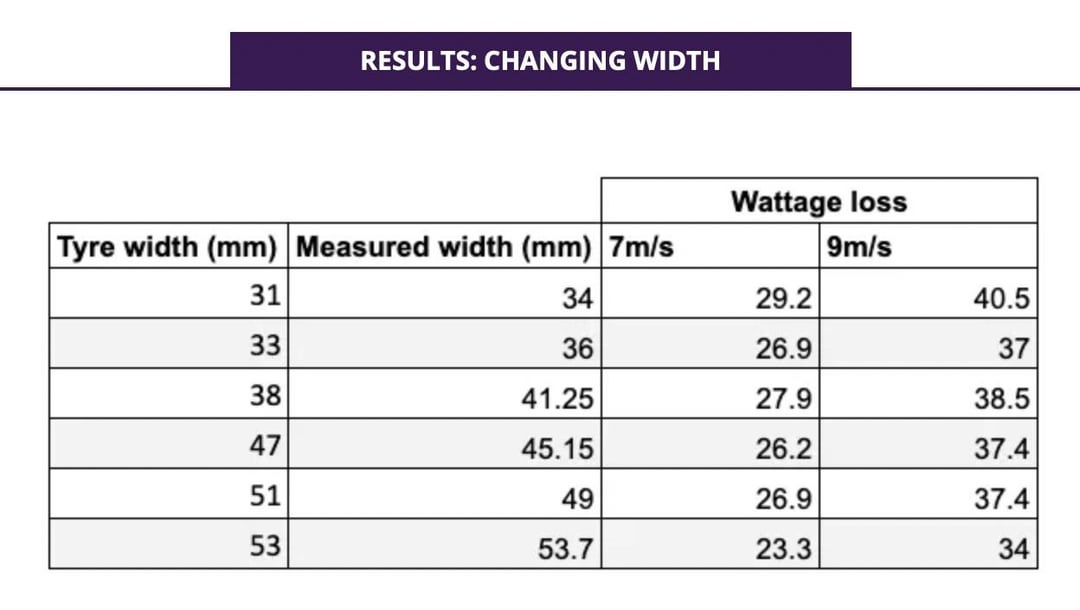
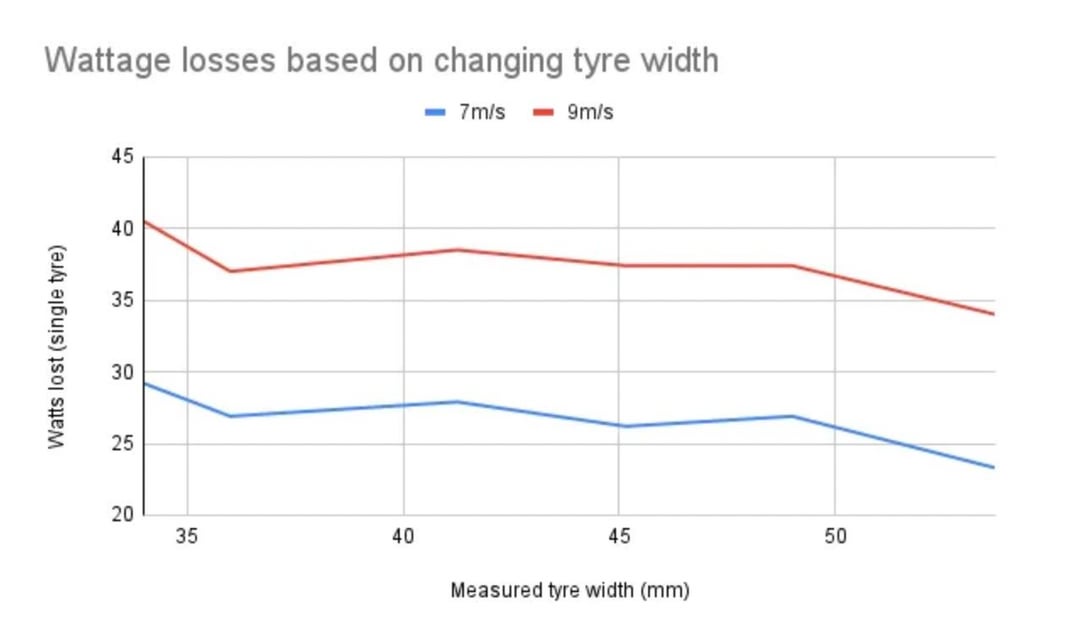
Cycling News tested Vittoria Terreno Drys in six sizes, with 700 x 31C being the narrowest and 700 x 2.2 the widest. The test was conducted on a drum roller set for tarmac, at speeds of 25.2 km/h and 32.4 km/h.
From looking at the graphs and tables (see photos), it’s apparent that… (drumroll)… the widest tyre is the fastest tyre on tarmac, while the narrowest is the slowest.
I quote from the test conclusion:
…first and foremost the key takeaway is that wider gravel tyres are faster, at least in terms of rolling resistance. We don’t yet have the aerodynamic data to contribute to the overall picture, but from what we can see there is a definite benefit to going wider, and it is likely based on other data sources we’ve seen that the benefits are even greater on rough surfaces than they are on smooth ones.
There is going to be an aerodynamic component to this, but again it seems that even for an extreme scenario of a 2.1in tyre, the wattage losses in terms of aerodynamics will be outweighed by the rolling resistance gains versus a 38c tyre even on smooth surfaces at moderately fast speeds.
So, this test does not take aero penalties into account. But even with that considered, the results seem very different from what we saw from Uncle Dylan the other day.
So what’s causing such a huge difference?
Being just a simple man, I cannot say. Yesterday, I was enlightened. Today, I’m more confused.
But even with my limited sense of logic, I can figure out that the biggest variation between the two tests must be… yeah, you’re right… it’s the brand specifics of the tyres.
One test was carried out on Pirellis + Continentals. The other? Vittoria all the way.
So… do the very different performances results eventually come down to the individual compound, casing, and tread of each manufacturer?
Feels like it.
Hmm…
Have a good day, everyone!
by Klumpegoej
9 Comments
The tldr is wider tires suit rougher terrain with slower speeds and skinnier tires suit smoother terrain and faster speed. Want more comfort add volume.
Very interesting, I would love to see the aero data for these too.
This tire stuff is total nonsense for most really.
Huge tires in a gravel race with not many turns but truly designed for huge farm equipment or logging trucks to navigate easily is no problem for a bike. Hell just riding a gravel course without traffic you almost never have to brake except downhill.
The big difference if you compare it to cx racing you are constantly getting back up to speed so you have to spin the wheels back up all the time. Gravel especially American farm roads not so much slowing down so spinning back up heavy wheels is not a problem.
Therefore it all depends on the course. Giant sweeping turns a logging truck can make yep big tires. In a bigger pack without much turning you run bigger tougher MTB sizes because you need to not flat. Without seeing the terrain in front of you because of the pack you run the biggest tougher tires.
If you are riding with friends and a good bit of pavement 40s are great. I love running hard pack cx tires on my commuter bike. That sees mostly pavement.
All those tests and stuff is for clicks and to pay bills and make you spend.
Just use your brain.
I stopped looking at lab tests, because lab tests are run in optimal conditions that are far from reality. Also they take into account only one parameter, the rolling resistance: what about air resistance, surface composition, rider weight, atmospheric air pressure and so on? We do not ride our bikes in a laboratory. So my take has always been, find the tires that fit your needs, simple. And ride the shit out of them!
IIRC, Dylan tested MTB tyres on the road as being slow, not wide gravel tyres. Does that explain the discrepancy?
That said (and again:IIRC) the rolling resistance website tests Thunder Burt MTB tyres as faster rolling than most narrower gravel tyres.
Make of that what you will.
Difference in rolling resistance on the same compound is mostly down to tire deformation.
On a completely smooth surface higher presure and therefor less tire deformation is faster.
At the same presure wide or narrow tires have the same total contact surface area.
Wide tires at the same presure is faster because the contract surface is spread widthwise whereas narrow tires spread the contact area lengthwise and therefor causes more tire deformation, and a less round tire and small diameter.
More detailed here: [https://www.schwalbetires.com/technology-faq/rolling-resistance/](https://www.schwalbetires.com/technology-faq/rolling-resistance/)
So why not 60 mm tires for all? Mainly weight and aero drag. A TerraSpeed 45mm tire is 110g heavier than a 35 mm tire per tire. If acceleration and overall weight is important and road surface is smooth then it’s easy 220g rotational weight to save.
Most of us don’t race and we just want durability and comfort without being draggy.
Dude, if you’re not racing why the hell do you care? Why does anyone who isn’t racing care?
Just put on whatever tires make your bike the most fun.
TLDR: bigger sized tires are faster in American farm and gravel roads compared to narrower gravel specific tires