Hey guys, I’m theorycrafting a 2 by 1 conversion, up from single speed in order to bail out steep climbs when needed.
A derailleur will be used to keep tension, with a cable stuck in it to keep the chain on the rear cog.
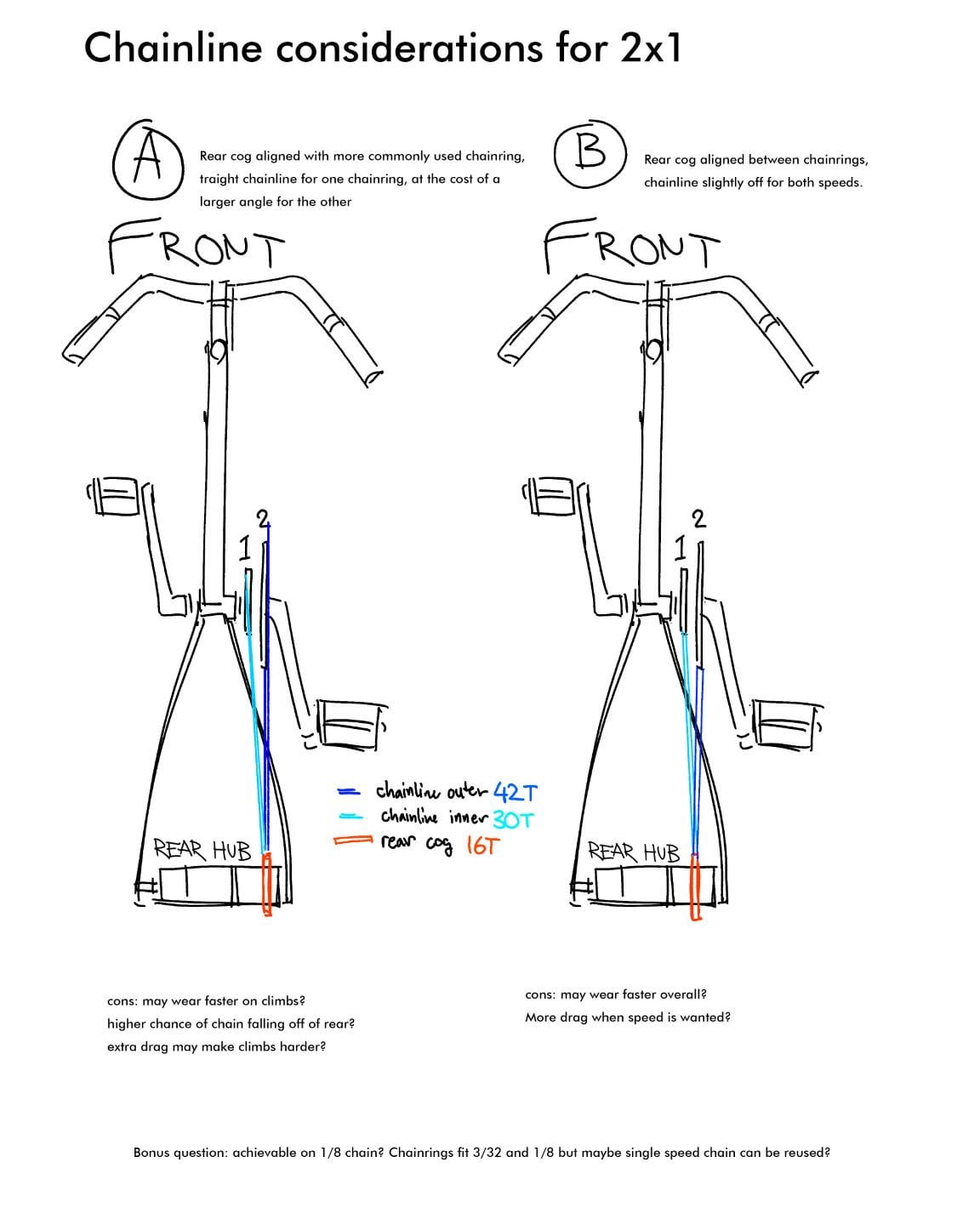
What’s the optimal chainline here? Aligned with one or in the middle? Any considerations for either? I’ve made a little sketch of what i was thinking would be the pros and cons for either option. Anything I haven’t touched on that could sway it either way?
Also, is it doable with a single speed 1/8 chain or should I get a 3/32?
simonster1000 on
I would align it to the gear you’re using more of the time, though you haven’t shared the ratio you’re expecting.
Are you using a derailleur in the front? Or repositioning it manually? I would go with an 8-speed chain for using a front derailleur, and a single speed chain for manual repositioning.
I think the difference in drag and wear between a perfectly straight chain and one tilted by one chainring is so small that you wouldn’t be able to notice. It’s almost certainly under 1%. Keep in mind, chains are efficient transmitters at upwards of 95%, 97-98% in many cases. Even if your chain’s inefficiency doubled, it would still be only 2-3% worse.
cycoziz on
SS chain won’t play nice with a derailleur tensioner. You probably don’t need to be too fussy. I’d set it up centered with a couple of .5mm shims either side so it’s easy to adjust if it seems necessary.
mtcerio on
The problem of A is that when in 1, chain may rub into the inner side of 2 and try to shift up by itself.
boopiejones on
I’d go with one gear up front and two in the rear. Line up your front and your smaller rear cog.
You can use a shifter to get into the larger/easier rear cog or even ditch the shifter and cable completely and just use the barrel adjuster on the derailleur when you need to get into your bail out gear. Look up “dinglespeed” to get more details.
CargoPile1314 on
It won’t matter in any way that you’ll be able to tell. The difference in angle between the 2 options is about half of a degree. The chain isn’t going to last longer by any appreciable amount. The chain isn’t going to be more or less likely to derail. You’re effectively setting up the 2 outer chainrings of a ’90s compact crankset and running in the middle of the cassette.
TheWorstePirate on
Is the goal maximum complexity for least benefit?
SunshineInDetroit on
make absolutely sure whatever you’re using as a tensioner can keep high tension on that chain.

8 Comments
Hey guys, I’m theorycrafting a 2 by 1 conversion, up from single speed in order to bail out steep climbs when needed.
A derailleur will be used to keep tension, with a cable stuck in it to keep the chain on the rear cog.
What’s the optimal chainline here? Aligned with one or in the middle? Any considerations for either? I’ve made a little sketch of what i was thinking would be the pros and cons for either option. Anything I haven’t touched on that could sway it either way?
Also, is it doable with a single speed 1/8 chain or should I get a 3/32?
I would align it to the gear you’re using more of the time, though you haven’t shared the ratio you’re expecting.
Are you using a derailleur in the front? Or repositioning it manually? I would go with an 8-speed chain for using a front derailleur, and a single speed chain for manual repositioning.
I think the difference in drag and wear between a perfectly straight chain and one tilted by one chainring is so small that you wouldn’t be able to notice. It’s almost certainly under 1%. Keep in mind, chains are efficient transmitters at upwards of 95%, 97-98% in many cases. Even if your chain’s inefficiency doubled, it would still be only 2-3% worse.
SS chain won’t play nice with a derailleur tensioner. You probably don’t need to be too fussy. I’d set it up centered with a couple of .5mm shims either side so it’s easy to adjust if it seems necessary.
The problem of A is that when in 1, chain may rub into the inner side of 2 and try to shift up by itself.
I’d go with one gear up front and two in the rear. Line up your front and your smaller rear cog.
You can use a shifter to get into the larger/easier rear cog or even ditch the shifter and cable completely and just use the barrel adjuster on the derailleur when you need to get into your bail out gear. Look up “dinglespeed” to get more details.
It won’t matter in any way that you’ll be able to tell. The difference in angle between the 2 options is about half of a degree. The chain isn’t going to last longer by any appreciable amount. The chain isn’t going to be more or less likely to derail. You’re effectively setting up the 2 outer chainrings of a ’90s compact crankset and running in the middle of the cassette.
Is the goal maximum complexity for least benefit?
make absolutely sure whatever you’re using as a tensioner can keep high tension on that chain.