
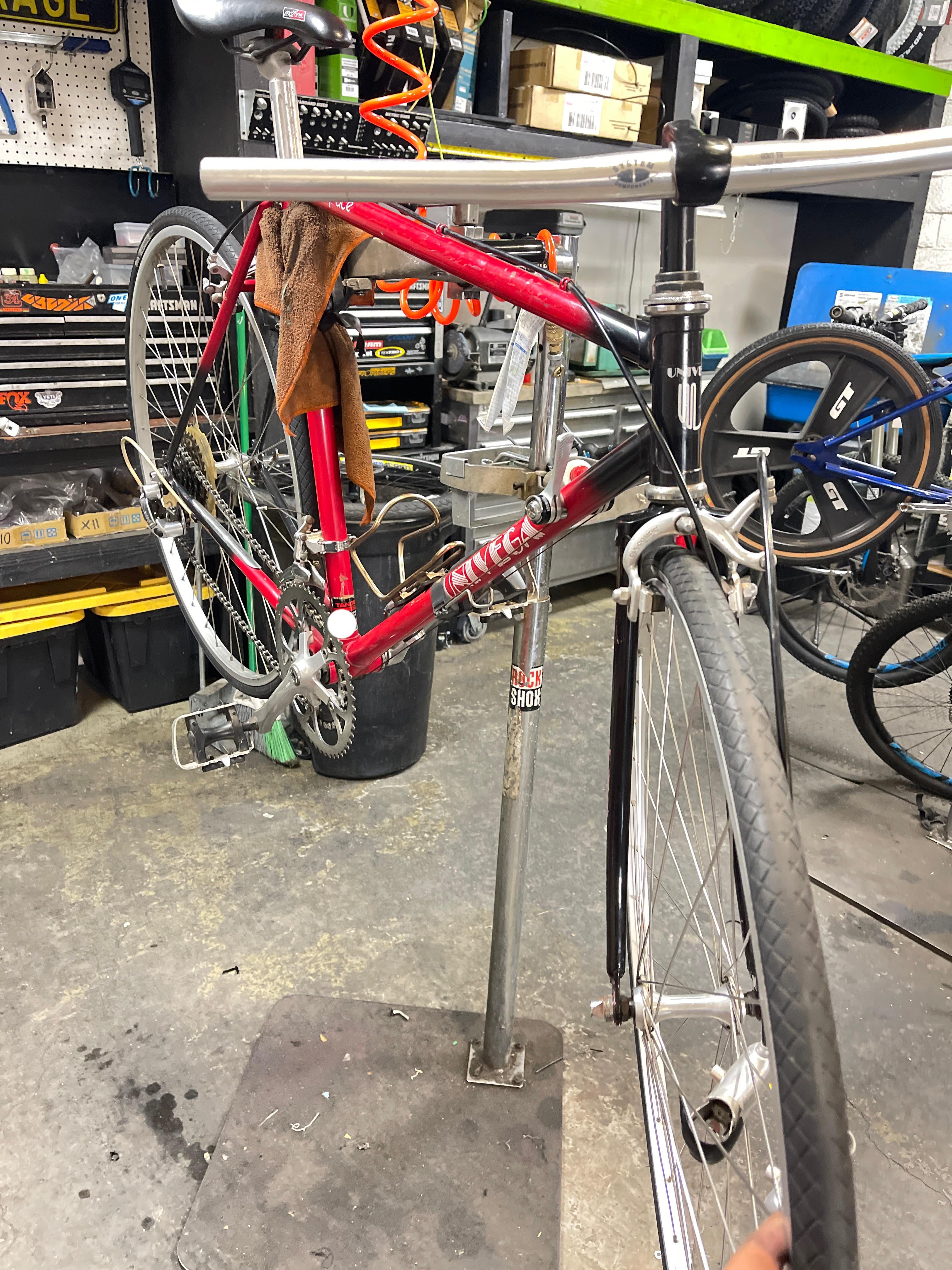
Trying to find out more information on this bike, had it for years but finally decided to update it. Looking for the year. Thanks in advance !!
by Streetcurve26
Trying to find out more information on this bike, had it for years but finally decided to update it. Looking for the year. Thanks in advance !!
by Streetcurve26
2 Comments
Univegas were mostly made by Miyata in Japan, but started to be made elsewhere towards the late eighties. Check the underside of the bottom bracket shell for a serial number. If it was made by Miyata, it will follow their numbering system and dating it will be super easy.
You just need the first letter.
I–1980, J–1981, K–1982, L–1983, M–1984, N–1985, O–1986, P–1987, Q–1998, R–1989, S–1990, T–1991, U–1992, V–1993, W–1994, X–1995, Y–1996, Z–1997.
Figure out it’s year, then search online for “Univega catalog (year)” to find more info on the bike. Unfortunately I think only some years have catalog scans available online, so you may not be able to find it.
From what I can tell of your photo, this would have been a sort of entry-level to mid-level bike. It looks like it has tange 900 tubing, which was seam-welded double-butted chromoly. This tubing hit the market in I think 1985 or 1986. It is functionally good steel, but it was cheaper and less prestigious than others because it has a weld running along its length, and there were some fears that this could weaken the tubing… but I haven’t read a single story in which this was proved to be a valid concern.
Your bike also has a Shimano Light Action rear derailleur, and probably front, as well. This was fourth in Shimano’s road bike lineup at the time, just below 105. So again, not the most prestigious or sought-after parts in the world, but I have heard that it shifts well, and personally I really like the brushed aluminum appearance of the rear derailleur, I think it looks great (not a fan of the chrome variant though). The light action shifters also have a little ratcheting “click” as you move them, which is kinda neat. I believe Light Action also came out around 1986, so if I had to guess your bike is probably from 1986/1987 or so.
Univegas are sexy, I have a road bike from 93. I love it so much after owning it for 13 years