
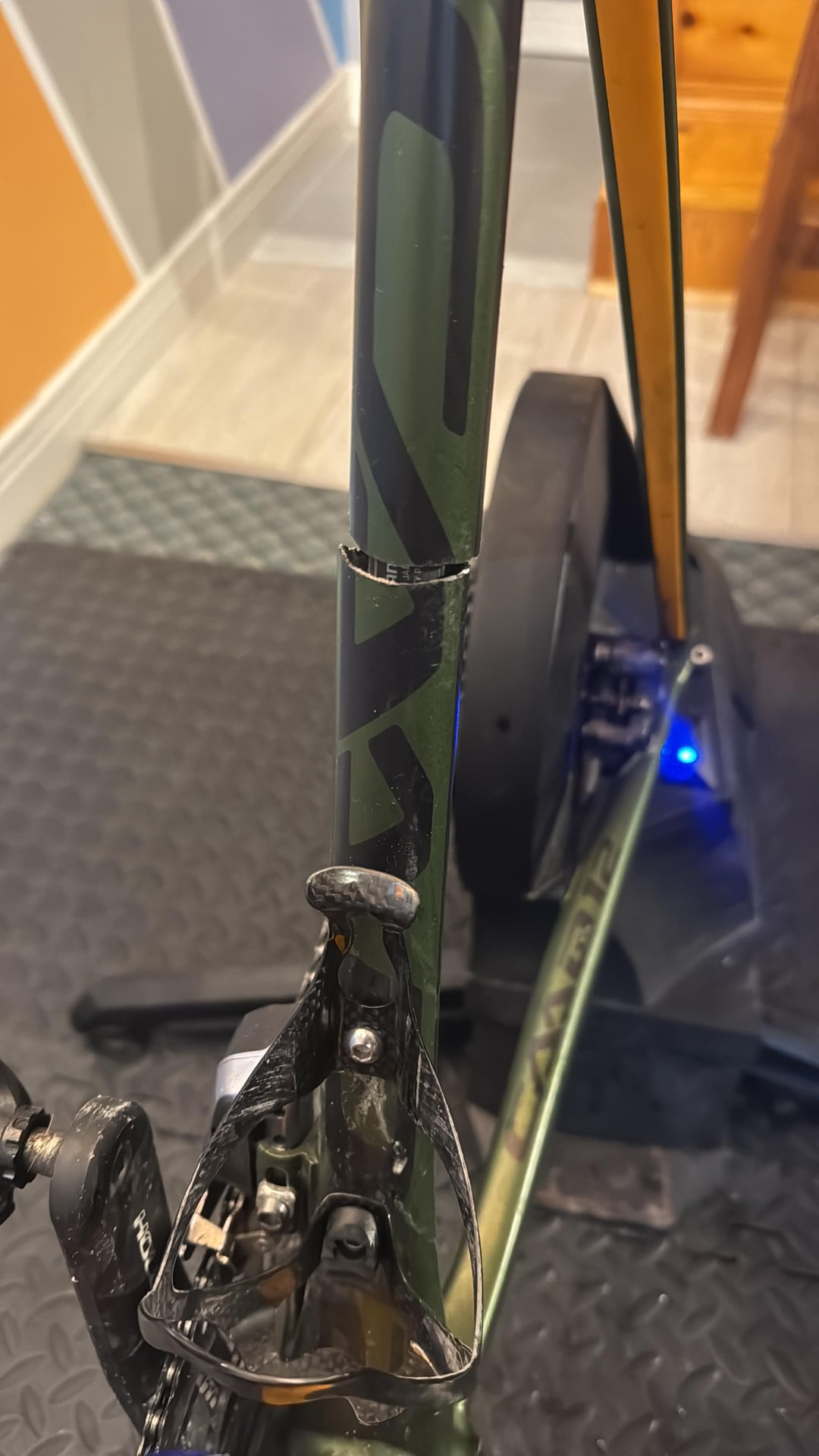
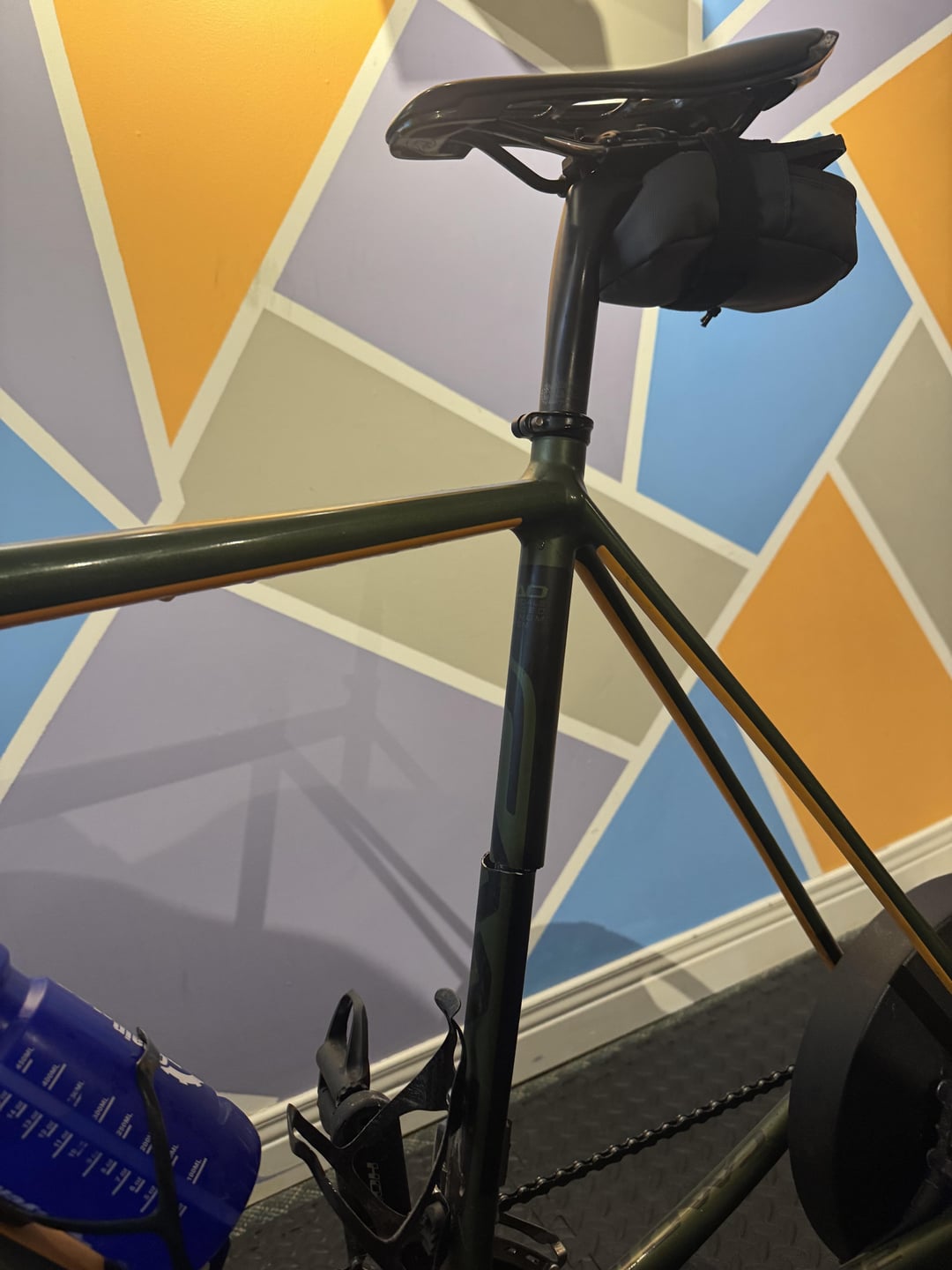
As my description says I am wondering about a repair to the down tube on my 2017 CAAD 12. I honestly ride about 75% indoors and about 25% outside and am considering my options to continue riding indoors after this happened yesterday. I have no history of doing bike work but am wondering if something like this would be repairable to let me continue to use my bike inside.
by mmars52
34 Comments
He’s dead Jim
Take the bb and seatpost out, block the holes in the seat tube and push a seatpost or wooden baton all the way down with a shitload of epoxy to make a big pinned joint like they use for alloy rims.
that frame is cooked
I have heard of old French road racers who didn’t trust their steel fork steerers (with good reason, they broke back then!) finding very hard pieces of wood and shoving them up the steerer to give them enough time to slow down before a decent crash in the case of their steerer failing. Maybe something similar could work?
But seriously, I’d just find an old Trek or Giant Road frame and set it up singlespeed as a turbo bike.
In my professional opinion that bike is done, even for indoor use.
But if you insist and absolutely only ride it indoors I’d say try as many stupid things as you can come up with. You can only injure yourself. Definitely don’t ever ride that bike outside again or sell it, no matter what repair you try.
Also, I suggest finding another place for that di2 battery before attempting any repairs.
Been there, done that. She’s dead man, time for a new frame.
I would find a tube that fits well in the tube and push it down between the two halves of the crack. Worth a shot.
That is a strange place for a tube to fail. If you’re just using it on the trainer you could just get it welded back together, it will never be strong again though the frame is done for.
You could probably do a hybrid repair with carbon fiber.
I’d offer my usual bad advice but then I’d get a hand slap.
It’s new frame day. Or a cheap bike off marketplace. The used bike market is flooded with cheap stuff.
its fuckio fuckio-d, replace it w some crappy old frame and move on. absolutely would not even sit on that personally.
Soup can and some bailing wire and you’re good to go. Used to fix my exhaust that way all the time.
(/S just in case)
Have you contacted Cannondale for possibly a discount on a replacement frame?
Super curious how an aluminum frame bike would even break in this spot?!
If you can find a tube (aluminum, steel, carbon, whatever) that fits snugly inside the seat tube, epoxy it in there – just be sure to leave it low enough to get your seat post back in. I’d never ride it outside but it should be fine on the trainer for a while.
You could probably get the seat tube sleeved by an aluminum welder that would be okay only for staying on a trainer. I mean, what’s the worst that could happen, it’s much less dangerous than riding a cracked frame.
Don’t they have lifetime warranty?
Scaffold clamps or something similar.
Really long seatpost that bridges the break might work.
Those frames are so thin. I had a 2019 CAAD 12, and put a dent right on the top tube. But I still rode it.
oh ffs folks its on a trainer.
Just shove a rod down there that matches the inner diameter of the seatpost, slathered in epoxy and perhaps with a scaffold clamp for good measure.
Perfectly fine for indoor use
Get the biggest dowel you can and shove it down to the crack. Epoxy, use small metal bars vertical (4 of them) around it and wrap with wire and epoxy those to the frame. You could also try to carbon fiber it
I would say just replace it. For a few hundred bucks you can get a new frame, or a full bike for a it more than that. If it’s for indoor use an old steelie will do fine and last a long time on the trainer.
Wrapping carbon fiber, a wooden dowel or a metal rod/tube which has a close fit and jam it down the seat tube combined with something like JB weld would likely work. Personally I’d rather spend my time looking for a used frame or bike if using it strictly for indoor trainer purposes. It would probably be a similar amount of work but you’d get a better safer result. Heck an old 1990s MTB or hybrid – possibly with a stem riser and drop bars would work for trainer use. It wouldn’t need to handle well just decent body position and adequate gearing. A top tube which is too short can be compensated for with a long stem. Stem risers work fine for getting the bars high enough – especially for trainer use. Heck I’d trust a stem riser for most MTB purposes (just about everything but monster DH/Enduro/freeride/park). If you can get the seat and handlebars in the right place it’ll be fine for trainer use.
I would repair and it doesn’t have to look good either as long as it holds. Just don’t ride it off the trainer.
Duct Tape.
Not regular stuff, but flexfix. It’s basically a bandage with water-activated resin.
https://m.youtube.com/watch?v=2SKrNUq22rk
Personally, I’d get a cheap steelie from Goodwill rather than continuing to ride this on a trainer. Swap your nice components if you feel like it. I feel like trainers actually put more stress on the frame than riding in the wild. It’s safer, in that if it breaks while you’re riding you’re not in traffic and not moving. But the fall distance is the same and you’re probably not wearing a helmet.
That’s not a fail, lol. This frame was cut
You could put a section of old seat post down there and some aviation clamps on either side of the crack.
Another idea would be to split a piece of pvc pipe vertically and clamp the halves over the crack.
I’d try to find a cheap frame on Facebook marketplace personally.
Quick internet search shows there are many of this frames for sale 300-850 I would just buy a frame online and swap it
and another crack-n-fail bites the dust!
For indoor use I’d simply wedge a wood pole in the seat tube, sand down the edges to avoid injury and put one of those steel hose clamp on it
It would probably cost $50 to get it fixed with a welded in sleeve from any local fabrication or machine shop.
Find a good alu welder, also you can insert a tube inside for more stiffness. For indoor cycling I dont see the problem, less metal waste on the world.
Steel splints and hose clamps. Make the splints a bit long, 3-4″ on either side of the break, to distribute the force across a greater area. You are going to get some galvanic corrosion between the aluminum and steel, but this is a bandaid fix.