
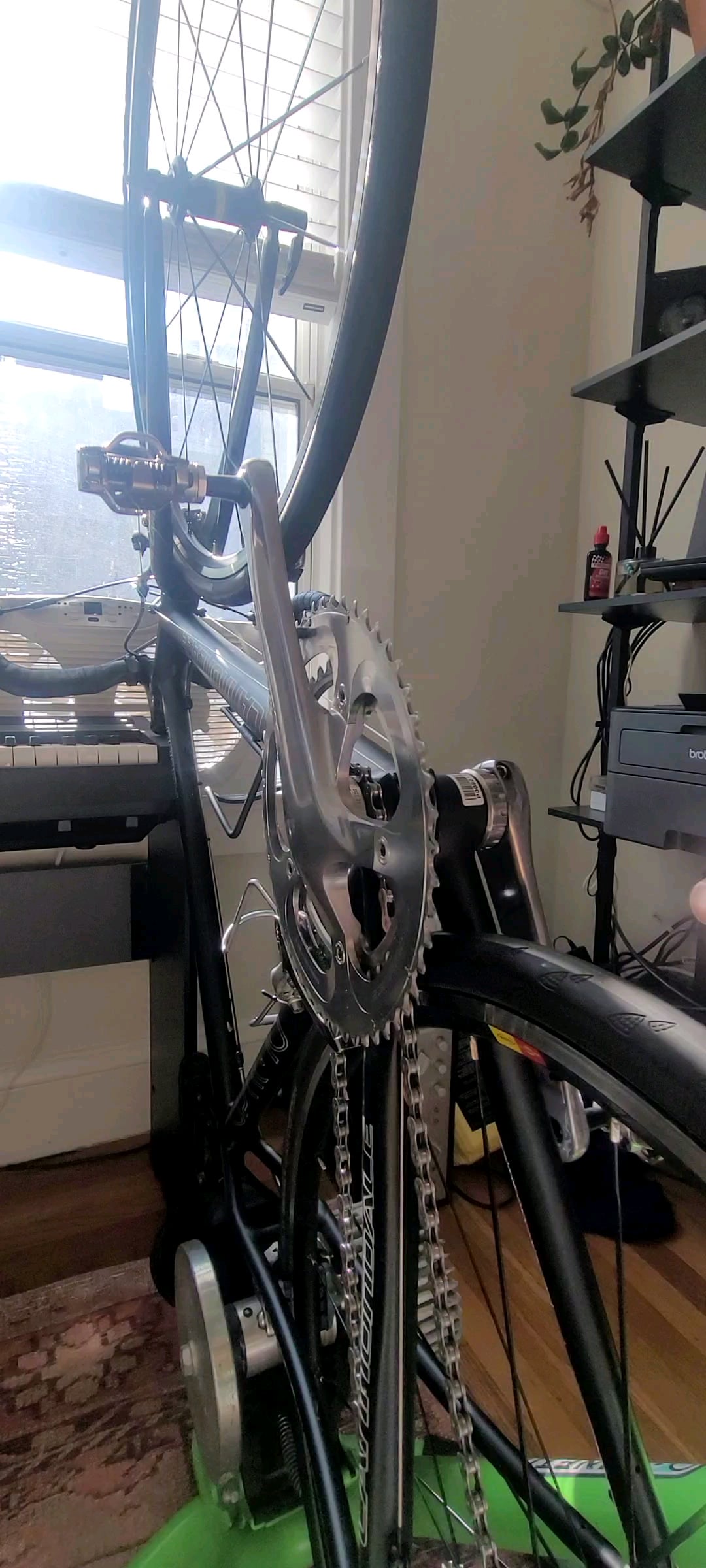
Ill delete this after a couple responses – sorry for spam
i ask this because i see many videos of people spinning their crank and it making multiple revolutions
the bottom bracket cap bolt (not sure how to describe – 8 point "star") was extremely tight before i tested this, so i broke it and tightened back to 30nm
Is this a normal amount of bottom bracket spin/friction
byu/guitarcrazy408 inbikewrench
by guitarcrazy408
17 Comments
the sound is the crank touching the disengaged chain – im sure contributing somewhat to the friction but not significantly as it only touches slightly
this is not good
Nein das ist nicht zehr gut
Was the last crank an internal bb? Is the bb facing in alignment?
30nm is a lot for the end cap. I just hand tighten mine until there’s no play, then torque the arm.
Get your chain out of the way, and try again.
Even a cheap BB should spin freely for multiple revolutions
Is your crankset overtightened to the bb? The locking to attach the non drive side crank shouldn’t be very tight
The preload cap on Shimano hollow tech 2 cranks should only be like finger tight (0.7-1.5nm).
Loosen the 2 pinch bolts on the non drive side, loosen the preload cap off, put it just barely snug, tighten pinch bolts. If there’s play in the cranks, re-do the process of tightening it a bit more.
On an outboard BB design, yes this is normal. It’s not a windmill meant to spin on its own and the second you have body weight spinning those cranks, you won’t notice any resistance worth mentioning. You might be able to adjust it and get it to spin ever so slightly more, but we are talking a marginal difference.
No bueno, should free spin many more revolutions effortlessly
For this type of bb is absolutely normal. Its the preload nut that make this friction. Negligible when riding. Campy has none and spins crazy loke some loose bearing type.
Bear in mind always the out of load behaviour is not important. It has nothing to do with under full load behaviour which if metals are “soft” be sluggish.
Soft VS hard
Watch the German made bouncing way more.
https://youtube.com/shorts/hlW9zdNNc88?si=fjKy_cMp9ieTz1rw
Could be the road bike just tensing up from having SPD’s screwed into it
Torque spec for that end cap is 1-2 Nm.
Bearing alignment, grease type/amount, and seals are big contributors to drag. If you dont like what you see, get some 6805 bearings from a reputable manufacturer (NSK, NTN, SKF etc)with non-contact seals,flush the grease out, and replace with a 25% fill of something quick like Kluber Isoflex Topas nb52. Remove the plastic tophats and old bearings, install the good stuff, reuse the tophats, and carry on.
You’ll need to maintain these more frequently, but if performance matters more than longetivity, these are the lengths that some people go to.
One ride and it’ll loosen right up.
Hollowtech II does not spin very freely (compared with square taper BBs). If the bottom bracket is very new it will improve a bit with use. There is a lot of grease in them when new.
If you did somehow manage to tighten the preload cap to 30 Nm then undo that and then undo the two pinch bolts. Then tighten the preload by hand and finally do up the pinch bolts again.
That is not normal, and there are a lot of terrible/hack comments in the replies saying that this is normal. Is it negligible in terms of how many watts you’re losing because of drag…yes it’s negligible. But you ar definitely introducing wear and tear on the bearings somewhere, and you are thus shortening the life of your bearings, which will inevitably result in crank play or even more bb grindiness/drag. Assuming you have tightened everything to the correct spec (e.g., bearing pre-load is only 1-2nm…like barely finger tight) and you’ve got sufficient miles in to break in the grease if this is a new bb, then there is only one other explanation…bottom bracket facing alignment. This has happened to 2 of my bikes. One of the bikes also had 105 hollowtech cranks and a outboard shimano external bb. Both were fixed after facing the bottom bracket shell…not just a simple “face until you see 360 degrees of bare metal” but rather, face it until you are pretty damn square, and within .5mm of uniformity across multiple areas measurements using a set of calipers. E.g. the top of the bottom bracket shell measures 67.8, the bottom measures 67.6, the sides measure 68.1mm etc…every measurement is within just a fraction of a mm of one another…this ensures your outboard drive side and non drive side bearing cups are sitting parallel with one, thus allowing the crank spindle to spin without binding. If doing that doesn’t work, then your BB is likely old and toast and needs replacement
Nope, not at all. That should spin as smoothly as silk. Tighten it properly.