
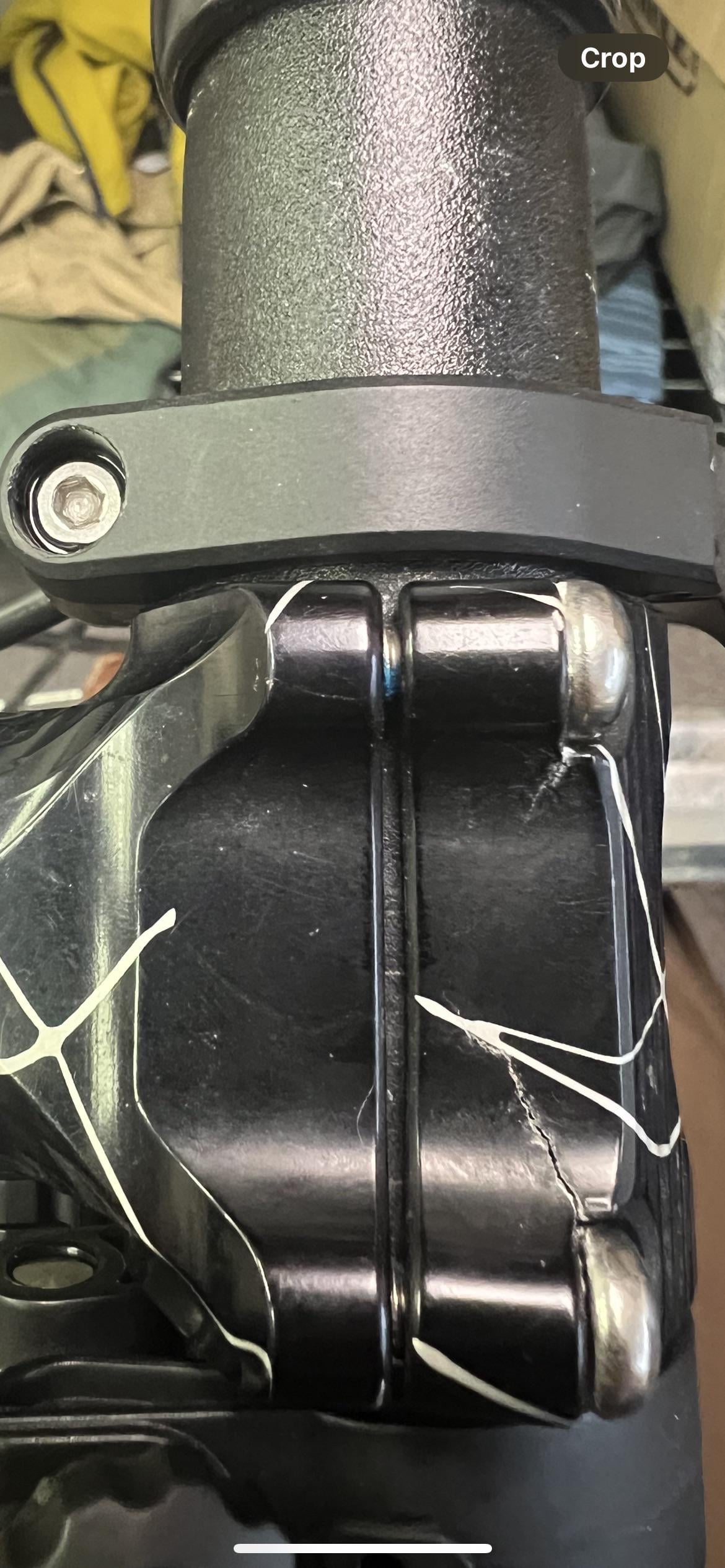
Ouch, just noticed cracking on both sides of my faceplate. I’m a bit OCD with torque spec so I know it’s was never been over torqued. What else could cause this?
And yes I’m replacing the stem ASAP
by sixweight
Ouch, just noticed cracking on both sides of my faceplate. I’m a bit OCD with torque spec so I know it’s was never been over torqued. What else could cause this?
And yes I’m replacing the stem ASAP
by sixweight
7 Comments
It was over tightened and is cracked . Do not ride this any more. Replace it
Sketch. Glad it happened on top where you could see it. I bet they’ll send you a new one.
My chinese 30$ stem has never cracked and I have never seen a torque wrench in my life. Just saying.
Definitely get in contact with Paul if you haven’t already. Even if they don’t replace it, they should know it happened.
A defect in the metal itself could cause this. A torque wrench that’s not calibrated could as well (as could misuse of a calibrated torque wrench). I suppose a very uneven gap side to side or top to bottom might contribute? A bar that’s slightly over 31.8 would add a little extra stress as well, but I’m really grasping at straws for these last two.
Paul and Thomson have both had issues with cracking stems/face plates throughout the years, and both have done a fair amount of damage control to try and prove that their stems are safe. The fact that both offer faceplates for sale separately is telling (the cost of a Paul faceplate seems ridiculous, FWIW). Despite their claims that only user error can crack a faceplate, they’ve seen enough cracked plates to make it an option. The truth probably lies somewhere in between “there’s a fault in the design” and “it’s always user error”. There are definitely conditions in which they can fail when installed correctly.
[Paul has a video on this page](https://www.paulcomp.com/shop/service-parts/stem-parts/boxcar-stem-faceplate/) where they claim to have torqued a faceplate to 25Nm without it cracking, though they say nothing about having put it through proper load cycles or riding simulations in an overtorqued state, so as far as I’m concerned it’s lacking scientific rigor. They end by saying they won’t warranty a faceplate that has cracked, which is a bit bullshit IMHO. I think they’re being a bit arrogant here. They’re on one hand saying it’s impossible to crack it because the bolt heads will strip first, and on the other saying it’s only going to crack from overtightening. That means there has to be a point under 25Nm where it cracks, right? Paul can never prove that you overtightened the faceplate, and you can never prove you didn’t (nor realistically prove there was a defect).
These types of failures get more visibility and attention because both brands are boutique and expensive, but it seems to me that CNC stems are more likely to suffer failures than forged ones.
Not sure what it is with some CNC stems. I9 stems also have cracking faceplates.
I had a similar problem. If heads of the screws are too big for contact surface, stresses will lead to this sort of failure. That was my problem. Can’t say that’s happening here.
Are you certain it’s a legit Paul stem? There are many, many counterfeits out there from Aliexpress and Temu. It’s why I personally won’t ever buy used Paul components.