I made an excel spreadsheet (linked below) which anyone can look through to see my calculations. I’ll try to keep this short enough to be readable, but detailed enough to explain what’s happening.
The excel spreadsheet analyzes, second by second, a rider (assumed to be a 1m diameter sphere of 60kg mass) putting a constant power input (200 Watts) into the pedals for an hour (3600 seconds) straight. It is accounting for kinetic energy, potential energy, aerodynamic drag, and the air density change as the rider climbs in altitude. Rolling resistance and mechanical friction are ignored as these are negligible compared to the aero drag and work to climb the hills. The spreadsheet calculated two rides; one on perfectly flat ground at sea level, and the other climbing up and over 3.5 sinusoidal 200m tall hills.
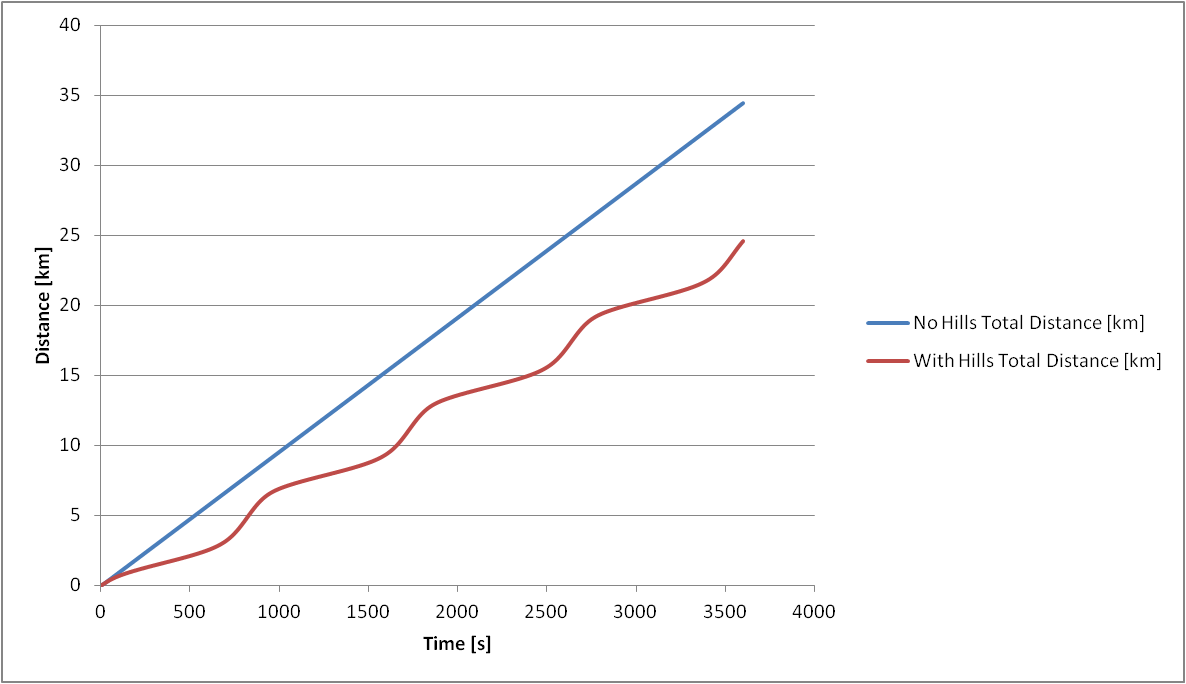
The flat ride went 34.46 km and the hilly ride went 24.6km. Each ride consumed a total of 720,000 J (172 kcal) of energy. This analysis wasn’t meant to be super accurate for an actual ride, but it does correctly demonstrate why hills are harder. Long story short, all the energy you input to climb the hill doesn’t get equally converted back into speed on the way back down. As you go faster a larger proportion of energy is bled off into aero drag which you can not get back. Its lost to the environment. Feel free to poke holes in my analysis and ask questions. I did this just for fun because I like math and physics and welcome any criticisms or improvements. Thanks.
That’s a lot of statistical analysis to explain something that is intuitively self-explanatory.
Pushing up against gravity is harder than not. Who’d have thought.
2pnt0 on
Efficiency losses are higher with higher intensity riding to a degree that outstrips the gains in potential energy that can later be recouped, especially if you need to regulate the expenditure of that potential energy.
I think most people understand this intuitively, even if they lack the means to describe it technically. Walking uphill his HARD. Walking downhill is easier. Walking downhill can often be harder than walking flat, depending on the grade.
Wyliegerr1 on
Time lost riding uphill can never be recovered by riding downhill.
This is very simplified – say you can ride 30 kph on a flat road. This means it takes you 2 minutes to ride 1 km. Now, you ride up a hill that is 2 km long, and you then get to ride down the other side for 2 km. But due to the hill you can only go 15 kph on the climb. How fast do you need to go on the downhill to average 30 kph for the 4 km of road?
It can’t be done unless you travel the downhill side at the speed of light. In order to average 30 kph you would need to cover the 4 km of roadway in 8 minutes. But at 15 kph it takes you 8 minutes to ride the 2 km uphill section. You have 0 minutes in which to complete the 2 km of downhill….
Raccoonridee on
Now go ahead and test your theory on a windy day.
holger-nestmann on
This is great. Thanks. I would love to have a navigation system that would properly show this. I think google maps has started doing „Less hilly“ suggestions and there is an open source one, that let‘s one to tweak a lot of parameters, which I couldn‘t get to work yet. But Komoot could better incorporate hills (and routing in general)
codeedog on
OP, this is a very cool analysis.
Some experiments you didn’t run that I think might telling with your setup are with removing aerodynamic drag. Meaning, the rider on the flat need only push 200W accelerating until they reach some theoretical speed limit (let’s say 40kph). After that, the rider on the flat stops pedaling and coasts to a finish line 39.99 km away.
Meanwhile, the hill rider must push 200W against gravity for the first half of the first hill and then can coast down and up each subsequent hill until they finish, presumably it will be less than 40km.
A third simulation would be to do this for just one hill.
Add a fourth simulation riding at 10W in the original with drag and instead of 200W. This last one effectively eliminates air resistance as a consideration for climbing because nearly all of the power goes into potential energy and will still allowing the sea level rider to reach a reasonable top speed. The hill climbing rider will never reach that speed.
I’m fairly certain that although aerodynamic drag is critical for any realistic analysis, removing it will show that even with energy recovery and speed increase on the downhill, the hilly rider will take longer or go less distance regardless of the situation.

8 Comments
I wanted to follow up on a post I saw here the other day and explain why hilly terrain costs more energy. Original post here:
[https://www.reddit.com/r/bicycling/comments/1g1i8tq/does_cycling_up_and_down_on_hilly_terrain_burn/](https://www.reddit.com/r/bicycling/comments/1g1i8tq/does_cycling_up_and_down_on_hilly_terrain_burn/)
I made an excel spreadsheet (linked below) which anyone can look through to see my calculations. I’ll try to keep this short enough to be readable, but detailed enough to explain what’s happening.
The excel spreadsheet analyzes, second by second, a rider (assumed to be a 1m diameter sphere of 60kg mass) putting a constant power input (200 Watts) into the pedals for an hour (3600 seconds) straight. It is accounting for kinetic energy, potential energy, aerodynamic drag, and the air density change as the rider climbs in altitude. Rolling resistance and mechanical friction are ignored as these are negligible compared to the aero drag and work to climb the hills. The spreadsheet calculated two rides; one on perfectly flat ground at sea level, and the other climbing up and over 3.5 sinusoidal 200m tall hills.
The flat ride went 34.46 km and the hilly ride went 24.6km. Each ride consumed a total of 720,000 J (172 kcal) of energy. This analysis wasn’t meant to be super accurate for an actual ride, but it does correctly demonstrate why hills are harder. Long story short, all the energy you input to climb the hill doesn’t get equally converted back into speed on the way back down. As you go faster a larger proportion of energy is bled off into aero drag which you can not get back. Its lost to the environment. Feel free to poke holes in my analysis and ask questions. I did this just for fun because I like math and physics and welcome any criticisms or improvements. Thanks.
Excel spreadsheet: [https://docs.google.com/spreadsheets/d/1lYVqMtcbxBLNNkAlniFlfI8_s_YQUNK8/edit?usp=sharing&ouid=103838984067373816926&rtpof=true&sd=true](https://docs.google.com/spreadsheets/d/1lYVqMtcbxBLNNkAlniFlfI8_s_YQUNK8/edit?usp=sharing&ouid=103838984067373816926&rtpof=true&sd=true)
Maybe just ride your bike.
That’s a lot of statistical analysis to explain something that is intuitively self-explanatory.
Pushing up against gravity is harder than not. Who’d have thought.
Efficiency losses are higher with higher intensity riding to a degree that outstrips the gains in potential energy that can later be recouped, especially if you need to regulate the expenditure of that potential energy.
I think most people understand this intuitively, even if they lack the means to describe it technically. Walking uphill his HARD. Walking downhill is easier. Walking downhill can often be harder than walking flat, depending on the grade.
Time lost riding uphill can never be recovered by riding downhill.
This is very simplified – say you can ride 30 kph on a flat road. This means it takes you 2 minutes to ride 1 km. Now, you ride up a hill that is 2 km long, and you then get to ride down the other side for 2 km. But due to the hill you can only go 15 kph on the climb. How fast do you need to go on the downhill to average 30 kph for the 4 km of road?
It can’t be done unless you travel the downhill side at the speed of light. In order to average 30 kph you would need to cover the 4 km of roadway in 8 minutes. But at 15 kph it takes you 8 minutes to ride the 2 km uphill section. You have 0 minutes in which to complete the 2 km of downhill….
Now go ahead and test your theory on a windy day.
This is great. Thanks. I would love to have a navigation system that would properly show this. I think google maps has started doing „Less hilly“ suggestions and there is an open source one, that let‘s one to tweak a lot of parameters, which I couldn‘t get to work yet. But Komoot could better incorporate hills (and routing in general)
OP, this is a very cool analysis.
Some experiments you didn’t run that I think might telling with your setup are with removing aerodynamic drag. Meaning, the rider on the flat need only push 200W accelerating until they reach some theoretical speed limit (let’s say 40kph). After that, the rider on the flat stops pedaling and coasts to a finish line 39.99 km away.
Meanwhile, the hill rider must push 200W against gravity for the first half of the first hill and then can coast down and up each subsequent hill until they finish, presumably it will be less than 40km.
A third simulation would be to do this for just one hill.
Add a fourth simulation riding at 10W in the original with drag and instead of 200W. This last one effectively eliminates air resistance as a consideration for climbing because nearly all of the power goes into potential energy and will still allowing the sea level rider to reach a reasonable top speed. The hill climbing rider will never reach that speed.
I’m fairly certain that although aerodynamic drag is critical for any realistic analysis, removing it will show that even with energy recovery and speed increase on the downhill, the hilly rider will take longer or go less distance regardless of the situation.