I’m at a similar loss. Maybe it’s to assuage the anger of car drivers at bicyclists for sharing their street?
TryingNot2BLazy on
they are there so that when they try to pass you aggressively in the least safe way possible to get to the next redlight, you can point at the ground and pretend they know what you’re pointing at.
sarcasm aside, it’s better for us from a legal perspective…
ride defensively. be safe. love every day.
calderholbrook on
it’s definitely one of the less helpful efforts you’ll see
BluMonday on
Ah but you see now it can be included in a map of this city’s bike network and many planners and engineers can give themselves a big pat on the back.
IdleContemplations on
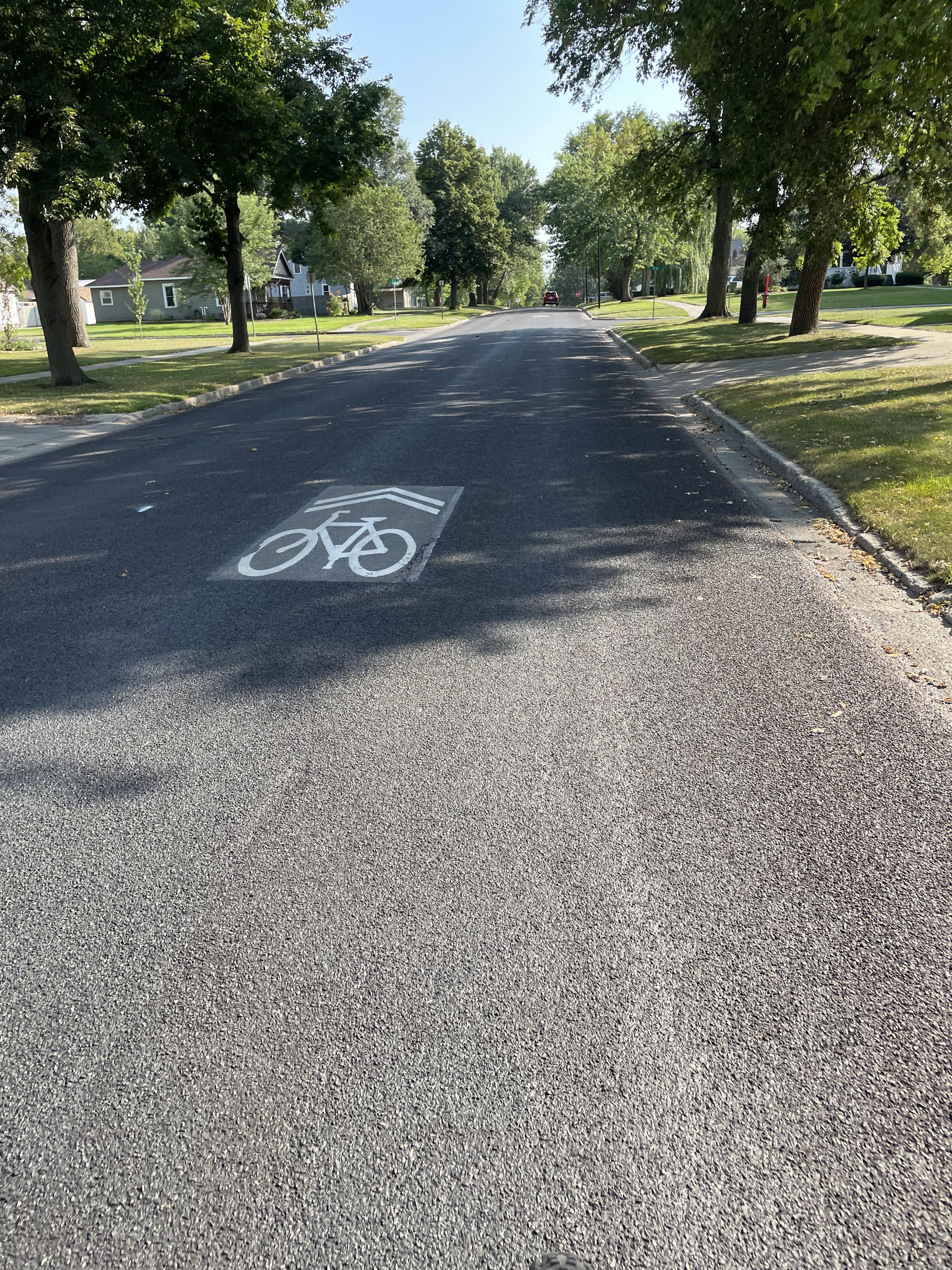
It is to inform drivers that bicycles are allowed to take up the full lane on this street. In my experience, most drivers have no idea what it means.
sanjosethrower on
They are called [Shared Lane Markings](https://nacto.org/publication/urban-bikeway-design-guide/bikeway-signing-marking/shared-lane-markings/). One of the uses is to remind drivers bicycles may use the lane. Another use is to inform bicycles this is meant to be a bike route. Another use is to let a municipality claim they are doing things without actually doing the hard work of doing things in effective ways.
aaaayyyy_lmao on
exactly
t92k on
It’s called a “Sharrow”. My city uses them to mark the official city bike routes, but the cycling orgs say that they don’t increase safety and streets that parallel the sharrows may be lower traffic and safer.
amped96 on
It’s called a “sharrow” and I’m pretty sure these only exist so that municipalities can check a box indicating they are installing bike “infrastructure.” They are useless in my experience.
fejobelo on
That means you can use the whole lane. The same sign will sometimes be close to the right, which means you are supposed to ride closer to the curb.
TheNetworkIsFrelled on
They’re called “sharrows” in the bike community, and they’re there to remind drivers that cyclists are entitled to use the road.
Existing_Beyond_253 on
Basic do nothing infrastructure in order of uselessness
Sharrow
Painted White line
Plastic bollards
Green paint with plastic bollards
6″ curbs next to green paint
Laserdollarz on
InFrAsTrUcTuRe
delicate10drills on
To tell carheads they can’t get pissy when there’s a voting, tax paying, human bike rider taking the lane for a fraction of a minute of their day.
joshhan on
Is this a one way street?
DryMeasure11 on
I take a “sharrow” during my commute home. It’s on a long residential street where street “humps” are also installed. The humps prevent speeding and I feel relatively safe. Not perfect, but it’s better than nothing.
Skagit_Buffet on
There are even worse bike markings out there, to be fair. Where I used to live in the Los Angeles area, many of the highlighted roads on the so-called (sparse, discontinuous, disingenuous) bike network map were “bike routes.” A “Bike route” has no on-street markings or barriers, no traffic calming, no lower speed limits.
Bike routes have the occasional tiny sign on the side of the road that says, “Bike Route.” Generally a short distance from that sign is a “Speed Limit 45” sign. Good luck.
BicycleIndividual on
It is partially to remind cyclists that they should be taking the lane, no hanging out on the shoulder waiting for cars to pass them dangerously and partially to tell the motorists who are annoyed that they are behind a cyclist that the cyclist has a right to use the road. Of course without the markings the cyclist should still be taking the lane and the motorist should still realized that the cyclist has a right to use the road.
noip83 on
I’ve always seen this as a visual representation of a bike in 2D, meant to signify what your bike will look like after a truck squashes it at 40mph in the middle of the lane… kind of like a preemptive chalk outline of a murder.
SugaryBits on
>PAint Is InFrAStRuCTurE
* U.S. ~~Transportation Engineers~~ glue eaters
Dothemath2 on
Some drivers yell at cyclists to get off the road and ride on the sidewalk. This bit of paint settles that misconception.
Betanumerus on
It shuts up arrogant car drivers.
anh-one on
to let people know that this is a bike-friendly avenue/ground. bikers welcome & incoming
aubreysux on
Honestly I don’t hate this. It’s not infrastructure and it doesn’t really keep me safe, but it does help me figure out ok bike routes if I am biking somewhere that I don’t know as well.
I hate turning a corner and realizing that I’m suddenly going onto a 35 mph or 45 mph road. This stuff at least helps avoid that.
The idea was it would make drivers more aware but it has actually just encouraged cyclists to drive in a dangerous road.
Late-Stage-Dad on
We have these in our city, and I had to look it up before I started riding all the time. For us it means a designated bike route and the bikes can use the entire lane (there are road signs to go along with the striping). These routes also connect to bike paths. I still use a Garmin Varia.
Lillienpud on
It means “cyclist may use entire lane”.
username_1774 on
These are to show a Bicycle Route (not to be confused with a Bicycle Lane). The intent is that cyclists follow Bicycle Routes and stay off roads that are not Bicycle Routes and that cagers follow non-bicycle routes and stay off roads that are Bicycle Routes.
The theory is that cyclists move to roads with fewer cars on them by following these routes.
It does not work.
DesertCardinal259 on
These are for cars: Like most painted bike infrastructure, they are intended to steer bikes away from cars on busier streets, so cars can drive faster, even though actually you sometimes see these on busy streets as well. They also help attract “complete streets” funding and let engineers give themselves a pat on the back.
They don’t serve any practical purpose for bicyclists, and in fact ironically are counterproductive since they are typically a bit bumpy to ride over.
secondhandoak on
I’ve seen these in video games. when you run over them it gives you a temporary speed boost.
randomredditor0042 on
I believe they are just pointing out a bike trail route, not denoting a bike lane. Am I wrong?
like_shae_buttah on
Probably to get transportation funding
Apart_Bid2199 on
We have some here. Those streets usually have infrastructure to prevent cars from making certain turns and prevent through traffic or speeding. Usually parks like this or neighborhood roads adjacent to busier streets. They make up and connect our bike infrastructure. When I’m driving on the one near me it doesn’t make sense to pass bikes so I just cruise slowly a safe distance behind and pretend my car is a bike.
0ooo on
This will vary depending on the location, but where I’ve ridden, these have been used to alert drivers to the higher chance of cyclists using that roadway. Often, I’ve seen these used on streets called things like “bike boulevards” to indicate that to road users. These bike boulevards have had signage and traffic flow implements that directed automobile traffic away from the road or prevented automobile traffic from entering the roadway.
Ok-Push9899 on
Yes these are widely criticized and subject to a lot of cynicism but as a cyclist I find them very useful. If I am cycling in an area I don’t know and stumble upon one of these, it tells me instantly that there is unlikely to be a better street to cycle along.
Sometimes you’re caught wondering “Hmmm, this is a bit busy. I wonder if there’s a parallel route, a quieter route, better suited to cycling.” These “sharrows” are say to me “The local cycling specialists who advise the council have chosen this route. All other routes are gonna be more dangerous.”
Yes obviously they are not perfect and obviously they are not protected cycleways, but I would much rather them spend a few dollars on paint than not spend it. And I am pretty sure they don’t have to start a 2 year long process of negotiating with local residents to put down the paint.
It may well turn out that IF the “sharrows” concentrate a lot of bikes along a particular street, that street may be the obvious target for a cycleway update in the future. If not, even the presence of 10 bikes in one street creates a safer perception than 10 solo bikes spread over 10 streets.
Another thing they tell me is that if you’re looking for the link between two wonderful protected cycleways, you’re on it. They’re simply route maps.
So yeah, I ain’t cynical about these.
chillpalchill on
these mean “if a car driver kills you, it’s your fault”
ChocolateBunny on
Those indicate that it’s a bike friendly road where car drivers are required law to be friendly to bicycles. When they’re not present then its a bike unfriendly road where car drivers are required by law to be unfriendly to bicycles.

39 Comments
I’m at a similar loss. Maybe it’s to assuage the anger of car drivers at bicyclists for sharing their street?
they are there so that when they try to pass you aggressively in the least safe way possible to get to the next redlight, you can point at the ground and pretend they know what you’re pointing at.
sarcasm aside, it’s better for us from a legal perspective…
ride defensively. be safe. love every day.
it’s definitely one of the less helpful efforts you’ll see
Ah but you see now it can be included in a map of this city’s bike network and many planners and engineers can give themselves a big pat on the back.
It is to inform drivers that bicycles are allowed to take up the full lane on this street. In my experience, most drivers have no idea what it means.
They are called [Shared Lane Markings](https://nacto.org/publication/urban-bikeway-design-guide/bikeway-signing-marking/shared-lane-markings/). One of the uses is to remind drivers bicycles may use the lane. Another use is to inform bicycles this is meant to be a bike route. Another use is to let a municipality claim they are doing things without actually doing the hard work of doing things in effective ways.
exactly
It’s called a “Sharrow”. My city uses them to mark the official city bike routes, but the cycling orgs say that they don’t increase safety and streets that parallel the sharrows may be lower traffic and safer.
It’s called a “sharrow” and I’m pretty sure these only exist so that municipalities can check a box indicating they are installing bike “infrastructure.” They are useless in my experience.
That means you can use the whole lane. The same sign will sometimes be close to the right, which means you are supposed to ride closer to the curb.
They’re called “sharrows” in the bike community, and they’re there to remind drivers that cyclists are entitled to use the road.
Basic do nothing infrastructure in order of uselessness
Sharrow
Painted White line
Plastic bollards
Green paint with plastic bollards
6″ curbs next to green paint
InFrAsTrUcTuRe
To tell carheads they can’t get pissy when there’s a voting, tax paying, human bike rider taking the lane for a fraction of a minute of their day.
Is this a one way street?
I take a “sharrow” during my commute home. It’s on a long residential street where street “humps” are also installed. The humps prevent speeding and I feel relatively safe. Not perfect, but it’s better than nothing.
There are even worse bike markings out there, to be fair. Where I used to live in the Los Angeles area, many of the highlighted roads on the so-called (sparse, discontinuous, disingenuous) bike network map were “bike routes.” A “Bike route” has no on-street markings or barriers, no traffic calming, no lower speed limits.
Bike routes have the occasional tiny sign on the side of the road that says, “Bike Route.” Generally a short distance from that sign is a “Speed Limit 45” sign. Good luck.
It is partially to remind cyclists that they should be taking the lane, no hanging out on the shoulder waiting for cars to pass them dangerously and partially to tell the motorists who are annoyed that they are behind a cyclist that the cyclist has a right to use the road. Of course without the markings the cyclist should still be taking the lane and the motorist should still realized that the cyclist has a right to use the road.
I’ve always seen this as a visual representation of a bike in 2D, meant to signify what your bike will look like after a truck squashes it at 40mph in the middle of the lane… kind of like a preemptive chalk outline of a murder.
>PAint Is InFrAStRuCTurE
* U.S. ~~Transportation Engineers~~ glue eaters
Some drivers yell at cyclists to get off the road and ride on the sidewalk. This bit of paint settles that misconception.
It shuts up arrogant car drivers.
to let people know that this is a bike-friendly avenue/ground. bikers welcome & incoming
Honestly I don’t hate this. It’s not infrastructure and it doesn’t really keep me safe, but it does help me figure out ok bike routes if I am biking somewhere that I don’t know as well.
I hate turning a corner and realizing that I’m suddenly going onto a 35 mph or 45 mph road. This stuff at least helps avoid that.
The EXACT same point as these: [https://i.imgur.com/1DKUc7J.jpg](https://i.imgur.com/1DKUc7J.jpg)
Paint protects you, trust me one this
The idea was it would make drivers more aware but it has actually just encouraged cyclists to drive in a dangerous road.
We have these in our city, and I had to look it up before I started riding all the time. For us it means a designated bike route and the bikes can use the entire lane (there are road signs to go along with the striping). These routes also connect to bike paths. I still use a Garmin Varia.
It means “cyclist may use entire lane”.
These are to show a Bicycle Route (not to be confused with a Bicycle Lane). The intent is that cyclists follow Bicycle Routes and stay off roads that are not Bicycle Routes and that cagers follow non-bicycle routes and stay off roads that are Bicycle Routes.
The theory is that cyclists move to roads with fewer cars on them by following these routes.
It does not work.
These are for cars: Like most painted bike infrastructure, they are intended to steer bikes away from cars on busier streets, so cars can drive faster, even though actually you sometimes see these on busy streets as well. They also help attract “complete streets” funding and let engineers give themselves a pat on the back.
They don’t serve any practical purpose for bicyclists, and in fact ironically are counterproductive since they are typically a bit bumpy to ride over.
I’ve seen these in video games. when you run over them it gives you a temporary speed boost.
I believe they are just pointing out a bike trail route, not denoting a bike lane. Am I wrong?
Probably to get transportation funding
We have some here. Those streets usually have infrastructure to prevent cars from making certain turns and prevent through traffic or speeding. Usually parks like this or neighborhood roads adjacent to busier streets. They make up and connect our bike infrastructure. When I’m driving on the one near me it doesn’t make sense to pass bikes so I just cruise slowly a safe distance behind and pretend my car is a bike.
This will vary depending on the location, but where I’ve ridden, these have been used to alert drivers to the higher chance of cyclists using that roadway. Often, I’ve seen these used on streets called things like “bike boulevards” to indicate that to road users. These bike boulevards have had signage and traffic flow implements that directed automobile traffic away from the road or prevented automobile traffic from entering the roadway.
Yes these are widely criticized and subject to a lot of cynicism but as a cyclist I find them very useful. If I am cycling in an area I don’t know and stumble upon one of these, it tells me instantly that there is unlikely to be a better street to cycle along.
Sometimes you’re caught wondering “Hmmm, this is a bit busy. I wonder if there’s a parallel route, a quieter route, better suited to cycling.” These “sharrows” are say to me “The local cycling specialists who advise the council have chosen this route. All other routes are gonna be more dangerous.”
Yes obviously they are not perfect and obviously they are not protected cycleways, but I would much rather them spend a few dollars on paint than not spend it. And I am pretty sure they don’t have to start a 2 year long process of negotiating with local residents to put down the paint.
It may well turn out that IF the “sharrows” concentrate a lot of bikes along a particular street, that street may be the obvious target for a cycleway update in the future. If not, even the presence of 10 bikes in one street creates a safer perception than 10 solo bikes spread over 10 streets.
Another thing they tell me is that if you’re looking for the link between two wonderful protected cycleways, you’re on it. They’re simply route maps.
So yeah, I ain’t cynical about these.
these mean “if a car driver kills you, it’s your fault”
Those indicate that it’s a bike friendly road where car drivers are required law to be friendly to bicycles. When they’re not present then its a bike unfriendly road where car drivers are required by law to be unfriendly to bicycles.