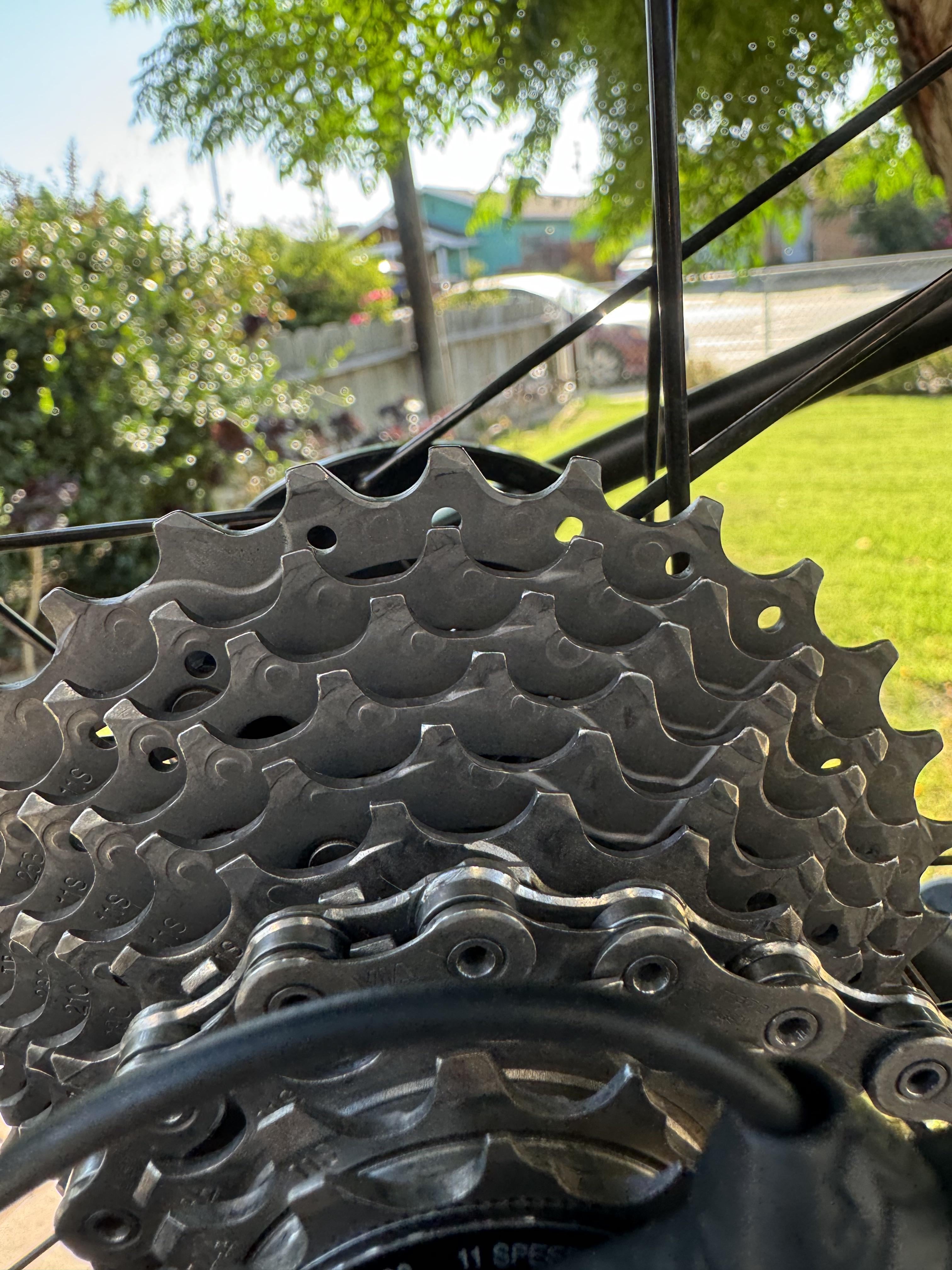
Point out the spots you are considering wear. On first look that appaers normal to almost new.
Ass_Over_Teakettle on
Most of those variations and grooves aid the chain in moving from gear to gear.
klaasypantz on
Look at your chain then ask yourself what made that wear pattern…
Wineandbikes on
It’s the hollow pins of the chain doing this. Seen it before.
JeanPierreSarti on
Chain is the hardest component of the drivetrain. That’s why it’s reasonable to change your chain earlier than the old conventional wisdom. The chain is usually the cheapest component and once it’s elongated, it (and normal contamination) abrades the cassette and chainrings. Zero Friction Cycling suggests the jump point in drivetrain wear is around 0.6% elongation of the chain. Seeing these cases in the shop, I would change a chain by .75% at the latest, and never go past .6% on an expensive drivetrain.
If a chain is past 1% elongation the cassette is often (50-50) toast
dotcomie on
Just a guess, a wrong size chain (IE 10sp chain on 11sp cassette)?
Suspicious-Double162 on
I think you have the wrong chain.
ChillinDylan901 on
The chain is too wide for the cassette!
Hotsky23 on
Unless I’m missing something here. That’s just how casset is designed. Different angles and length help with shifting. Looks like new to me.
lingueenee on
I’m counting an 11 spd cassette: 11 cogs mean tight tolerances. Now obviously the circular divot wear comes from the chain’s pins and–just speculation here–I’d wager the OP has a 1X drivetrain.
So cross-chaining with a tight tolerance cassette, where only one chain ring assures the chain leaves the cassette at the same angle every time (as opposed to multi-ring setups where chain angles entering and exiting the cassette vary slightly, for more diffuse wear) would lead to this type of wear pattern.
I’ve never seen this wear pattern with older 8 and 9 speed (multi-ring crankset) drivetrains.
Xafilah on
Wrong chain.
fckreher99 on
Wrong chain width, or possible on the wrong way around?
hunglowcharlie on
Looks like may be the wrong size chain.
pesciasis on
Your cassette is cleaner than my conscience.
Specific_User6969 on
Watt bombs
Suspicious_Tap_1616 on
Riding the bike 🫠
co_mtb303 on
Hills
LifeguardSas976 on
Looks like the chain is too wide for this cassette.

18 Comments
Point out the spots you are considering wear. On first look that appaers normal to almost new.
Most of those variations and grooves aid the chain in moving from gear to gear.
Look at your chain then ask yourself what made that wear pattern…
It’s the hollow pins of the chain doing this. Seen it before.
Chain is the hardest component of the drivetrain. That’s why it’s reasonable to change your chain earlier than the old conventional wisdom. The chain is usually the cheapest component and once it’s elongated, it (and normal contamination) abrades the cassette and chainrings. Zero Friction Cycling suggests the jump point in drivetrain wear is around 0.6% elongation of the chain. Seeing these cases in the shop, I would change a chain by .75% at the latest, and never go past .6% on an expensive drivetrain.
If a chain is past 1% elongation the cassette is often (50-50) toast
Just a guess, a wrong size chain (IE 10sp chain on 11sp cassette)?
I think you have the wrong chain.
The chain is too wide for the cassette!
Unless I’m missing something here. That’s just how casset is designed. Different angles and length help with shifting. Looks like new to me.
I’m counting an 11 spd cassette: 11 cogs mean tight tolerances. Now obviously the circular divot wear comes from the chain’s pins and–just speculation here–I’d wager the OP has a 1X drivetrain.
So cross-chaining with a tight tolerance cassette, where only one chain ring assures the chain leaves the cassette at the same angle every time (as opposed to multi-ring setups where chain angles entering and exiting the cassette vary slightly, for more diffuse wear) would lead to this type of wear pattern.
I’ve never seen this wear pattern with older 8 and 9 speed (multi-ring crankset) drivetrains.
Wrong chain.
Wrong chain width, or possible on the wrong way around?
Looks like may be the wrong size chain.
Your cassette is cleaner than my conscience.
Watt bombs
Riding the bike 🫠
Hills
Looks like the chain is too wide for this cassette.