
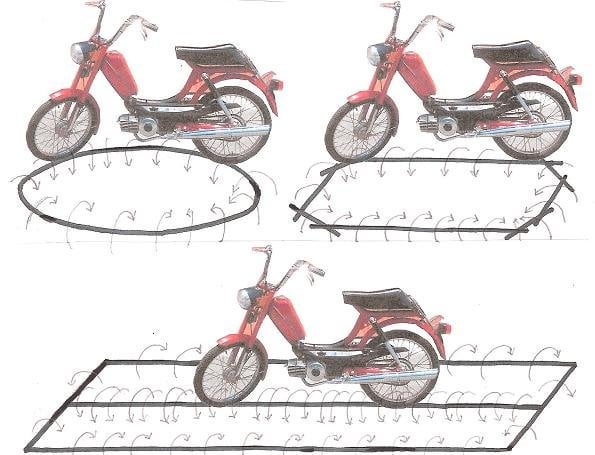
I've recently discovered that the induction loop sensors for traffic lights are easily tripped by a bike. Here's an image that describes how I position myself on the detectors.
By positioning the bike directly above the tarred-line (for square loops), or at a tangent to the line (for circular loops), I've never not been able to turn a red light green.
Does this work everywhere, or are the detectors in my city just calibrated low enough to respond to bikes? I should also specify that I'm on an ebike, so the added metal might create a larger signature.
by bcl15005
9 Comments
In the Netherlands basically every bikelane has these.
It will vary. The important variables are position (you’re absolutely right on how to position the bike for most applications), detector setting and the amount of ferromagnetic metal (metal that can attract a magnet) you have in your bike. If you’re reliably able to trip the sensors in your area, they may be turned to “high” sensitivity and/or your bike may have a good hunk of that metal located fairly low on the bike.
Sometimes if you find your bike isn’t tripping the detector, you can lay it down in the positions shown in your diagrams, which gets any small amounts of ferromagnetic metal closer to the sensor.
My area has a mix of those induction loop detectors and video detection. Overall, the video detection does a slightly better job of detecting my bike. But there are a few very frustrating intersections where nothing works and I have to wait for a car to trip it or make the miserable side trip to find a pedestrian crossing button to press.
We have ‘bike boxes’ in our city that are supposed to trigger the light. But as far as I can tell they don’t do shit; I sit there for minutes on end. Only until a car comes along does a light change to green. I’m going to have to try this sensor trick.
Definitely depends where you are. For me it even depends on what part of the city I’m in. Stuff with newer infrastructure seems to be calibrated to detect bikes, but older stuff seems to ignore me.
I was somewhere with a gate using this kind of sensor and could NOT get it to open with a (steel) bike no matter what I tried. And lights, well, in my city I don’t think they do anything anyway. IOW, YMMV.
In my state they are now required to be sensitive enough to detect an aluminum bicycle rim over a fairly large area, so newer sensors work even if you are not carefully aligned. I do line up like that when I can see the tar marks from installing the loop, but sometimes the road has been paved over, so it is harder to know where the loop is.
Carbon frame with carbon rims probably never work to trigger sensors.
Most work if I position myself per your diagram. There is one set of lights at the intersection, leaving a supermarket I frequent that never works. If there is a car behind me, I pull over and wave them ahead. Or use the crosswalk
We just have a little picture of a bike on the ground plus two white lines where you’re supposed to put your wheels. They’re at basically every intersection and they work pretty well. I live in a suburb on the West Coast (USA).
I remember as a kid having to hold my bike sideways and waving it over the loop to trigger it