
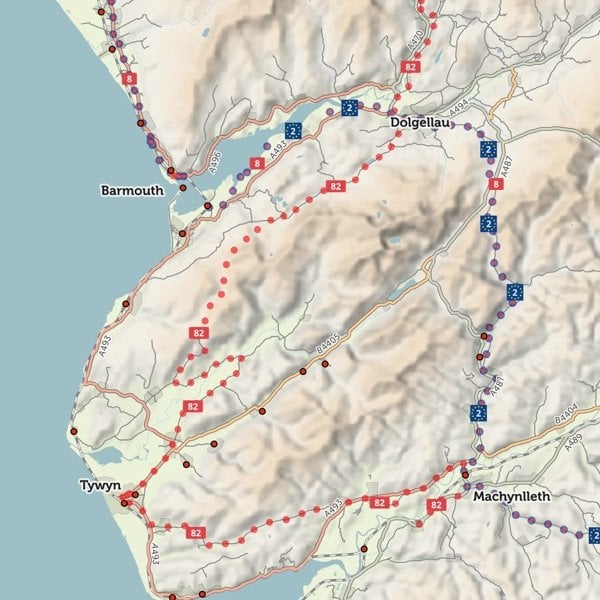
I did my first 2-week bike tour the other week. I’m surprised to find that some people in my life are quite impressed by this(!!). Alongside questions about bike, fitness, fear, and where to take a dump, I’m realizing that many folks have challenges conceiving and planning routes.
The thing is, I’ve always struggled with route planning too! And this is a big reason why I’m only dipping my toes into touring slowly, but surely.
You see, on the one hand, I’m a planner. I can’t handle uncertainty. And I can’t bear FOMO! I hate to think that I might miss out on sights, routes, and camping spots. But on the other hand, I’m a terrible map reader. The worst. I could get lost on a straight road.
So with this background, I’m kind of amazed that I’ve been able even to leave the house. But when I look at it, that’s because I’ve now got a list of go-to resources that help me plan good tours even in very remote areas.
So I thought I’d write down my top five, here – and I'd love to know what yours are. Do you approach things differently? Am I missing out on a whole way of thinking about touring?
Planning resource #1: Maps.
No matter how far I’m going, hard-copy maps are my best friend in route planning. Paper maps do things that online mapping just can’t.
Unfold a big map, and you’ll quickly see the off-beat trails. No needle-in-haystack zooming in to see details!
And without even trying, you get an overview of your trip – right in front of you.
For cycling in the UK, all the different OS products have their place, including the ultra-detailed explorer (Orange), Landranger (pink), and road maps (green). And the best bit? Many local libraries hold complete sets of these maps.
Nothing takes the place of paper maps for me.
Planning resource #2: Books from Cicerone.
When I decided I was going to the Scottish Highlands this summer, the first thing I did was to buy a Cicerone guidebook.
Why?
I needed accuracy, clarity, and first-hand experience. And I didn’t have time to the google searching: sure, they might give me 1000 SEO blog posts, but let’s face it, most of them will be are copies of copies of copies of copies.
Cicerone, as the go-to press for outdoors guidebooks, had exactly what I needed. In the end, I didn’t follow their routes exactly (in some cases, I didn’t follow them at all!). But it gave me the large-scale overview of the highlands – quickly and effectively.
Planning resource #3: Cycle.travel
This is a new tool for me. And I can’t believe I’ve only just discovered it!
Like many online tool based on enthusiastic user input, it delivers over and over again. In several places, it suggested rideable routes that no other source would.
With realistic assessments of roads, clear links to photographs, I’m hooked on Cycle.travel. (I’m stacking up a load of “drafts” in my account – lots of dreams!).
Planning resource #4: Other people!
I’m not much of a people person. So this one doesn’t come naturally.
But let me tell you. Along with maps, books, and apps, actual human people gave me a lot of the best advice for a long tour.
I’m lucky enough to have a couple of close personal friends who’ve done a fair bit of touring. They were happy to answer question after question about the wisdom of my plans.
And whenever I needed further support, I headed over to THIS SUBREDDIT, a community which is incredibly enthusiastic and supportive. That was the way I got some amazing ideas about the Coigach peninsula, Loch Vaich, and the horrors of the A9.
So, let’s hear it for human beings.
Planning resource #5: Komoot
For on-trail directions, Komoot does a great job.
In the past, I’ve used Google maps. But it’s just too eccentric. And it really can’t handle offline directions.
So I was grateful when a trusted friend suggested Komoot, For thirty quid, I downloaded all the maps I needed – and got audio directions for every part of my route.
Komoot still has its quirks. And to make the most multi-stage journeys, really, I will have to upgrade to premium. But for now, I’m still happily exploring everything this handy little app can offer.
Planning resources #6 onwards…
What do you think I should add to my portfolio?
by National-Oven-192
6 Comments
Mapy.Cz is great – flick to the outdoor layer and they’ve done a really good job at adding national hiking and cycling trails / paths.
https://brouter.de/brouter-web
>What do you think I should add to my portfolio?
The most beginner-friendly planning resource of all time: **rivers**.
It’s a bit of a cheeky answer, but if someone asks me where to start on bike touring, I will always advise to just follow a river.
At least in Europe, almost all rivers have roads right alongside the river bank, and all the main ones have dedicated bicycle paths.
And they just have unbeatable benefits:
* Impossible to get lost. Just keep the river on your right or left hand and you’ll be going the right way.
* No elevation, but still pretty views over hills or mountains.
* People generally built their towns and castles right next to the river, so no FOMO: you won’t miss out on sights to see.
* Generally plenty of nature, parks, camp sites and/or hostels.
* Gives a good sense of progress. You’re not just riding around willy-nilly, you’re actually *going* somewhere.
* If you discover you hate cycling you can always continue by boat.
* And even if the region is boring, you at least have the river to look at.
It’s no coincidence that the oldest and most popular [Eurovelo ](https://en.eurovelo.com/)routes are alongside the Danube, Rhine, Rhone and Loire. I’ve had great fun with the Elbe, Ems, Meusse, Yser, Lot and Fulda too
I know the veterans here sometimes find river routes a bit boring. They’re often busier and the flat easy riding isn’t challenging. But for beginners that is not a bug but a feature.
So, yeah… struggling with route planning? Pick a river, follow it. Done!
^(Works with long lakes, coastlines, gorges, border walls or ancient roads too, in a pickle.)
Google earth at work when I should be working was probably my biggest planning tool. Finding a safe/legal campsite was primarily a concern for the first 2 weeks of my tour and then I kinda became less anxious.
I’m really not a big fan of elevations and I’m also going to follow rivers on my next tour. But what I also like to help with deciding which general direction to follow are topographic maps so that I can avoid crossing the worst areas. [topographic-map.com](http://topographic-map.com)
Komoot.
Google Maps Streetview.
Booking and AirBnB.