
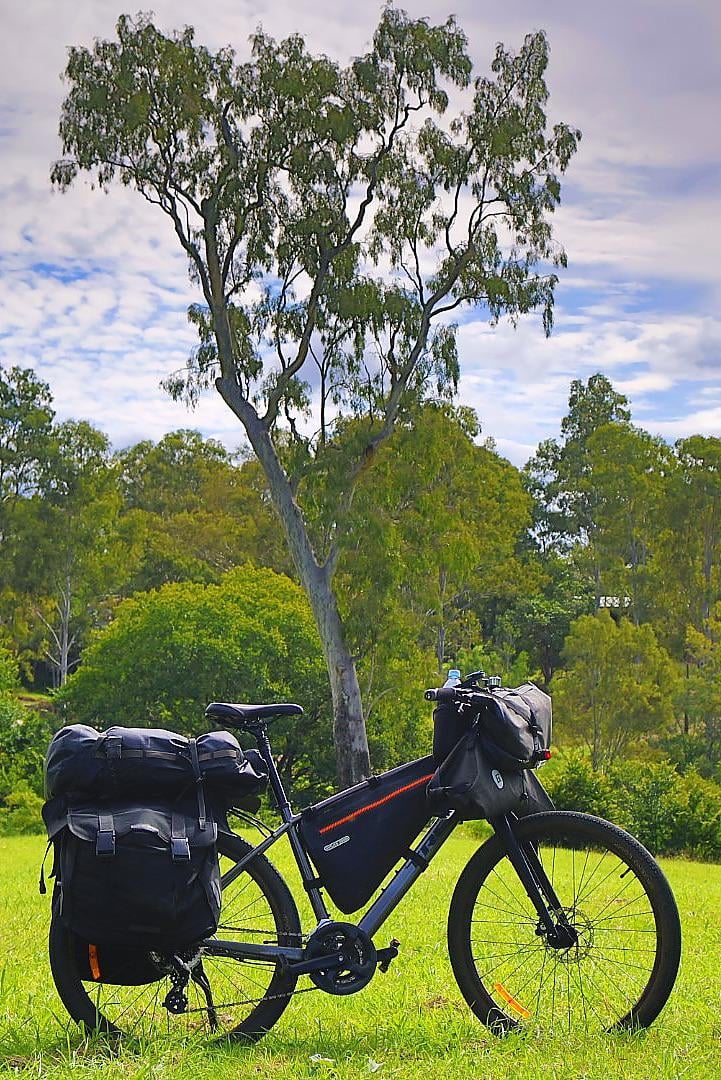
I’m bikepacking and as you can tell by the photo, my rear wheel is holding a looot of weight. At just 5 weeks old, the bike has its first snapped spoke. So I’m looking for advice on which wheel to put on the back. I’ll be putting front panniers on to reduce the load, but the rear wheel will still be supporting a lot of weight. I went to the bicycle shop and got recommended a “wheel 27.5 Trucky 30 36H 6 bolt disc sealed novatec hub”. I’ve no idea what that is as I’ve only been cycling for a couple months 😅 do any experts have an opinion?
Cheers.
by 002dollar
10 Comments
If the spokes are too loose, they’re more likely to break. Get the spoke tension checked on any wheels you use.
What is the model of your Trek?
How much do you and your gear weigh? There is a limit to everything.
They’re recommending a Trucky 30 rim, 36 spokes, laced to a Novatec hub. I have no idea if those are good rims so do some research.
If they’re building the wheel, which I highly recommend for a heavily loaded bike (I was ~315lbs at one time with rear panniers) ask for 3-cross lacing and pay for the upgrade to double butted spokes. Both make for a wheel more suited to carrying a lot of weight. 4-cross spokes overlap the next spoke head and I don’t like that, and double butted spokes are more elastic which takes some of the shock from being transferred into the j-bend.
—-
Sheldon Brown:
Double-butted spokes are thicker at the ends than in the middle. The most popular diameters are 2.0/1.8/2.0 mm (also known as 14/15 gauge) and 1.8/1.6/1.8 (15/16 gauge).
Double-butted spokes do more than save weight. The thick ends make them as strong in the highly-stressed areas as straight-gauge spokes of the same thickness, but the thinner middle sections make the spokes effectively more elastic, allowing them to stretch (temporarily) more than thicker spokes.
As a result, when the wheel is subjected to sharp localized stresses, the most heavily-stressed spokes can elongate enough to shift some of the stress to adjoining spokes. This is particularly desirable when the limiting factor is how much stress the rim can withstand without cracking around the spoke holes.
You really do need a special purpose, very stout rear wheel. The Novatec hubs are a good value and will do the job. The Trucky 30 is a good choice, tubeless ready and adapted for wide tires, and their recommendation of a 36H rim is appropriate too, as you can do a 3-cross (or even 4-cross) pattern. I’d go 3-cross myself. But, I’d definitely go with Sapim CX-Ray spokes, or even Sapim CX-Sprint spokes. They are the strongest spokes on the market, and I have built dozens of wheelsets with them and have yet to see a failure. I put CX-Sprint’s on my e-bike wheelset, and they are plenty compliant. Just stiffer than most. That and brass nipples, ideally with nipple washers, and you won’t have any more problems.
The bike shop recommendation is good.
Depending upon your load, consider a trailer.
Might want to redistribute some weight to a front rack if possible.
The entry level Bontranger wheels are notorious for breaking spokes when bikes are heavily loaded (with either big riders or lots of cargo).
The shop recommendation is sounds good, but I’d also be trying to reduce your overall load as well as redistribute it. If you head up a steep slope with that much weight at the rear you’ll likely feel like you’re about to tip backwards – and that front bag looks like its hanging like a sail which is bound to catch wind in a bad way.
Could be no one tensioned the wheel correctly from the start. Before giving up on it have a good shop tension/true the wheels. Uneven tension will break spokes quickly
I’m certainly no expert. But if I were you, with your experience, I’d go with your LBS recommendo. Being on scene, they might know your situation best. Short of that, I’d say, a Phil hub, 36h and 14 ga spokes. Hand assembled/ built from a good shop. Of course.