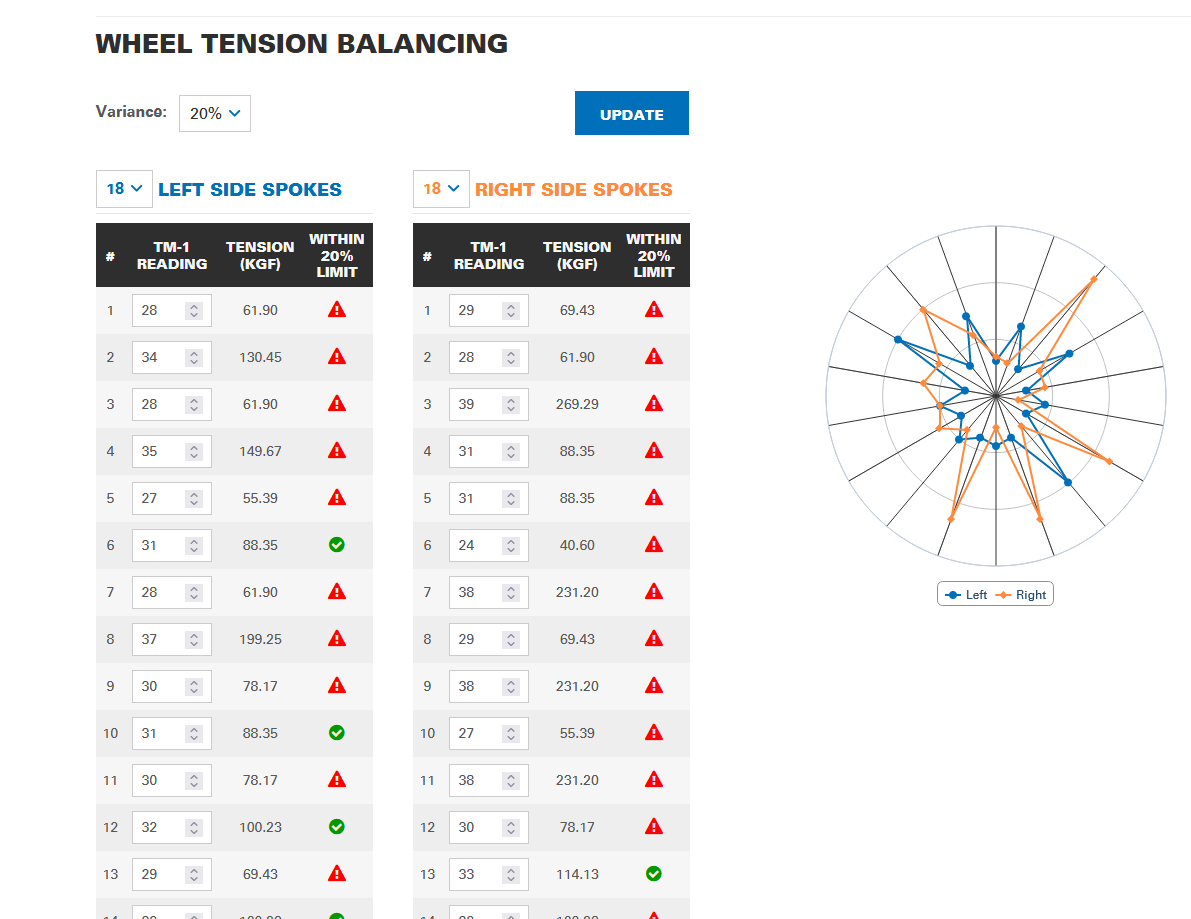
Hello Reddit! Recently I broke a spoke on my rear wheel (ebike hub motor with atypical spokes). Unfortunately none of the local bike shops can help so I have to do the repair on my own. I ordered replacement spokes, popped the new one in, and the first tension measurement looks like this. I only had to touch a couple spokes to get in the new one, so it seems like this problem/pattern was here beforehand.
It looks like the tension was alternated spoke-to-spoke on both sides, almost as if it was deliberate. I know the correct tension level and balance will depend on a ton of different factors, so mainly I am curious if this alternating tension pattern is intentional or if it should always be even on either side.
I’m thinking maybe this was done to account for high hub motor torque but I can’t find any sources that say you should do that for hub motors. Everything I read says to try to get them even within 20%. So has anyone seen this before? Any recommendations?
chattycat1000 on
Typically When there is a high spoke tension on a few spokes and loose ones next to it and kinda straight in the truing stand. The rim itself is bent.
nsfbr11 on
That is frighteningly bad. You have spikes over 200kgf! And those lowest ON THAT SIDE is <25% of that.
I’m not sure I’d even redo that, but if you want to try, start over and gradually retention them all.
Antti5 on
That’s extremely bad. The ones which are just 50 kilos are at a risk of losing their tension, or maybe they have already.
On the other hand, 200+ kilos is really super fucking high, and there’s a very high probability of breaking the rim. I’ve run into some rims that have a manufacturer recommendation of 150 kilos tension, but most are more like 100 kilos.
The easy way to correct a wheel like this is to balance the tension between adjacent spokes on the same side of the wheel. You want to loosen the spoke that is too tight, and tighten a loose spoke next to it.
As an example, you can loosen spoke #3 on the right side (because it’s too tight) and tighten spoke #2 next to it (because it’s too loose). If you adjust both spokes the same amount, like 1/4 turn or even 1/2 turn, the overall tension does not change and the wheel should not go badly out of true, if at all.
You could do the above until the tensions are reasonably uniform (within +-20 %), and only then check the trueness. This is how you do NOT end with a wheel like you have now. Whoever built your wheel paid absolutely no attention to tension, only focusing on the trueness. With a beefy, stiff rim it’s possible to get the tensions all over the place in a wheel that is superficially fine.

4 Comments
Hello Reddit! Recently I broke a spoke on my rear wheel (ebike hub motor with atypical spokes). Unfortunately none of the local bike shops can help so I have to do the repair on my own. I ordered replacement spokes, popped the new one in, and the first tension measurement looks like this. I only had to touch a couple spokes to get in the new one, so it seems like this problem/pattern was here beforehand.
It looks like the tension was alternated spoke-to-spoke on both sides, almost as if it was deliberate. I know the correct tension level and balance will depend on a ton of different factors, so mainly I am curious if this alternating tension pattern is intentional or if it should always be even on either side.
I’m thinking maybe this was done to account for high hub motor torque but I can’t find any sources that say you should do that for hub motors. Everything I read says to try to get them even within 20%. So has anyone seen this before? Any recommendations?
Typically When there is a high spoke tension on a few spokes and loose ones next to it and kinda straight in the truing stand. The rim itself is bent.
That is frighteningly bad. You have spikes over 200kgf! And those lowest ON THAT SIDE is <25% of that.
I’m not sure I’d even redo that, but if you want to try, start over and gradually retention them all.
That’s extremely bad. The ones which are just 50 kilos are at a risk of losing their tension, or maybe they have already.
On the other hand, 200+ kilos is really super fucking high, and there’s a very high probability of breaking the rim. I’ve run into some rims that have a manufacturer recommendation of 150 kilos tension, but most are more like 100 kilos.
The easy way to correct a wheel like this is to balance the tension between adjacent spokes on the same side of the wheel. You want to loosen the spoke that is too tight, and tighten a loose spoke next to it.
As an example, you can loosen spoke #3 on the right side (because it’s too tight) and tighten spoke #2 next to it (because it’s too loose). If you adjust both spokes the same amount, like 1/4 turn or even 1/2 turn, the overall tension does not change and the wheel should not go badly out of true, if at all.
You could do the above until the tensions are reasonably uniform (within +-20 %), and only then check the trueness. This is how you do NOT end with a wheel like you have now. Whoever built your wheel paid absolutely no attention to tension, only focusing on the trueness. With a beefy, stiff rim it’s possible to get the tensions all over the place in a wheel that is superficially fine.