
Hey all,
5 months after the first protected bike lanes went in, we already have a councilor proposing to halt all new bike infrastructure planning and seeing what ripping them out would cost. Most of the arguments are the usual “this is killing downtown” or “this is a woke agenda” nonsense, but some disability advocates have also raised concerns that the cycling community wants to take seriously.
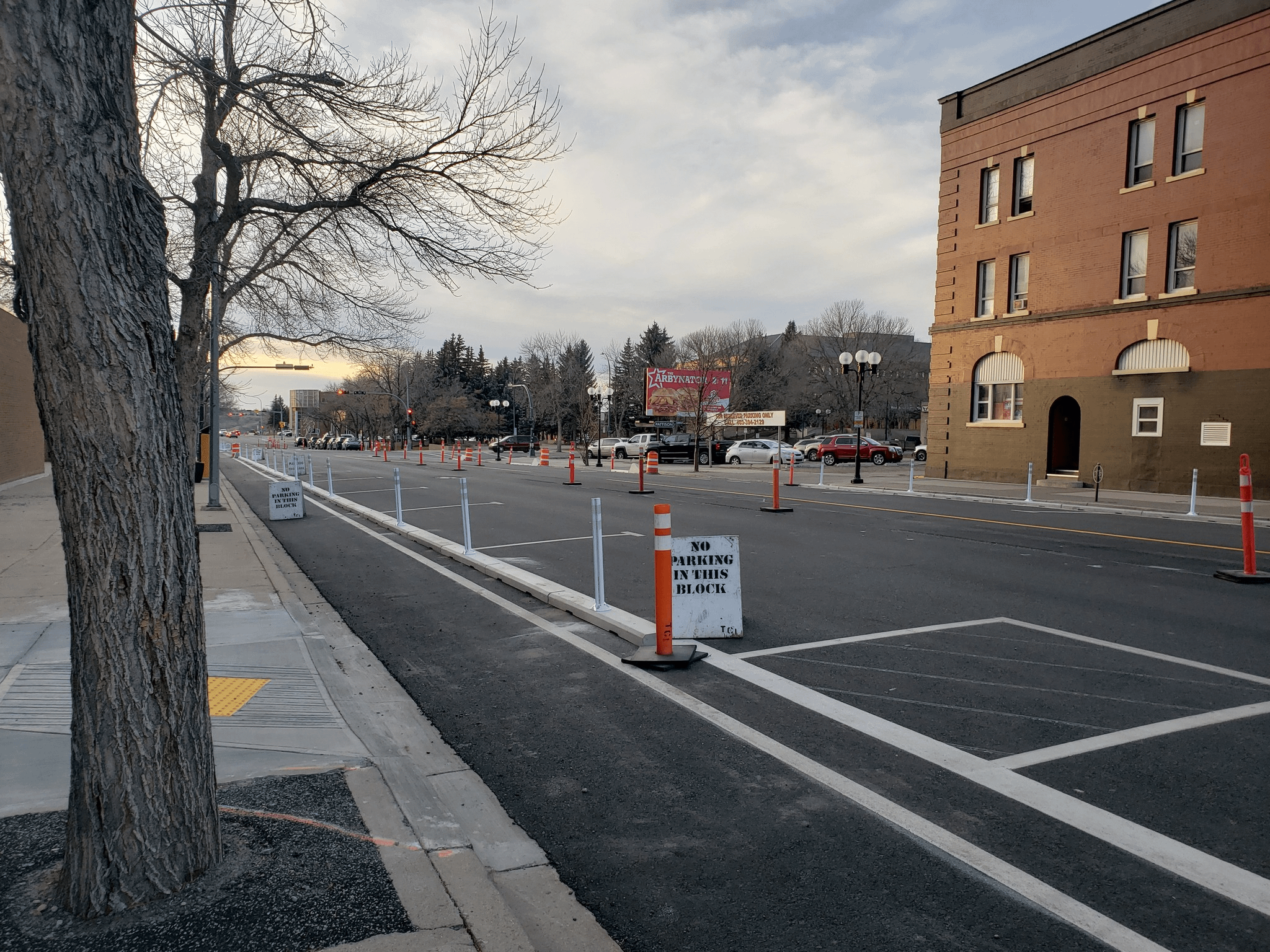
The bike lane currently looks like this – the no-parking sign was due to construction, but generally there is parallel parking between the white lines.
[https://i.imgur.com/CwVHyy9.png](https://i.imgur.com/CwVHyy9.png)
The issue is that we get snow for a few months and the concrete curbs tend to build up snow and ice – so for anyone who has mobility issues but not to the degree that they can get an accessible parking permit, there are now 2 icy curbs to navigate instead of one.
Has anyone encountered this issue and come up with a good solution? A few ideas I’ve seen so far.
1. Better snow clearing – there aren’t many bike lanes, we should be able to do a more thorough job. Good work around, but not very scalable.
2. Remove the concrete dividers and use bollards only – with the right spacing this should strongly discourage cars, but remove the second curb.
3. Elevate the whole thing to sidewalk level.
These are all reasonable options, but I’d love to hear from other cities that have encountered and solved this problem. Even better would be cheap ways to retrofit the existing lanes.
by KeilanS
5 Comments
3 is best but would cost a billion dollars. 2 is rough because without the curbing, drivers will park half into the bike lane. 1 is great, but would take buying specific narrow snow equipment and the labor to do it.
Here in Cambridge, MA where we have those type of concrete dividers on some streets, but they aren’t flush with each other like in your photo; there is a space between adjacent ones, big enough for a wheel chair to get through, but small enough to keep cars out. You can see what I mean in the photo on top of this page: https://www.cambridgema.gov/streetsandtransportation/projectsandprograms/brattlestreetsafetyimprovementproject.
As a bonus, this decreases the number of concrete blocks needed and lowers costs. Although this stuff is pretty cheap to begin with.
There are many lanes that just use plastic flex posts though; these can work ok.
For clearing the bicycle lane itself, Cambridge has bicycle lane sized snow clearing equipment, as well as bicycle lane street sweepers.
You need to win over the disability advocates. Biking infrastructure can absolutely benefit disabled people who do not bike (although plenty of them do bike!). The parking needs to be designed to be accessible parking. I would also talk about shortening crossing distance by improving the design at intersections. A person using a walker for example benefits enormously by being able to cross a bike lane (less busy, better visibility, etc), wait in a curb extension (for example, in the same lane as parking but that has been blocked off with concrete or planters) rather than having to try to look around a bunch of cars parked at the curb and cross more lanes of traffic (which is probably what your old design was).
3 is your best bet (of your solutions) but the most expensive and unlikely with those kind of politicians.
1 – slow clearing is absolutely doable. One of the challenges, however, is that your bike lane is very narrow, so you would need specialized equipment to clear it. A *better* design if you can’t get special equipment is actually a wider bike lane (like 8′) that a truck with a plow can get through. If they don’t want this on both sides, they could instead have a two way cycle track – which allows the benefits of making the road smaller (safer for everyone), cycling access (just do intersections well), disabled user benefits (snow plowing, shortened crossing distance), etc.
I would potentially suggest angled parking, as this lets some folks feel more comfortable loading/unloading from the car.
EDIT: consider using Streetmix to create a design. Be sure to focus on WHY bike lanes benefit everyone – and if there are schools etc nearby, gotta bring up kids too.
Firstly, my apologies, I cannot seem to open the link to the photo you posted, there is a 404 error for me.
As a disabled person myself, I would ask who the ‘disability advocates’ are; are they disabled people such as myself, or are they car people saying ‘but what about disabled people with cars?’, which is a thing that is happening a lot lately – and often a lot of these folks haven’t even tried to speak to anyone with a disability.
I ask this, because a lot of car folks are using those of us with mobility difficulties as an excuse as to why they think bike lanes are bad, whereas a lot of us in the disabled community actually benefit from bike lanes and adapted public transport, as many of us cannot drive cars, so instead use bikes, trikes, and mobility devices – and separated bike lanes benefit us hugely, as we can use those mobility devices safely on separated bike lanes instead of the sidewalk (dangerous for us, folks with strollers, and regular pedestrians), or on the road (dangerous for us, and pretty frightening).
But, I am in a snowy city, and I have to say; although our snow clearance is pretty good on roads (and the separated bike paths!) I often cannot walk on the sidewalks, because of the snowbanks across the path *from private snowclearing* of people’s driveways. That impacts my day so much more than the snow clearing done by the city. I cannot climb the snow banks, so often it is still easier for my to get around slowly by bike than it is by walking.
What your city needs to do is speak to *actually* disabled people of different abilities and mobility, and see what they *need*, rather than ask ‘advocates’ to give an opinion. If they have, hats off to them; if they haven’t, well, there is your problem.
So TL;DR – better snowclearing will help. It always helps. Removing safe passageways often does not help.
There’s a bunch of snow clearing options. Here’s an article that’s now couple years old.
https://usa.streetsblog.org/2016/02/11/how-to-clear-snow-from-protected-bike-lanes-a-starter-guide