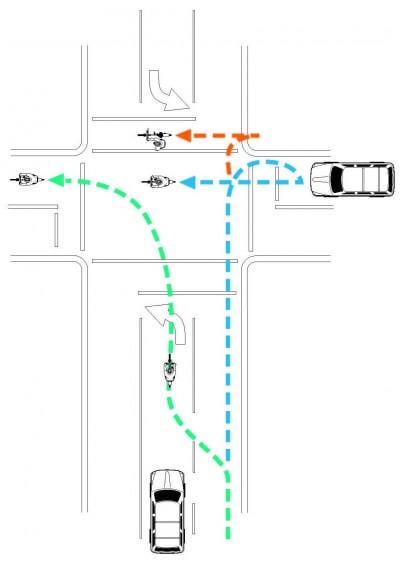
I find it super awkward to make that 180 degree spin needed in order to follow that blue path.
CokeCanNinja on
Are there any upsides?
Express-Welder9003 on
I do this on occasion. You have to wait for the light to change instead of being able to turn on your light and it also depends on what the traffic is like in the lane you are turning into as a car generally won’t appreciate you popping yourself in front of them while they’re waiting at the light. Given the choice I’d rather do the illegal move of cross the near side of the intersection as a pedestrian (going left in the diagram) and then cross again as a pedestrian (going up as a pedestrian) and turning onto the road from the crosswalk. That way when I end up in the lane I want to turn into I’m not worrying about merging into a lane full of cars.
CranberrySoftServe on
Yes. I have to wait for an extra light change (which can be 5 minutes at some of the lights in my area) vs just using the turn lane on a green light.
jeffbell on
Bikes that are waiting at the turning point.
LatexPringleCan on
If I did this where I grew up I would probably get shot at for “cuttin in line n gettin in the way” of someone’s lifted silverado😭
oldstalenegative on
I use it pretty often, whatever is safest
Large_Excitement69 on
I do green if there is a turn arrow or now cars, blue if it doesn’t seem safe to do green (usually do the 270 degree turn and wait for my green). Never do orange.
rhapsodyindrew on
It’s often slower.
I often see the blue path referred to as a “box turn,” BTW.
Trandoshan-Tickler on
Depending on the traffic situation, green is there’s little to no traffic, orange if traffic is heavy.
EnergyEast6844 on
It is useful. It is a good way to get less confident cyclists through the intersection.
adamaphar on
Only the inconvenience. I do it when there’s a lot of traffic or (more commonly) I forgot my turn was coming up so didn’t get into the turn lane.
Which_Leopard_8364 on
I generally only use it where there are bike lanes especially protected.
oldcactusjoe on
I’ll use a combination of the blue and orange paths as highlighted on your diagram. Just depends on traffic
audiomagnate on
I do that sometimes (the blue path).
thedirte- on
Do what you feel is safest in the U.S.
DOTs don’t care about your safety and neither do drivers.
Personally, if there are sidewalks. I would make my way to the left side mid-block if a clear opportunity presented itself. Obviously riding much slower and cautiously if I’m on the sidewalk.
Wuz314159 on
Correct me if I’m wrong, but downtown Melbourne is like this even for cars.
Gr0ggy1 on
Without a marked “bike box” and a car waiting I would use the turn lane and wait for the light here.
Location and customs will strongly influence what the better path is!
I used the right on red – u turn – right on red daily on my old commute, but that was with very light traffic in the early hours. Never doing a u turn in front of cars around here (Central NYS), the drivers do not expect it and being unpredictable and trusting is just about the most dangerous thing one can do.
rolsskk on
America and it’s love for rights on red.
baatar2018 on
Time.
Monomatosis on
Yes it is totally idiotie and dangerous. Nobody in the Netherlands will accept this combination of being slow, making silly moves, waiting for an extra traffic light and having a worse route than cars. Besides, where I live there is not enough space to do this with 10 bikes atthe same time. Also I didn’t see anybody do it like this in Copenhagen, altough the Danes stem to like waiting for red lights.
36482971i on
Do people actually follow the blue line in the drawing? In Copenhagen we turn a sharp 90 degree to the left, instead of doing 270 the other way around.
Pittsburgh_Photos on
It depends on the road and traffic conditions. On busy more than 2-lane roads I will do this.
Caloso89 on
Time
kookylemur on
I Do this when I’m down down at night!!!! Feels safer 🙂
Brave_Jacket_1700 on
only Fabio Wibmer can do this maneuver in a non awkward maner
james_Tucson on
I frequently use that technique. Especially, when I’m at a giant intersection with lots of traffic.
uhsiv on
I do green. There are intersections in Chicago trying to force me to do blue so I avoid those protected bike lanes in favor of painted ones. Paint doesn’t protect me, but also doesn’t constrain me either.
Comfortable-Fly5797 on
I do this when there is a bike box (which is typically the case for protected bike lanes here). I’ll use the crosswalk (red line) if there is no bike box but I’m not sure I’ll be able to safely turn from the left turn lane, such as heavy traffic or no bike sensor in the left turn lane. If I use the crosswalk I am extremely careful and watch for turning cars.
WentzWorldWords on
Depends on the intersection, traffic, the color of the light, etc. I usually just go left when I can, when I can’t, I corner it; which I just learned is called a Copenhagen left. Thanks internet!
BD59 on
Yes, simply because it’s not a normal way of negotiating a left turn in the USA. I’m an advocate of behaving like a vehicle, which means crossing over to the left turn lane before reaching the intersection, and making my turn from there. That’s the green path.
Negotiating the turn by becoming a pedestrian temporarily is accepted too. That’s the red/orange path. You do need to dismount and walk your bike across in the crosswalk.
Big-Presentation832 on
Theres one place on my commute where I feel unsafe waiting to turn left. The left lane is a straight/left turn lane and the right lane is right turn only. I don’t want a car to clip me trying to get past me to go straight when I’m turning left, so I turn right instead. I continue to the back of the line of cars instead of turning in front of them though.
DJ0Cherry on
I wouldn’t consider blue. Green is a daily occurrence for me. I usually filter to the front or take the turn lane.
french-snail on
I make this determination base on the light at the time I roll up. If it’s green going straight and left turn is waiting, I cross and wait at the other light. If both are red, I wait in the left turn lane.
CommunicationTop5231 on
If it’s a road in which there’s heavy traffic alongside me that I can’t keep up with, yes. But I’m in NYC, I can almost always keep up with traffic and hold the lane without holding anybody up. So green it is, 99% of the time.
I will also do this if I’m riding with someone who isn’t confident. The trick is to make sure they know the move *before* they get on the bike, so that I can signal it without having to explain myself in the heat of the moment. Oh, and I don’t do the curlicue, that seems like a recipe for disaster.

36 Comments
I find it super awkward to make that 180 degree spin needed in order to follow that blue path.
Are there any upsides?
I do this on occasion. You have to wait for the light to change instead of being able to turn on your light and it also depends on what the traffic is like in the lane you are turning into as a car generally won’t appreciate you popping yourself in front of them while they’re waiting at the light. Given the choice I’d rather do the illegal move of cross the near side of the intersection as a pedestrian (going left in the diagram) and then cross again as a pedestrian (going up as a pedestrian) and turning onto the road from the crosswalk. That way when I end up in the lane I want to turn into I’m not worrying about merging into a lane full of cars.
Yes. I have to wait for an extra light change (which can be 5 minutes at some of the lights in my area) vs just using the turn lane on a green light.
Bikes that are waiting at the turning point.
If I did this where I grew up I would probably get shot at for “cuttin in line n gettin in the way” of someone’s lifted silverado😭
I use it pretty often, whatever is safest
I do green if there is a turn arrow or now cars, blue if it doesn’t seem safe to do green (usually do the 270 degree turn and wait for my green). Never do orange.
It’s often slower.
I often see the blue path referred to as a “box turn,” BTW.
Depending on the traffic situation, green is there’s little to no traffic, orange if traffic is heavy.
It is useful. It is a good way to get less confident cyclists through the intersection.
Only the inconvenience. I do it when there’s a lot of traffic or (more commonly) I forgot my turn was coming up so didn’t get into the turn lane.
I generally only use it where there are bike lanes especially protected.
I’ll use a combination of the blue and orange paths as highlighted on your diagram. Just depends on traffic
I do that sometimes (the blue path).
Do what you feel is safest in the U.S.
DOTs don’t care about your safety and neither do drivers.
Personally, if there are sidewalks. I would make my way to the left side mid-block if a clear opportunity presented itself. Obviously riding much slower and cautiously if I’m on the sidewalk.
Correct me if I’m wrong, but downtown Melbourne is like this even for cars.
Without a marked “bike box” and a car waiting I would use the turn lane and wait for the light here.
Location and customs will strongly influence what the better path is!
I used the right on red – u turn – right on red daily on my old commute, but that was with very light traffic in the early hours. Never doing a u turn in front of cars around here (Central NYS), the drivers do not expect it and being unpredictable and trusting is just about the most dangerous thing one can do.
America and it’s love for rights on red.
Time.
Yes it is totally idiotie and dangerous. Nobody in the Netherlands will accept this combination of being slow, making silly moves, waiting for an extra traffic light and having a worse route than cars. Besides, where I live there is not enough space to do this with 10 bikes atthe same time. Also I didn’t see anybody do it like this in Copenhagen, altough the Danes stem to like waiting for red lights.
Do people actually follow the blue line in the drawing? In Copenhagen we turn a sharp 90 degree to the left, instead of doing 270 the other way around.
It depends on the road and traffic conditions. On busy more than 2-lane roads I will do this.
Time
I Do this when I’m down down at night!!!! Feels safer 🙂
only Fabio Wibmer can do this maneuver in a non awkward maner
I frequently use that technique. Especially, when I’m at a giant intersection with lots of traffic.
I do green. There are intersections in Chicago trying to force me to do blue so I avoid those protected bike lanes in favor of painted ones. Paint doesn’t protect me, but also doesn’t constrain me either.
I do this when there is a bike box (which is typically the case for protected bike lanes here). I’ll use the crosswalk (red line) if there is no bike box but I’m not sure I’ll be able to safely turn from the left turn lane, such as heavy traffic or no bike sensor in the left turn lane. If I use the crosswalk I am extremely careful and watch for turning cars.
Depends on the intersection, traffic, the color of the light, etc. I usually just go left when I can, when I can’t, I corner it; which I just learned is called a Copenhagen left. Thanks internet!
Yes, simply because it’s not a normal way of negotiating a left turn in the USA. I’m an advocate of behaving like a vehicle, which means crossing over to the left turn lane before reaching the intersection, and making my turn from there. That’s the green path.
Negotiating the turn by becoming a pedestrian temporarily is accepted too. That’s the red/orange path. You do need to dismount and walk your bike across in the crosswalk.
Theres one place on my commute where I feel unsafe waiting to turn left. The left lane is a straight/left turn lane and the right lane is right turn only. I don’t want a car to clip me trying to get past me to go straight when I’m turning left, so I turn right instead. I continue to the back of the line of cars instead of turning in front of them though.
I wouldn’t consider blue. Green is a daily occurrence for me. I usually filter to the front or take the turn lane.
I make this determination base on the light at the time I roll up. If it’s green going straight and left turn is waiting, I cross and wait at the other light. If both are red, I wait in the left turn lane.
If it’s a road in which there’s heavy traffic alongside me that I can’t keep up with, yes. But I’m in NYC, I can almost always keep up with traffic and hold the lane without holding anybody up. So green it is, 99% of the time.
I will also do this if I’m riding with someone who isn’t confident. The trick is to make sure they know the move *before* they get on the bike, so that I can signal it without having to explain myself in the heat of the moment. Oh, and I don’t do the curlicue, that seems like a recipe for disaster.
two chances to get a right hook.