If the center one can “rock”, that means it will constantly be at one side or the other, as it is constantly under “pressure” so to speak – and wear accordingly both in the bushing area and the teeth going in and out the chain links.
Not sure that is the win the manufacturer thinks it is.
CargoPile1314 on
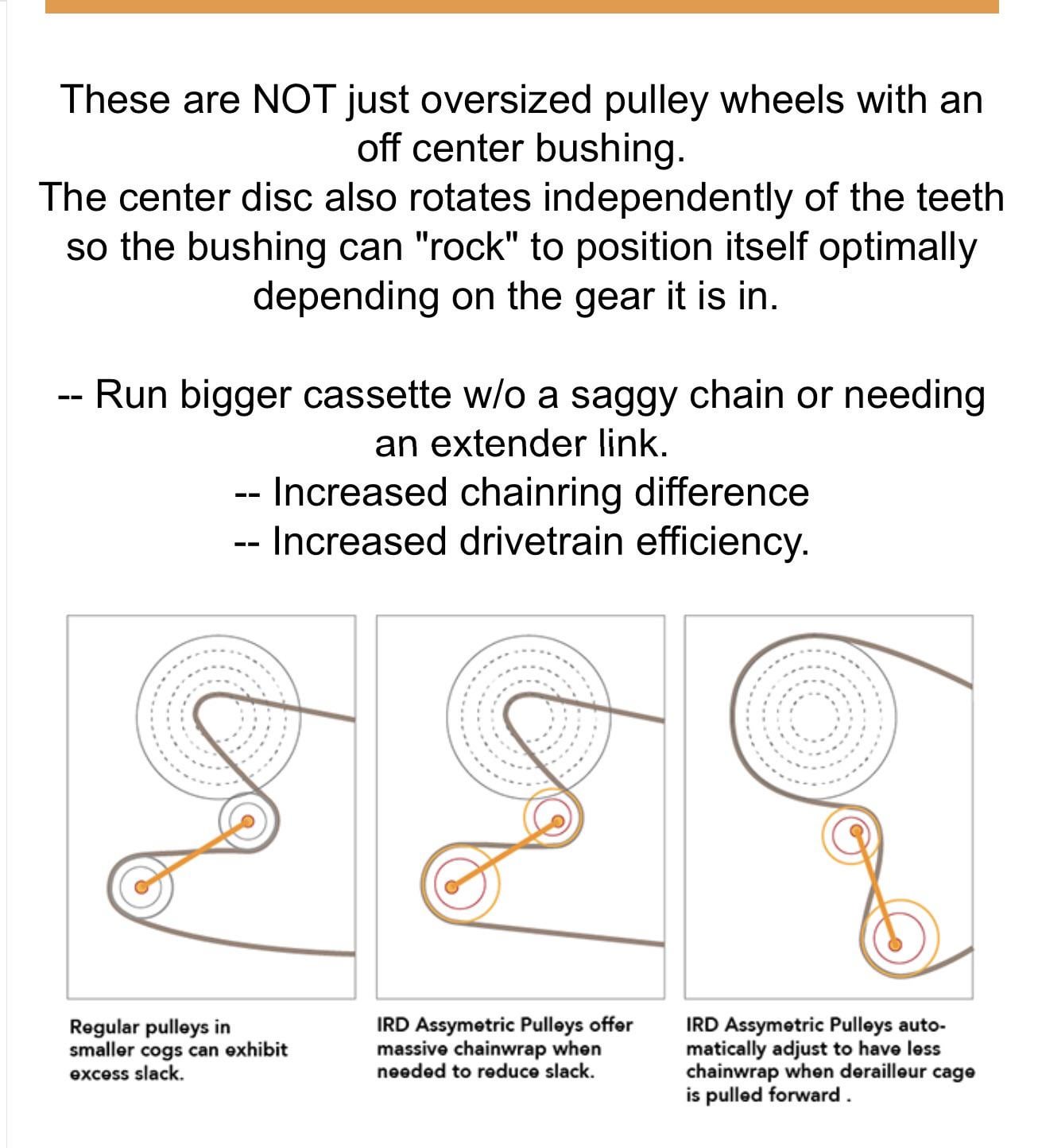
In the middle illustration, where it touts massive chainwrap capacity and the chain is on the smallest cog, both pullies are oriented at the lower wrap positions. Then, in the rightmost illustration, where it touts automatic adjustment, it looks like the pulley centers are rotated exactly as much as the virtual cage rotated. Unless there is some sort of wound-up spring mechanism, it’s not going to automatically adjust anything.
I know IRD as Interloc Racing Design. There is no Interloc Racing Design derailleur pulley. Is your IRD from AliExpress?
rvralph803 on
Mechanically it makes sense.
Dunno what else to say though, but the use case for most touring probably isn’t there. Unless you’re constantly on washboard, big gravel, or highly rutted roads, it’s not likely to make much of a difference.
This is downhill MTB marginal gains territory in my opinion.
commeatus on
Explaining the principle: this would not change the chain wrap, tooth capacity, or any other Rd spec. What it does is allow a larger radius bend in the chain for a given chain length.
Let’s say your drivetrain maxes your chain wrap with 13 tooth pulleys, but you want that sweet, sweet 26 tooth friction reduction: this product would allow you to do that without making your chain so long that it sags in little-little. It’s a product hub an incredibly niche purpose that I don’t think anyone should buy but there might be someone out there who wants to drop 1/8 watts when crosschaining so more power to them I suppose.
Curun on
Yea thats how modern jocket wheels are on shimano and many kits, 11/14t stagger. Larger on bottom
Diederiksft on
What is the idea, reduced friction or 10-50 cassettes with 2x in front?

7 Comments
Discuss what?
If the center one can “rock”, that means it will constantly be at one side or the other, as it is constantly under “pressure” so to speak – and wear accordingly both in the bushing area and the teeth going in and out the chain links.
Not sure that is the win the manufacturer thinks it is.
In the middle illustration, where it touts massive chainwrap capacity and the chain is on the smallest cog, both pullies are oriented at the lower wrap positions. Then, in the rightmost illustration, where it touts automatic adjustment, it looks like the pulley centers are rotated exactly as much as the virtual cage rotated. Unless there is some sort of wound-up spring mechanism, it’s not going to automatically adjust anything.
I know IRD as Interloc Racing Design. There is no Interloc Racing Design derailleur pulley. Is your IRD from AliExpress?
Mechanically it makes sense.
Dunno what else to say though, but the use case for most touring probably isn’t there. Unless you’re constantly on washboard, big gravel, or highly rutted roads, it’s not likely to make much of a difference.
This is downhill MTB marginal gains territory in my opinion.
Explaining the principle: this would not change the chain wrap, tooth capacity, or any other Rd spec. What it does is allow a larger radius bend in the chain for a given chain length.
Let’s say your drivetrain maxes your chain wrap with 13 tooth pulleys, but you want that sweet, sweet 26 tooth friction reduction: this product would allow you to do that without making your chain so long that it sags in little-little. It’s a product hub an incredibly niche purpose that I don’t think anyone should buy but there might be someone out there who wants to drop 1/8 watts when crosschaining so more power to them I suppose.
Yea thats how modern jocket wheels are on shimano and many kits, 11/14t stagger. Larger on bottom
What is the idea, reduced friction or 10-50 cassettes with 2x in front?