
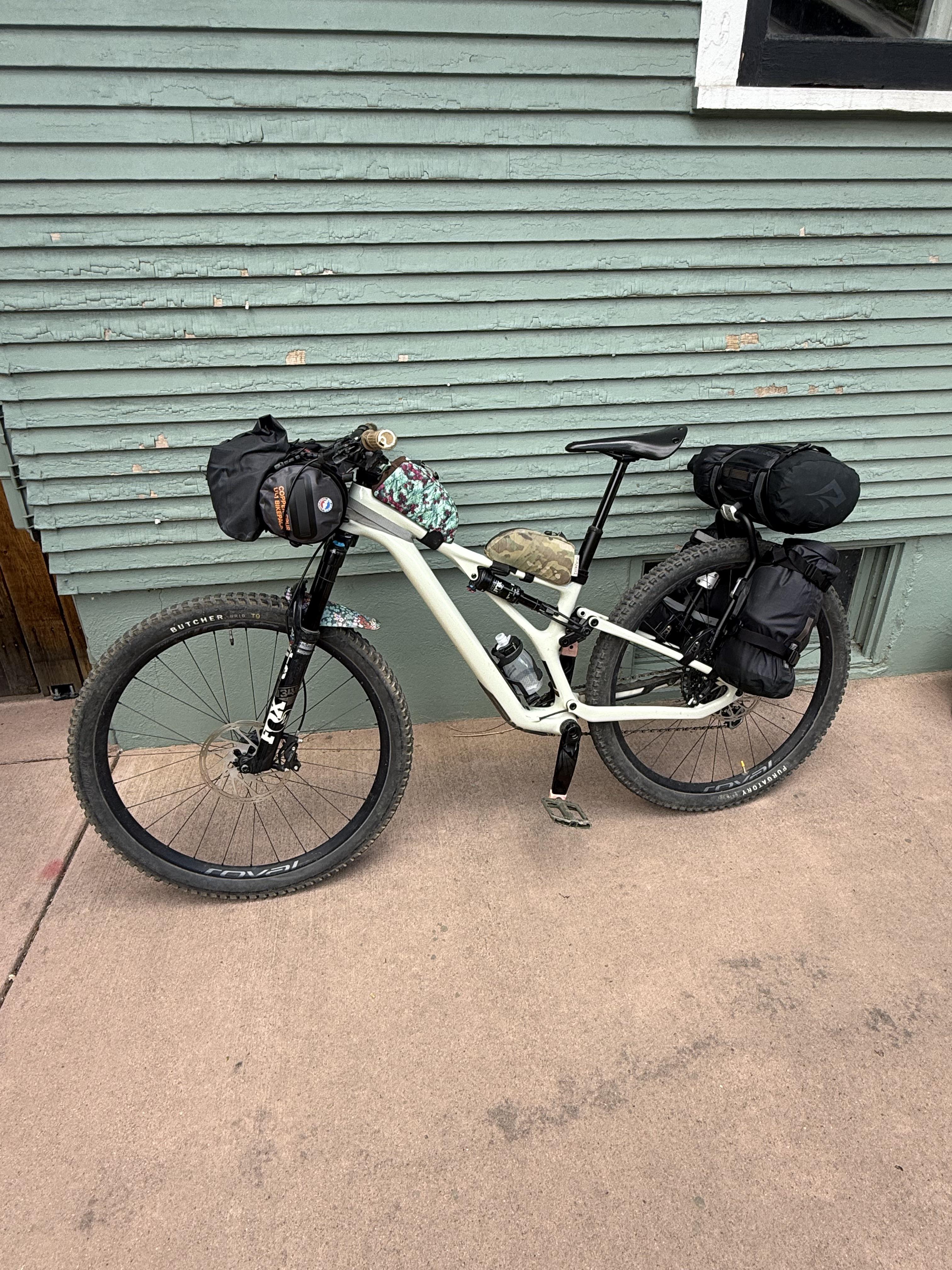
Handlebars: tent + egress pocket
Rear Aeroe Spider Rack: 13L bag with remaining sleep system, 8L bag with clothes/rain gear/FAK, 8L bag with kitchen/food.
Top tube bags: food and tools
Down tube holds tire levers, tube, and patch kit.
I’ll also wear a hip pack with water/food which I don’t normally do but seems important for this.
I’ve done a lot of bikepacking (Peru’s Divide, Great Divide, part of the CT, and other smaller trips) on a hard tail 29er. This summer I’m going to attempt the CT again on a full squish. Many components of this set up are new. I feel like I have too much stuff. But I’ve also been wet and cold and miserable and starving on trips so I try not to go too bare bones. I don’t know how those CT racers do it. But maybe I need to try to be tougher.
Thoughts on volume? Should I get some fork bags and reduce volume in the back slightly? I still need to check my rear bags to make sure I’m under 35 lbs per aeroe suggested limit…
Bike is a Stumpy Expert S2, so I’ll be using carbon tape etc before final mounting/shakedown.
I don’t really have friends that bikepack, at least not with anywhere near the amount of experience I have. So really seeking some seasoned pro thoughts!
by oomshalala
8 Comments
I don’t know about that rear rack anchor but I hope you have trust in it 🙂
What’s the bike weight and gear weight? I’m a little worried about that rear rack with no triangulated stabilizer type attachments.
Overall volume feels about right, that looks like 30ish liters of non food gear. Then another 10ish for food?
Distribution though…. looks a bit rough to me. That is like 30lbs of unsprung weight on the rear? I know people do trips on the Aeroe system, but that much weight setup like that sketches me out.
With what you have, I’d go for the fork bags, I personally use the OMM axle mount system and have found it to be pretty solid. That’ll move about 8-10L of volume forward on the bike (and maybe lower on the bike). Then reduce the size/number of bags on the Aeroe rack
—
This is just me, but I would also consider getting a seat bag or something for bike tools instead of the rear of top tube bag because it makes getting on and off the bike so much easier for me.
Another check I would make is to load up that front handlebar bag and see how the bike feels, I also ride a FS and with the slacker headtube angle, heavy handle bar bags that far out causes wheel flop instability issues for me.
Rear rack might give you problems
>I don’t know how those CT racers do it.
Bivy instead of a tent. Bivys can allow you to get away with a lighter bag. No stove/pots. Only cold food on the trail. Extra clothes? not likely. Extra socks, underwear, shift if you get wet. Use rain gear for insulation. If you wake up cold at 3am, then you start biking again; it’s a race after all.
Looks dope mate
I really don’t like the way that rack clamps to your frame, and how much force it’s going to put on the tubes. I know Aeroe thinks this is fine, but I don’t think Specialized would agree with this kind of frame loading. Plus all of that becomes unsprung weight, so it’s both going to work against your suspension and drive its weight into your frame without then cushion of suspension.
I’d be a lot more comfortable using a large seat bag instead, full sus bikes are where seat bags really make the most sense. You’ll let your suspension work and keep the weight loading on areas that are meant to be loaded.
You will be hiking and pushing this rig up steep, rocky trails, sometimes for hours a day. Panniers in the rear are tough when the inclines go above 20%, since you will be in a ‘superman’ position with your hands on the bars, and that puts the pannier right at your calf. For the CT, I ran a pannier on just one side so I could hike more easily on the other side. Also, any weight you can shed the better. You’ll need to lift your bike and all bags for some of the really rocky steps. The CT is a hiking trail first (with the exception of the bypasses) so the lightest, most comfortable rig optimized for hiking the better.