
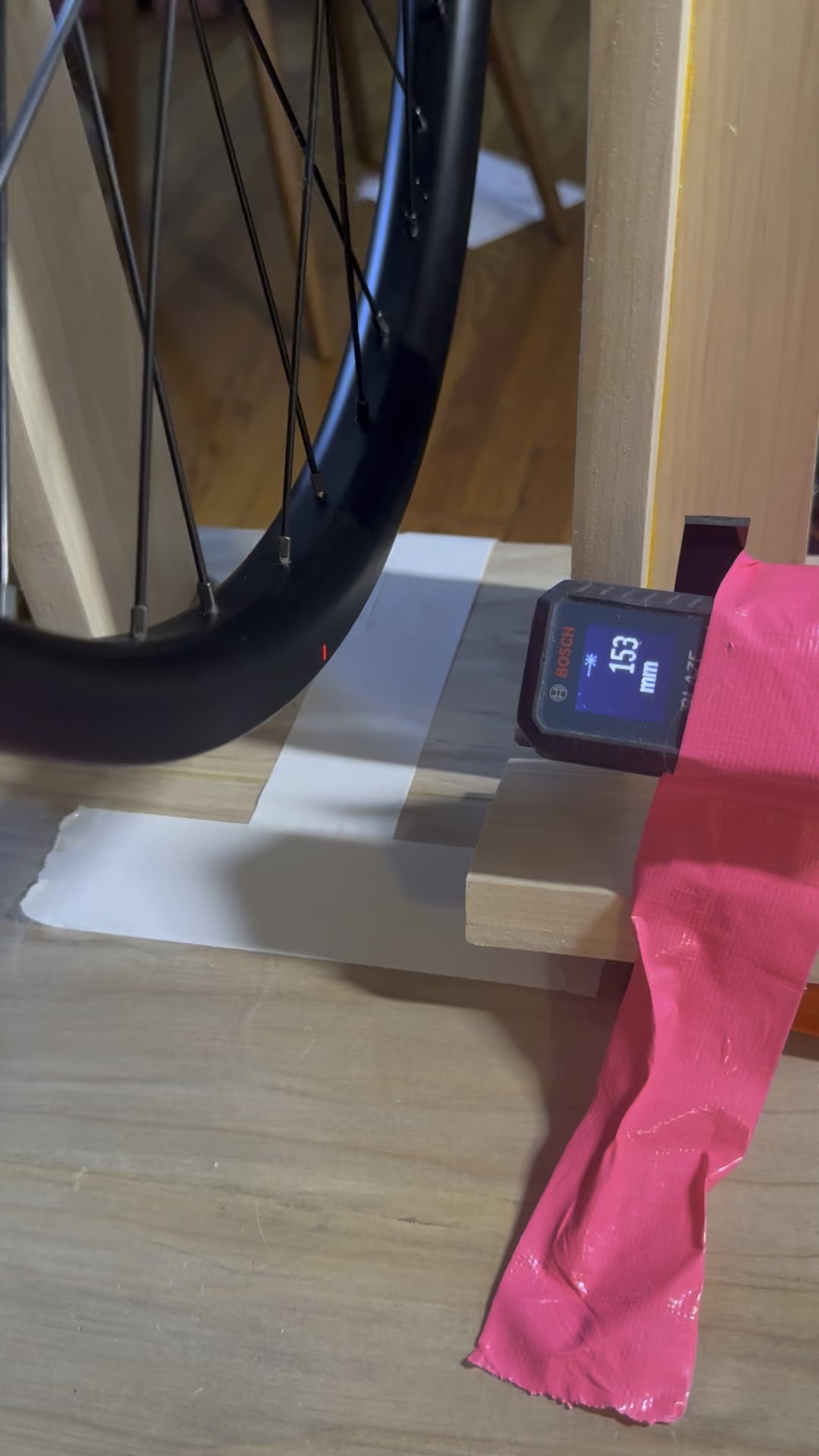
Built a Roger Musson truing stand and it’s been great. My first wheel build, and the ~1mm lateral deviation I was seeing was driving me nuts — I don’t fully trust my eyes yet, so I slapped a laser tape measure on it to verify.
Two questions:
1.  Is \~1mm lateral deviation acceptable for a first build? Its really annoying that I cant seem to perfect it.

2.  Is using a laser tape measure a reasonable way to check if you are a perfectionist?
Is this a valid way to measure lateral trueness?
byu/baverso inbikewrench
by baverso
8 Comments
1mm is a lot of deviation for a fresh wheel.
+- 1mm is perfectly adequate.
I’ll split the difference on the first two answers. Back in the 90’s I worked at Wheelsmith Fab (not Inc.), and the standard for production with rim brakes was 0.014-0.016 inches which translates to around .40mm so you are close.
My wheel guy uses 1000ths needle gauges
thank you all for your feedback. it’s my first wheel built and as you can imagine, I want to try to get things right. as a follow up question, I noticed that roughly 1/3 of the wheel is high laterally. And so it’s difficult to pinpoint any one offending spoke that is over tight or under tensioned relative to their neighbors.
in a situation where the high side of the rim laterally is such a large surface area how would you adjust the tension across so many spokes?
It looks like your measuring instrument has 1mm precision with no decimal point, that is too coarse for what you’re trying to measure — It’s not clear whether the runout is actually 1 mm or whether it’s just flipping the end digit because it’s going from 152.4 to 152.6 or something and it’s rounding to the nearest mm. You want something that can measure to tenths. I use a cheap machinist dial indicator with a ball bearing end.
I like to get within .02″ (.5 mm) runout for a rim brake wheel. Disc brake wheel you can have a bigger lateral runout.
I like my wheels trued to the nearest 0.1 mm. 1mm is way too much.
A zip tie on my fork works well, but it is really difficult to measure the dimensions of a room with.