
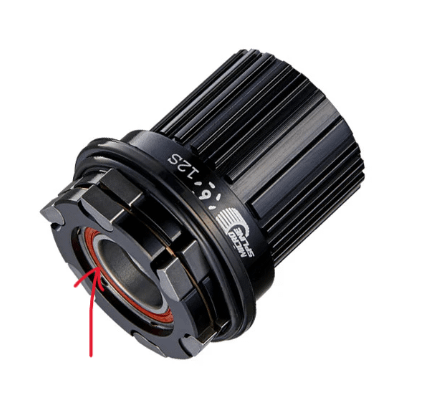
TLDR: Lower freehub body bearing exploded. Has it ever happened to you? How and why does it happen? How to prevent it?
(Pictured is not the exact freehub body I have but similar, FH-MT410-B microspline shimano hub)
I was riding my Orbea Wild when all of a sudden I hear the rear hub grinding when coasting.
When pedaling it was fine so I figured it weren't the pawls, but when coasting I could see the drivetrain moving forward, but I could coast fine because the ebike chainring is separate from the cranks, so the chainring was spinning without me pedaling.
When I got back home I removed the freehub body and saw a million little half-balls and some retainers, so I figured a bearing has exploded, but I never could've imagined it was the lower freehub body one. Completely GONE. The inner race was on the hub axle (and looks like it was seized, it was a bit hard to remove) and the outer race stayed on the freehub body, which I had to hammer to remove.
My question is, how and why do this happens? I luckily have the knowledge and tools to fix but I don't want it to happen again. Did it ever happen to anyone?
by Barde_
3 Comments
I’ve had bearings disintegrate. My video of replacement, a rant, and thinking out loud why it happened:
[https://www.bikegremlin.com/2701/shimano-fh-mt410-b-12-speed-microspline-freehub-overhaul-and-a-rant/](https://www.bikegremlin.com/2701/shimano-fh-mt410-b-12-speed-microspline-freehub-overhaul-and-a-rant/)
Relja
Most failures I see if from water (or degreaser/chain cleaner) ingress. Bearings without grease or that rust have a tendency to self-destruct. 1 in a million chance it was a bad or damaged bearing to start. IMO
Happens to loads of freehub bodies, I changed two last week in a Giant SLR 0 wheelset and some Zipp 303’s. A good mechanic will knock them out and press new ones in, a shit mechanic will tell you to buy a new freehub body.
Why does it happen? Small bearings, high load, somewhat exposed to the elements. Bearings are consumable.