
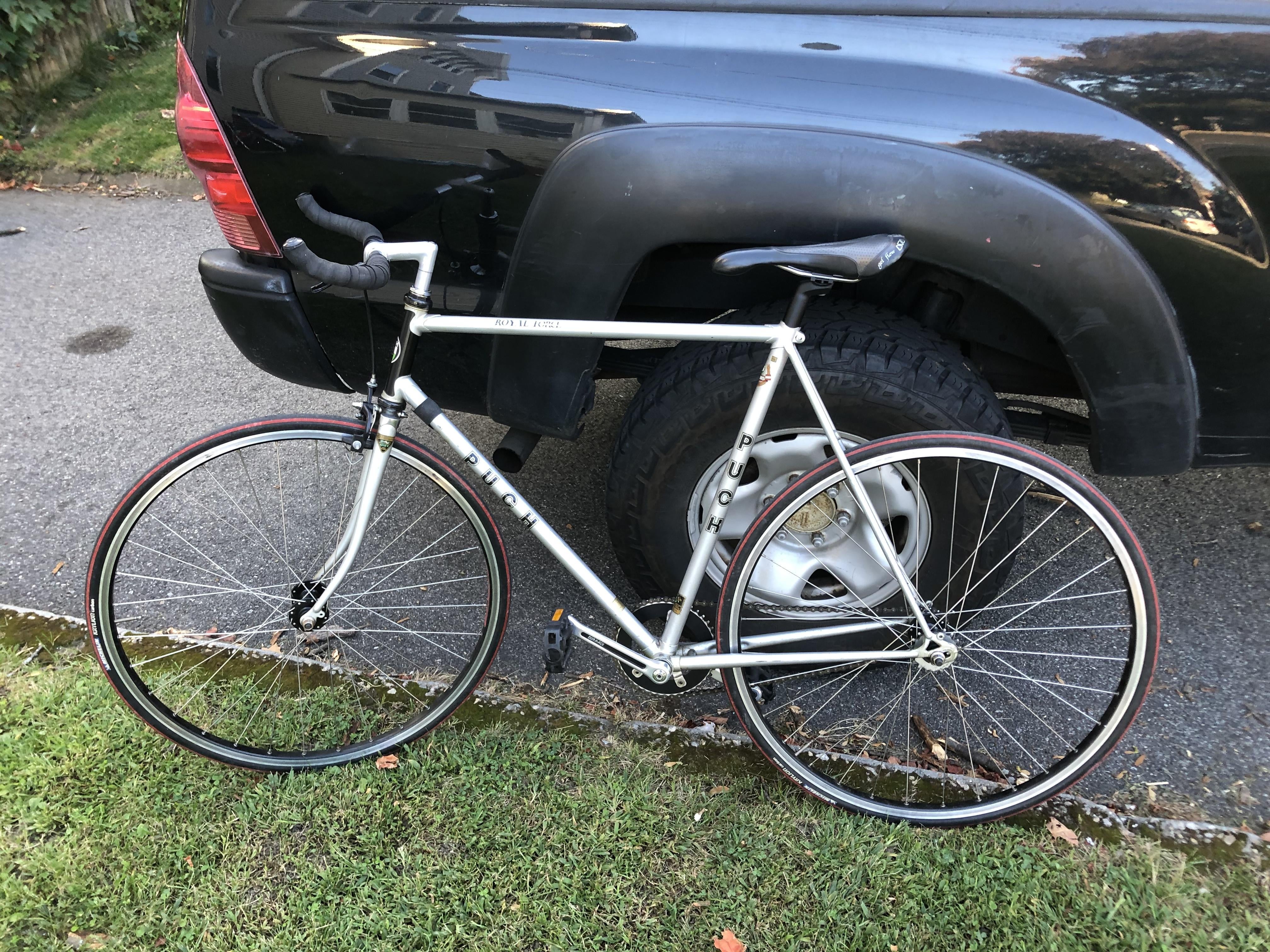
Okay I've been lurking for a while, I ride an old Puch converted to a single speed. It's incredible, I've lived in Boston and Philadelphia with it and one of the best things in my entire life is ripping it full speed through traffic in the heart of Philly.
Anyway. If I wanted to build an absolute rocket ship, what frames should I consider? a modern steel frame with horizontal drop outs, what would it be? Who is selling the lightest single speed steel frame on the market? Seems like it's probably Wabi with the lightning? What about something more boutique combined with a chain tensioner?
I attached a picture of my bike when it was much newer (to me), I ride with flat bars now and run 32mm gator skins
by Georgelino
6 Comments
Before you do anything else, first dial your position to be as aerodynamic as possible while being sustainable for the longest distance you ride. In total system aerodynamics, the rider is responsible for 80% of drag, so start with tuning your position. It’s also free, so the biggest gain also is lowest cost.
After that, swap the Gatorskins and butyl tubes for GP5000s with TPU tubes…or latex if you don’t mind inflating them before every ride. Latex are fastest but they don’t hold air. TPU are a bit slower but hold air as well as butyl tubes, so TPU is the Goldilocks option. Butyl tubes are reliable AF but are heavy and slow (high rolling resistance). Neither the tires nor the tubes have anything to do with aero, but the substantially reduce rolling resistance, so making that change is a solid way to go faster for moderate cost.
After these, focus on the bike’s aerodynamic efficiency. Wheels…especially the front…make the biggest difference. 50-60 mm carbon aero wheels with 18 front, 24 rear bladed spokes. Only after you have aero wheels should you consider an aerodynamically shaped frame, fork, and bars.
Bottom line, you can substantially improve your speed by tuning your position and swapping for a low resistance tire/tube setup. Chasing aero gains via the bike gets expensive, and should be lower priority. Then, if/when you focus on the bike, invest first in aero wheels. Only then should you look for an aero frameset/cockpit setup.
Wabi seem to make nice bikes. I’ve no personal experience with them, though. They’re definitely not aero, but again the frame isn’t the most important place to find speed.
FYI…I ride a 2010 Jamis Sputnik that comes in around 19 lbs. The frame absolutely isn’t aero, but I built 55mm aero wheels, swapped in a somewhat aero carbon fork, and swapped for 38 cm bars and turned the brake levers in to reduce my frontal area. Combined with GP5000 tubeless tires, this is a fast, reasonably light bike despite the frame being aero inefficient due to its traditional round tubes. But again, the frame is responsible for only a small percentage of total system drag.
Dunno, man. Looks like you’ve got a lot of room for improvement on that bike just with wheels, tires, and adding fairings (fenders) over the tops of the tires.
Campy, Suzue, Miche, or DA loose ball hubs, CXRay or AeroLite bladed spokes, and even just Archetype rims, definitely GP5K tires, and some skinny dimpled aluminum VO/Honjo fenders all would cut a lot of mechanical & aero drag on the bike itself.
Clipless pedals & shoes will straight turbocharge your 0-20’s & climbing.
Then you want to get yourself doing more tai chi & yoga to make use of the lower portion of a Maes Parallel handlebar to get your head & torso out from parachute position down into knife position.
To lose about 12oz from the Puch frameset but gain a lot of stiffness which you may only enjoy for a short honeymoon period, Wabi Lightning is what I’d try out. Easy off the rack wheelset is Campy Bora.
The only thing I’d consider for possibly maybe better than the Wabi would be a legitimate carbon track frameset from Look with a custom deep aero 650b wheel set to fit 32mm gp5k tires to make it less awful for pavement riding.
Realistically, after having had my fair share of stiff aluminum & carbon track & timetrial framesets and finding that I’m fastest on my 1968 LeJeune built as I described above, if I had another itch for a new frameset I’d just be getting a Nobilette copy of my Lejeune but with bosses brazed on the fork for Paul Racer brakes and a Velogical rim dynamo.
Steel is only going to get so light. I have an 83 or so Schwinn Prelude that is 17lbs stock. After changing the brake levers, brake calipers, and wheels, it might’ve gained a pound or lost a pound. It went from a 12 to a 14 speed, got aero levers, Origin8 calipers, ditched the 27 inch Weimans with 700c alloy 20mm or so wheels.
My 83 Nishiki was converted to a single speed. Deep vee alloy wheels, a Sora and an Ultegra caliper, bull bars and a shorter stem. Currently has a steel nds crank arm, sealed bb, and bmx pedals. It’s lighter than the Prelude. It’s not lighter than my 2014 or so Next LaJolla converted to single speed, which is aluminum—one of the best BSOs in my opinion.
And honestly alloy bikes aren’t much lighter. If you’re looking for a sub 15 pound steel bike, you’re not gonna find one. And honestly there’s a line between going too light and having some durability. You’d need quite a bit of carbon parts for a light steel bike. A steel frame alone is going to be about 5-10 pounds or so.
Modern steel frames are usually not good, they are cheaply made frames. The whole point of steel frames was to use old top of the line frames that were build using butted high quality tubing.
The old high end stuff is most likely always lighter than the modern stuff, the modern stuff is not built to be light.. its just build to be steel and “cool”.
Ugh I miss riding in Philly. Was there for 3 years carless my last never missed the car.
I wouldn’t even bother buying a newer bike in this case unless you are going to carbon. This was quite a high-end bicycle in its day, and believe it or not, a newer steel frame isn’t going to be significantly better than a well-built vintage frame. The main advancements in steel technology since then have been heat-treated tubing, and specific alloys that can experience the high temperatures of welding without becoming weaker.
From what I can find, using just the top tube as an example, your Puch’s Reynolds 531 Frame was double butted, going from 0.8mm in the butted section to 0.5mm in the center. The Columbus Spirit tubeset that the Wabi you mention uses, is 0.6mm in the thicker section and 0.4mm in the center. So yes, its thinner and theoretically lighter… However the Wabi, like most modern bikes ever since the Schwinn PDG bikes in the late 80’s, uses larger, oversized tubes to prioritize frame stiffness. The Puch’s top tube is just one inch in diameter, whereas the Wabi’s is roughly one and a quarter inches, so the Wabi actually uses a little more material (than you would expect based off it’s thinner tubes) due to the larger overall diameter. Now, if I wanted to maybe I could calculate all of that to definitely find which tube is actually lighter and by how much, but that’s a lot of complicated math.
The long story short: the weight difference between these is likely negligible. If you really want to go maximum weight-weenie, skip steel, aluminum, and titanium and go with a carbon frame with as much carbon components as possible. But if not, and this old frame fits and is comfortable, just keep it. Besides, it’s got character and lugs are classy. Spend your money on upgraded components.