
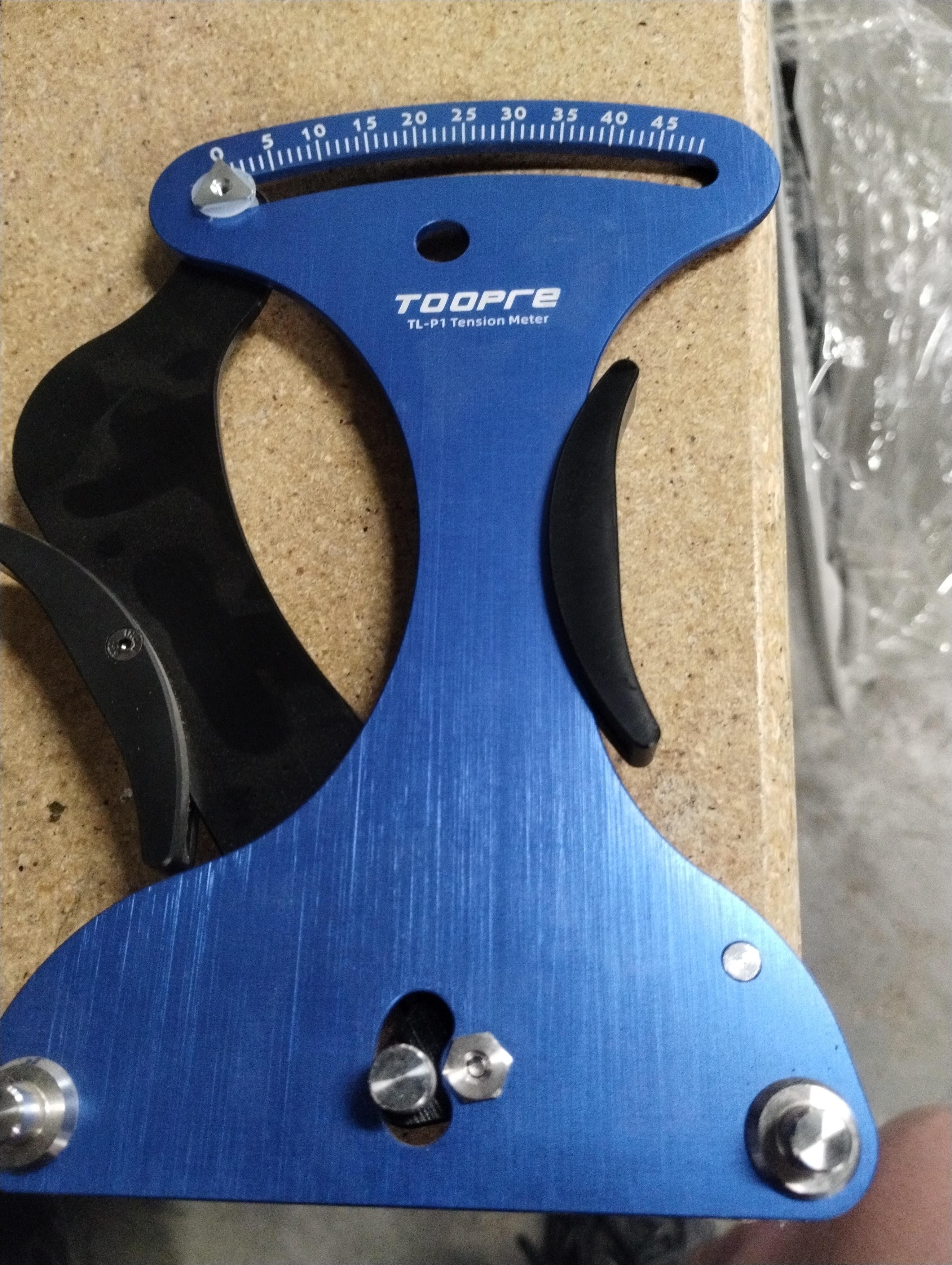
I've read that you can hang a spoke with a weight at the other end and adjust so the number matches. But what are the units? Kgs? Lbs? Newtons?
by JimboZona
I've read that you can hang a spoke with a weight at the other end and adjust so the number matches. But what are the units? Kgs? Lbs? Newtons?
by JimboZona
2 Comments
Je pense que ça peux aider
[Mesurer la tension des rayons](https://youtu.be/gKxaZRS-1hs?si=dgKkbaTQEdkBt9rm)
This kind of tensiometer does not give you a reading in any unit of force.
Imagine that you have a thick 2.0 mm spoke at 100 kg tension, or if you have a thin 1.5 mm spoke at the same 100 kg tension. You get two different readings because the thinner spoke will flex more under the same force. In other words, you always need a conversion table for different kind of spokes.
If it did not come with one when you bought it, then I would imagine it’s designed to give the same readings as the Park Tool TM-1: [https://www.parktool.com/assets/doc/product/TM-1_conv-table.pdf](https://www.parktool.com/assets/doc/product/TM-1_conv-table.pdf)