
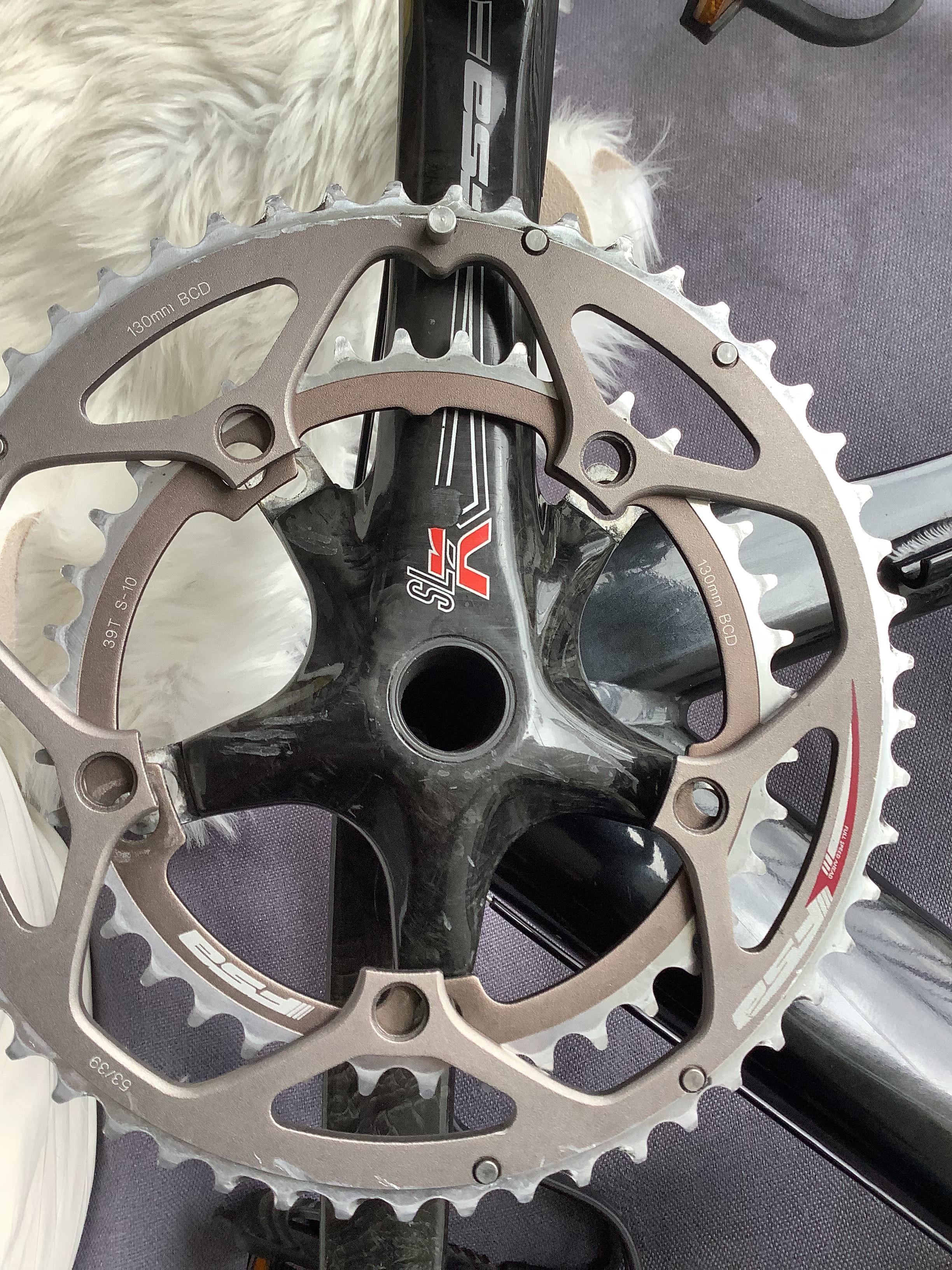
Unscrewed, cleaned, but now… there is a proper way to install these… I know it. But what is it? Is it that the chain ring nipples, both, go on der the crank, like shown? Is that it? Anyone know?
by Supadopemaxed
Unscrewed, cleaned, but now… there is a proper way to install these… I know it. But what is it? Is it that the chain ring nipples, both, go on der the crank, like shown? Is that it? Anyone know?
by Supadopemaxed
7 Comments
The crankset goes between the two.
Letters outside i’d say, given the fact that the bolts can sink flush in the holes from that side.
Edit: so basically like the photo, yes
I don’t get it. These are two different chain rings. Why are you using both of them? Your frame seems to support only one (it’s not a 90s mountain bike)
Correct. That pin on the larger chainring is aligned with the crank arm, so if you throw your chain outward, it won’t jam. The smaller ring has that small bump, which also aligns with the crank arm.
The rings’ phase/clock is also correct (assuming we get them behind the arm). The pin on the big ring’s outer edge and the little point on the inside of the small ring birth go behind the crank arm
Don’t over torque the bolts putting it back together. They break quite easily.
Ways to tell
– Chain catcher bolt Always faces outward, toward the crank arm.
– writing & logos face outward.
– flat, featureless steel chain ramp pins punched into the aluminum ring face outwards (the inward facing side is probably machined and sticks out proud, to catch the chain.
– the single nipple / tooth visible near the inside of each chainring always aligns with the crank arm.
– Bolt head recesses are machined into the ring to use standard bolts sized for thinner steel rings with these thicker aluminum rings – so they will always accept the heads, which are facing outwards too.
– Witness marks show where they go. You can see them visible in the mounting area of the inner chainring.
Stacking order: Crank arm flats are sandwiched by the rings, squeezed together by the bolts.
– Outward
– Big chainring
– Crank arm flats
– Little chainring
– BB Shell
– inward
Have fun with it!