Looks like a thing to me alright, a really dumb thing.
S0ylantGRN on
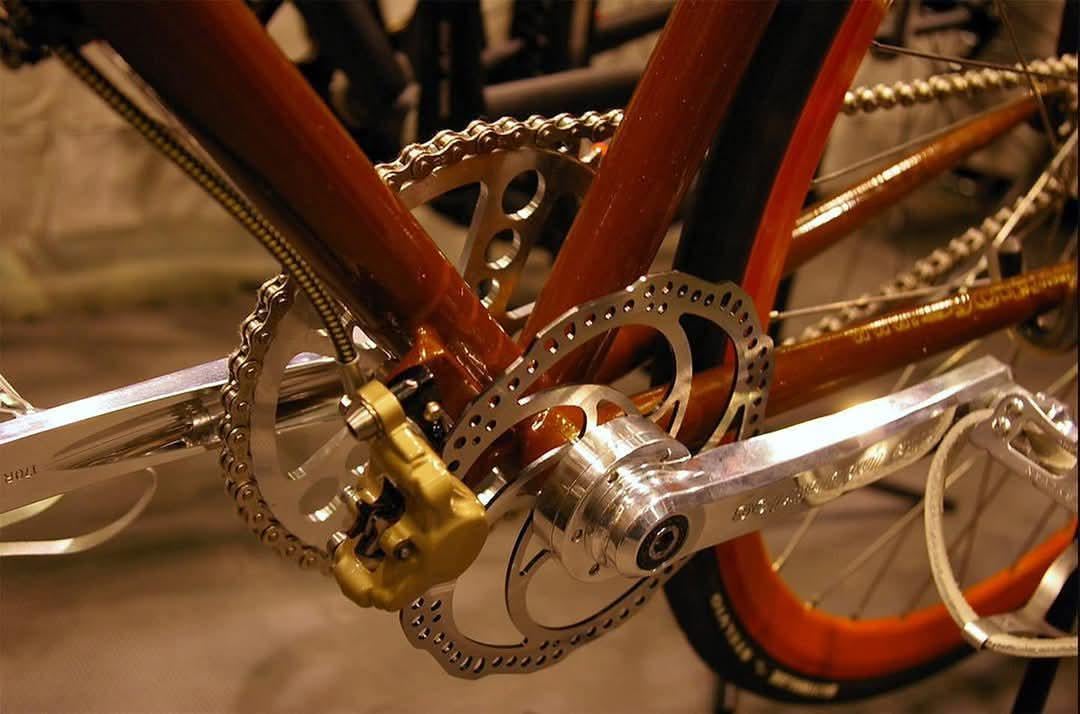
Not sure I’d want a brake rotor next to my unprotected leg. Plus, it looks like the caliper might interfere with whatever footwear you have on.
* I’m not sure the crank could even rotate with the caliper in the way.
Independent-Jumpy on
Why using rear brake in gereral?
[deleted] on
[deleted]
Jealous-Lawyer7512 on
I was having a good night until this. Fuck this. Fuck this right off!
kactapuss on
No brakes if your chain brakes
SpaceMonkey_321 on
How is one supposed to powerdrift outta corners with this?
CoOpMechanic on
Interesting, but nah I’m good.
iBN3qk on
If I needed brakes, this would be an option.
headcoat2013 on
So you add more parts, complexity, and weight for what benefit over traditional brakes?
pieisgude on
Haha man those Sycip boys and their ideas!
JoelJohnstone on
I don’t think people realize how hot break rotors get.
pauip on
I initially thought it was a very good idea until you consider the long, ugly housing going down the downtube would be much less aesthetically pleasing than the much shorter housing required for the fork, even if it is disc. What if the brake line is internally routed? That is an internal tube and the designed and machined caliper mount that need to be brazed on. Not to mention a machinist to make a custom rotor carrier and spacers and crank spindle. At this point, most people would lean toward the simplicity of getting a $100 surly disc fork or carbon Chinese wonder and call it a day. Or a front rim brake is still very acceptable.
It sounds like what would seem really cool is a brake that is totally hidden in the rear hub itself and doesn’t rely on a lever at all to use it. That way, you can have a completely brakeless look without any levers or cables. My daughter’s $20 bike actually has one. I’m waiting for her to outgrow it so I can use the hub.
RelationshipNo9336 on
I hate everything about it.
Plastic_Blood1782 on
The real reason is mechanical advantage. It is a lot easier to slow down a faster moving part. Due to the gear ratio this disc moves a lot slower than the wheel. So now you need a lot of force and you now have brakes that are reliant on your chain not breaking or slipping off which will happen eventually.
Bitter-Ad1274 on
A simple hand brake up front is more than enough? Why go all fancy with it
First_Apartment_1690 on
Brakes don’t belong on my bikes
DoctorDividend on
because if chain breaks you are in a world of hurt
Jazzlike-Weight3737 on
I adore this. Please make it. The world needs this to exist.

21 Comments
Looks like a thing to me alright, a really dumb thing.
Not sure I’d want a brake rotor next to my unprotected leg. Plus, it looks like the caliper might interfere with whatever footwear you have on.
* I’m not sure the crank could even rotate with the caliper in the way.
Why using rear brake in gereral?
[deleted]
I was having a good night until this. Fuck this. Fuck this right off!
No brakes if your chain brakes
How is one supposed to powerdrift outta corners with this?
Interesting, but nah I’m good.
If I needed brakes, this would be an option.
So you add more parts, complexity, and weight for what benefit over traditional brakes?
Haha man those Sycip boys and their ideas!
I don’t think people realize how hot break rotors get.
I initially thought it was a very good idea until you consider the long, ugly housing going down the downtube would be much less aesthetically pleasing than the much shorter housing required for the fork, even if it is disc. What if the brake line is internally routed? That is an internal tube and the designed and machined caliper mount that need to be brazed on. Not to mention a machinist to make a custom rotor carrier and spacers and crank spindle. At this point, most people would lean toward the simplicity of getting a $100 surly disc fork or carbon Chinese wonder and call it a day. Or a front rim brake is still very acceptable.
It sounds like what would seem really cool is a brake that is totally hidden in the rear hub itself and doesn’t rely on a lever at all to use it. That way, you can have a completely brakeless look without any levers or cables. My daughter’s $20 bike actually has one. I’m waiting for her to outgrow it so I can use the hub.
I hate everything about it.
The real reason is mechanical advantage. It is a lot easier to slow down a faster moving part. Due to the gear ratio this disc moves a lot slower than the wheel. So now you need a lot of force and you now have brakes that are reliant on your chain not breaking or slipping off which will happen eventually.
A simple hand brake up front is more than enough? Why go all fancy with it
Brakes don’t belong on my bikes
because if chain breaks you are in a world of hurt
I adore this. Please make it. The world needs this to exist.
I brake by threading a pipe into my front wheel.
Because it’s MADE for a show, not for riding.