
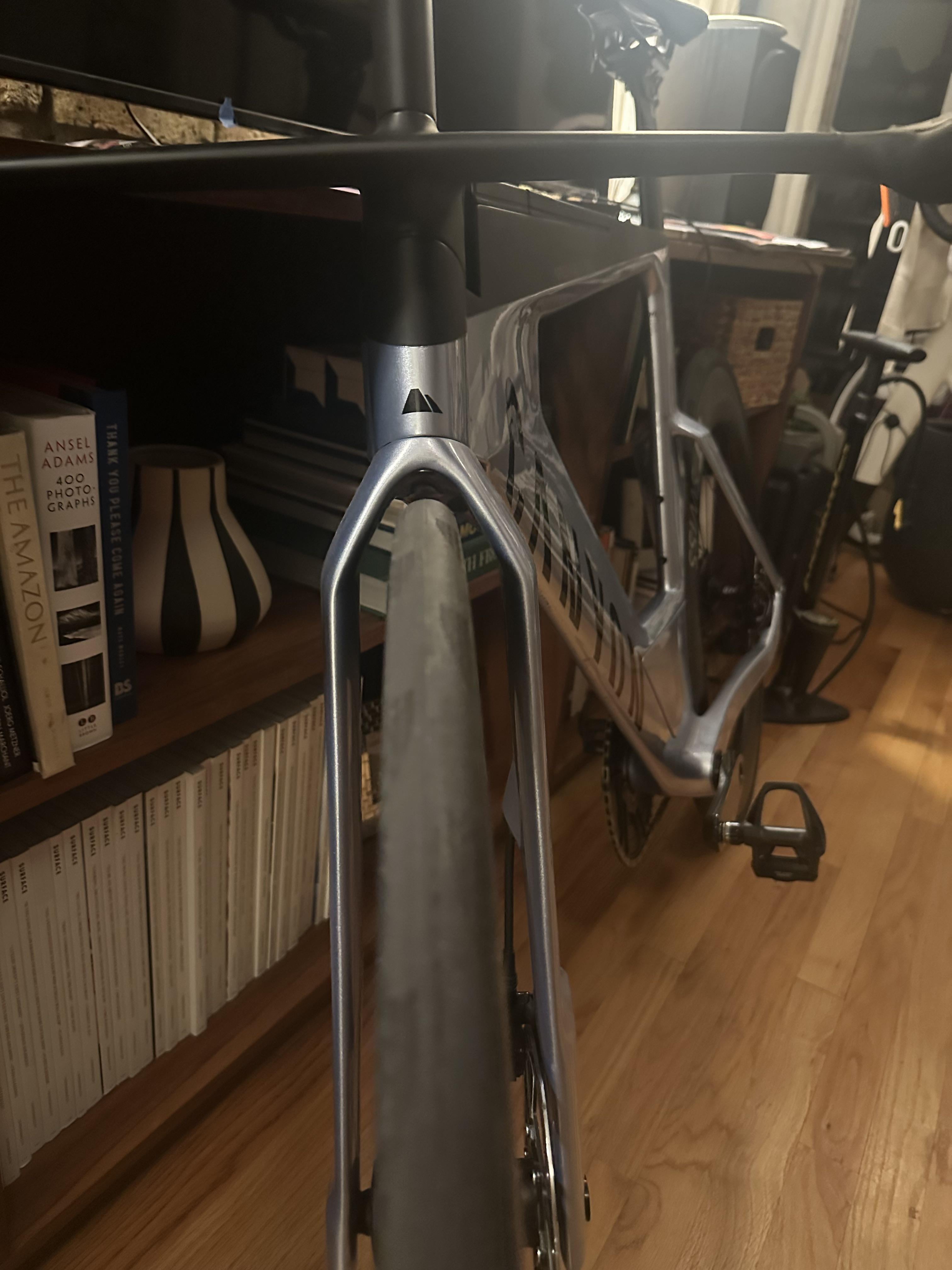
Specs say tire clearance is 30mm. It looks like I could fit a car tire between this fork. What's the deal? Thanks fam!
by dandanieldandan
Specs say tire clearance is 30mm. It looks like I could fit a car tire between this fork. What's the deal? Thanks fam!
by dandanieldandan
4 Comments
It’s usually measured at the narrowest point, take a look between your chainstays and see what the tire clearance looks like.
Check down tube clearance as well. Too big it might rub if you hit something rough and bike flexes. Also, not all tires will measure the same width or outside diameter when on whatever wheel is being used.
Wide forks like that are meant to be more aero because of the bigger gap between fork legs and spinning wheel. The fork legs are supposed work as a divider between the turbulences around the spinning wheel and the Airstream that goes around left and right outside the fork – > overall less turbulence in the Airstream around the front of the bike = less resistance
ISO norm “recommends” a min. of 4 mm around the tire. No matter what the manufacturer of the frame or the tire states, i.e. 30 mm allowed by bike brand XYZ. It is the measured width of the tire that counts. The clearance shall prevent that small parts get stuck between frame/fork while riding and thus might damage the surface or structure of the frame. My 2cts: why do you want “destroy” the aerodynamics of the frame by increasing the frontal area of the rim/tire with a wide tire? Aero drag increases over proportionally with the speed increase, rolling resistance only proportionally. On good roads 25/26 mm are sufficient, more rougher surfaces will be ok with 28 mm.