I don’t, but that’s not because they aren’t phenomenal. They are out of manufacturing and hard to service. I was chatting with Jake at Reactive Adaptations. Before ebikes were as easy to install every one of his trike had a schlumpf. Now he can’t get more and can’t fix any that break.
Lovely piece of kit. Very niche. Very marvelous. Not very reliable anymore.
Emergency_Release714 on
First of all, a Schlumpf Drive only makes sense if you cannot or don’t want to have a front derailleur. There are only a handful of situations where that is even necessary, with probably the most common one being bicycles with limited space near the bottom bracket, like with front drives (nowadays only found on a few recumbents), or if the combination of wheel size, rear derailleur capacity and necessary bandwidth causes issues (the smaller the rear wheel, the more likely you are to damage the derailleur when going over e.g. kerbs, and at some point the derailleur becomes entirely impossible to mount). Some velomobiles also rely on a Schlumpf, because their insanely huge chainrings make a front derailleur unreliable at best, or straight up impossible at worst (shifting from an 80-tooth chainring to a 36-tooth one is not a funny experience).
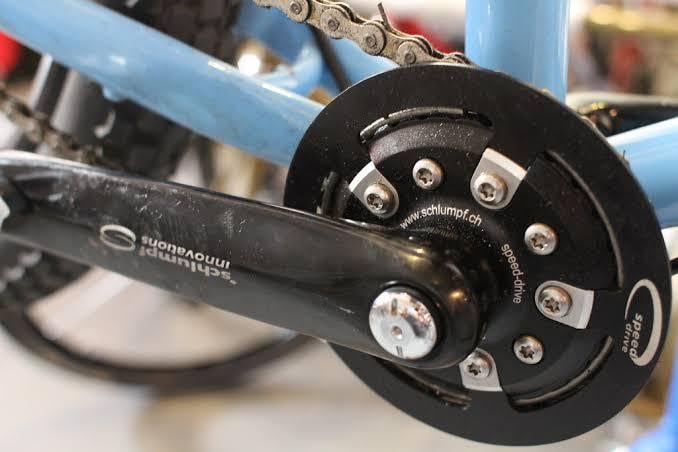
Which one you want to take depends on which gear you will typically use most often. The translation you depend on should be the direct gearing (1:1), because then your losses will be minimal. That means if you need the Schlumpf to crawl up inclines, you want the mountain drive option, because you’ll typically don’t need the under-translated gearing. On the other hand, if you only need the Schlumpf to avoid an overly large chainring, you should go with the speed drive option.
A small hint from someone who’s used these: You don’t use a Schlumpf like a normal gear selector. Because you have to manually (pedually? 😀 ) push the knob on the side of the crank to switch gears, you don’t just do that while pedalling. That means if you for example wanted to change into the under-translated gear before climbing a hill, you do that *before* you reach the hill, not when you’re already on it. On a bicycle, that’s an active thought process (I’ve never managed to get that into muscle memory). It’s better on a tricycle, because you don’t have to balance while doing so, and the kick against the knob doesn’t have any impact on your steering.
These things are also not maintenance free (no moving part ever is) and the build quality varies somewhat, now that they’re no longer manufactured in Switzerland. Reports of people losing the selector knob have become more common.

3 Comments
Why not just a front derailleur?
I don’t, but that’s not because they aren’t phenomenal. They are out of manufacturing and hard to service. I was chatting with Jake at Reactive Adaptations. Before ebikes were as easy to install every one of his trike had a schlumpf. Now he can’t get more and can’t fix any that break.
Lovely piece of kit. Very niche. Very marvelous. Not very reliable anymore.
First of all, a Schlumpf Drive only makes sense if you cannot or don’t want to have a front derailleur. There are only a handful of situations where that is even necessary, with probably the most common one being bicycles with limited space near the bottom bracket, like with front drives (nowadays only found on a few recumbents), or if the combination of wheel size, rear derailleur capacity and necessary bandwidth causes issues (the smaller the rear wheel, the more likely you are to damage the derailleur when going over e.g. kerbs, and at some point the derailleur becomes entirely impossible to mount). Some velomobiles also rely on a Schlumpf, because their insanely huge chainrings make a front derailleur unreliable at best, or straight up impossible at worst (shifting from an 80-tooth chainring to a 36-tooth one is not a funny experience).
Which one you want to take depends on which gear you will typically use most often. The translation you depend on should be the direct gearing (1:1), because then your losses will be minimal. That means if you need the Schlumpf to crawl up inclines, you want the mountain drive option, because you’ll typically don’t need the under-translated gearing. On the other hand, if you only need the Schlumpf to avoid an overly large chainring, you should go with the speed drive option.
A small hint from someone who’s used these: You don’t use a Schlumpf like a normal gear selector. Because you have to manually (pedually? 😀 ) push the knob on the side of the crank to switch gears, you don’t just do that while pedalling. That means if you for example wanted to change into the under-translated gear before climbing a hill, you do that *before* you reach the hill, not when you’re already on it. On a bicycle, that’s an active thought process (I’ve never managed to get that into muscle memory). It’s better on a tricycle, because you don’t have to balance while doing so, and the kick against the knob doesn’t have any impact on your steering.
These things are also not maintenance free (no moving part ever is) and the build quality varies somewhat, now that they’re no longer manufactured in Switzerland. Reports of people losing the selector knob have become more common.