
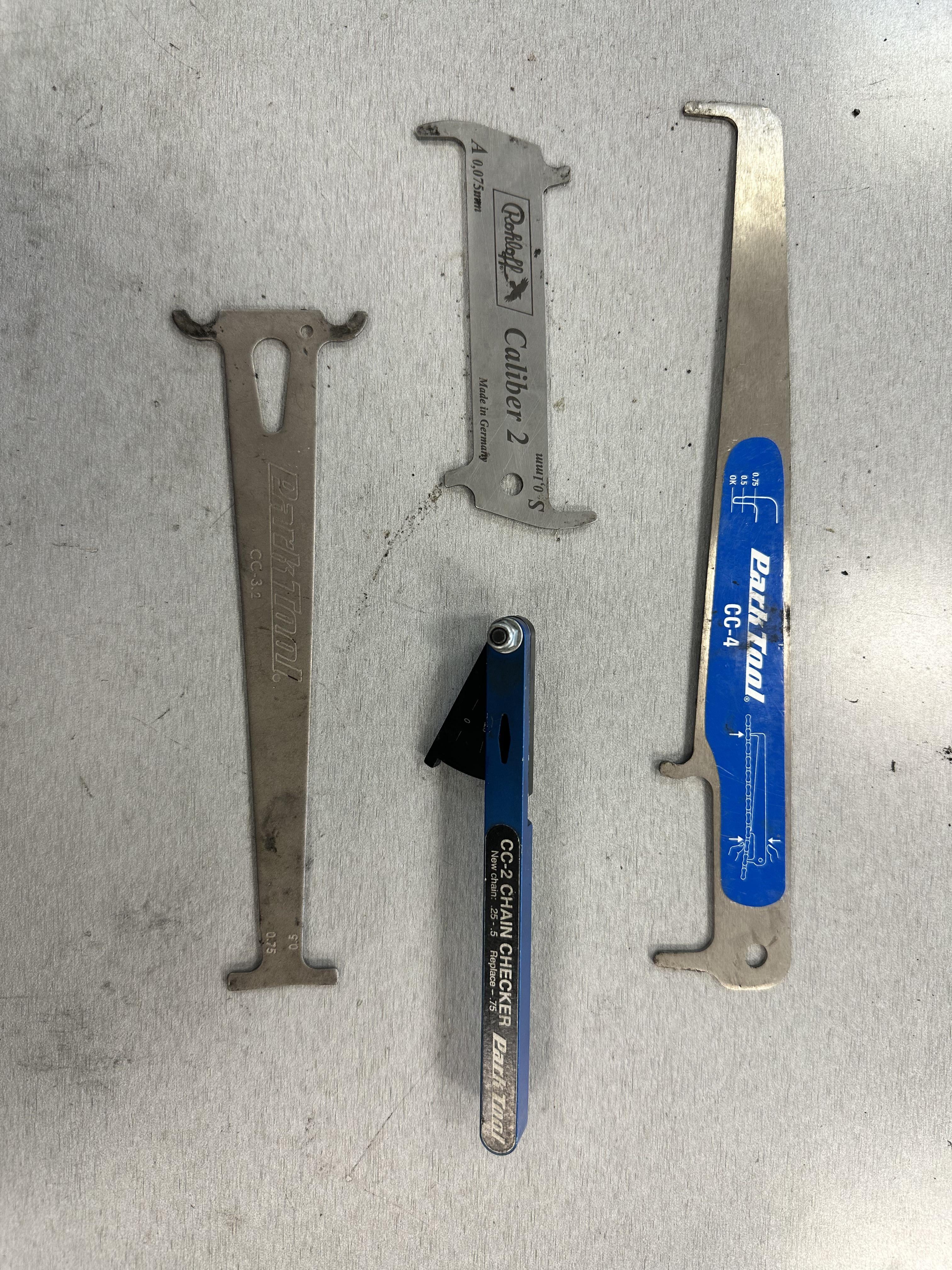
I have been using the CC-2 for about nine years now and just recently started trying some of the other chain checkers pictured in this photo, I am curious to what you guys think are the most accurate chain checkers. I get mixed results between all four of these.
by thebikeguy2001
16 Comments
I hate chain checkers. They seem inherently inaccurate. I get a different result every time I check.
What I do now I this: keep the 10 links or whatever is left after you cut the chain. When I want to check the wear, measure as many links as possible from pin to pin using a metal scientific ruler or digital caliper on the unused chain. Then measure the same number of links on the used chain. Divide the smaller number by the larger number to get the % of stretch.
They are all just indicators, it’s not a science. Park Tool CC-4 is more accurate than CC-2 when used right. Just want to make sure you have a .5 option for 11-12 speed if you use them, .75 is waiting too long for them
I like the one with the rotating dial and the eccentric pin – I don’t know why, but I like it more. It seems to be more solidly built and engineered. Those cheapest ones that we stamped, they have to vary quite a bit during production considering they are just stamped.
I have had the Rohloff chainchecker, like in the picture, for about 25 years. I’ve just learnt to go with it.
I use a good old-fashioned ruler.
You forgott the one and only….
https://preview.redd.it/za6ackt93ehe1.jpeg?width=474&format=pjpg&auto=webp&s=e703655bce47c31a221a55cc92b5f67fa3f79402
The CC-4 is regarded as the most accurate.
I’ve had very bad experiences with the Rohloff and checkers with a similar shape. One said that the chain was beyond 0,5 while the one my LBS used said it didn’t.
I’ve used a CC-2 for many years BUT I also register a new chain in Strava and keep track of the mileage there. I’ve found that when my chain checker says it’s time to get a new chain it’s also always at the same mileage in Strava.
For reference: I use SRAM XX1 chains and find that I get approx 2000 kilometers from a chain before needing to replace it.
Try them on new chains. Pedro’s and the CC-4 are known to be some of the most accurate checkers. If it gives you any comfort the inaccurate ones usually err on the conservative side .. indicating more wear than there is and a lighter wallet.
I use the Pedro’s checker and it seems accurate, or at least it’s extremely consistent.
https://escapecollective.com/threaded-24-a-modern-guide-to-measuring-chain-wear/
I like the abbey, cuz it’s green. Otherwise, I use the 3 prong Pedro’s.
I’ve used the CC-3 and CC-4. It seems like the CC-3 is more intuitive. Also, chain rivets are precisely 1/2” apart when new. So with a 12” ruler you can see if there is any stretch by measuring spacing between 24 rivets. If it’s stretched 1/16”, it’s def time to replace.
I use KMC digital chain checker. Results are consistent, and it’s helpful to have a number to gague how much longer a customer might be able to get out of the chain.
If you can find one which is more accurate than hanging the entire length of your chain on the wall and measuring with a standard tape measure, compared to the length of the chain when fitted, then you’ll be the first person on the planet to find a chain checker more accurate than the common tape measure.
You can find a pdf by zero friction cycling, where they tested lots of chain checkers for accuracy. According to this pdf cc-4 is accurate and thats the one I use as well.
Take the uncertainty out of the question, IMO get 2/3 chains and rotate them every few hundred miles.
When they’re all toast, time for a new cassette chain and crank