
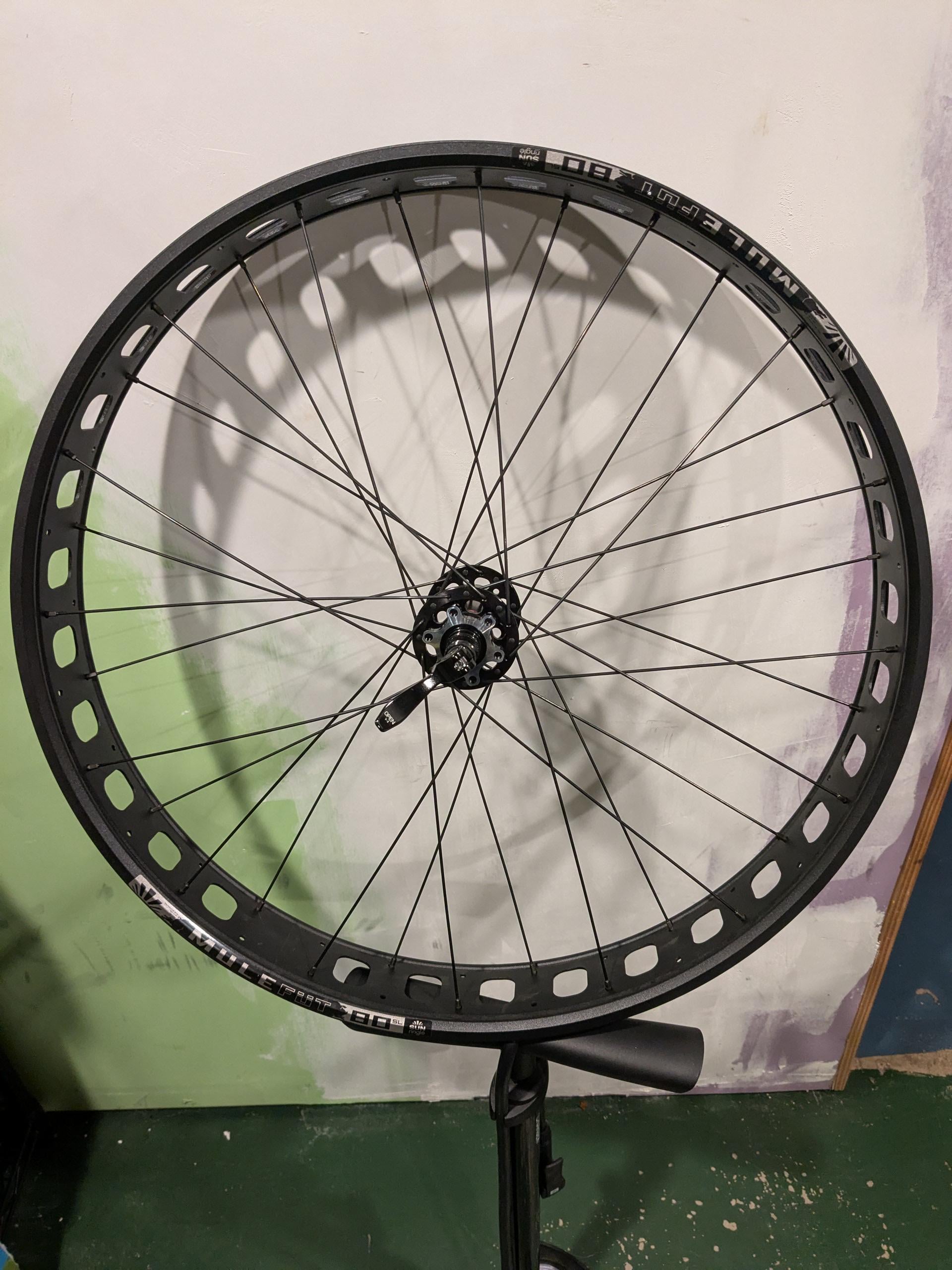
Building up a 26" fatbike wheel. Not sure how to measure dish or adjust spoke tension on disc vs non disc side of the wheel.
What bad things will happen if I just tighten spokes uniformly until threads disappear and they "feel" equivalent to another finished wheel? Do I need to buy a spoke tension gauge to get a rideable (safe) wheel?
Suggestions appreciated.
Specs are
mulefut 80 rim
Novatec D101SB 135mm hub, 32hole
266mm 14ga Sapim spokes
Bought the hub and spokes from (awesome) https://www.thebikesmiths.com/
by New_Old_Volvo_xc70
3 Comments
A lot of people fret about perfect spoke tension, and IMO aim for some level of perfection with a tensiometer that probably doesn’t amount to real world differences, but they are handy.
That said, I do have a spoke tension meter, and can share a few things that may help:
* I will tighten spokes just until the thread disappears inside the nipple as a starting point. This is likely not adequate tension unless your spokes are too short. With properly sized spokes there shouldn’t be that much friction on the nipple or tension in the spoke at this point
* Properly sized spoke should bottom out at the base of the nipple or slightly protrude into the wrench flat (depends on type of nipple, you can go longer on double square)
* Even when continuing to add tension in a a very consistent fashion (full turns > half turns > quarter terms as the wheel gets tighter), coming back with a tension meter you will still find spokes that are outliers—I mention this because even though you think you are being consistent, there is usually some deviations that build up, and if you don’t take care of them early on, you will end up over or under correcting the problem with adjacent spokes
Overall, I think its worth having one to get you into the ball park, even the lower end Park Tension meter will do the job—but don’t obsess over it—those tension meters will give you slightly different readings on the same spoke and have a window of tolerence that isn’t super right that is good enough to build a wheel.
Some people have good luck plucking the spokes like strings and there are some tuning apps that can help apparently but I have never relied heavily on this method so can’t really speak to it.
Get some spoke dope and put it on the threads. This gives you consistent tensioning while turning the wrench.
I dunno, if you’re gonna spend the $ on the wheels parts, and time building it, I’d invest in a tensiometer.
I have one of those, plus stand, dishing tool and Jobst Brandt’s book.
A cheap Park Tool TM-1 works good enough for me to archive proper even spoke tension. As for tension distribution between NDS and DS I would suggest to feed your hub and rim data into this calculator to get an idea. My experience with fatbike rims is that barely take 1000N on the site with higher tension and even less when you have even spoke tension on ds and nds.
https://www.kstoerz.com/freespoke/