
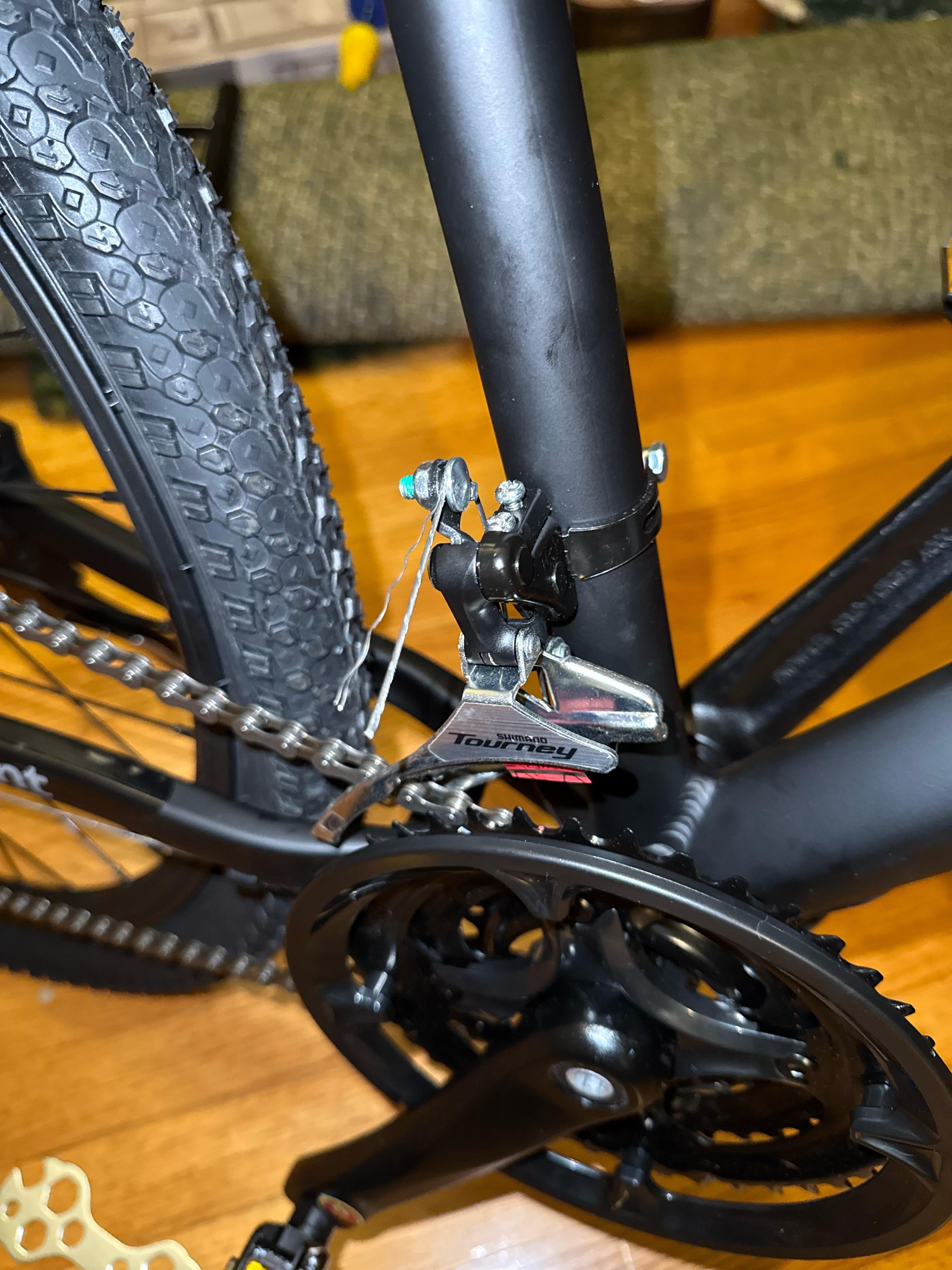
Hey, I need help fixing this bike I got (retrospec ascent). The front derailer seems to be messed up which caused the gear shifters on the left to not work. Not sure how to fix it hope you guys can help.
by Dry-Bathroom-8735
Hey, I need help fixing this bike I got (retrospec ascent). The front derailer seems to be messed up which caused the gear shifters on the left to not work. Not sure how to fix it hope you guys can help.
by Dry-Bathroom-8735
3 Comments
Note: from research that I have done i think it might be the tension but idk
There’s basically the cable tension, the position of the derailer, and the limit screw settings. Assuming the shifter is working as intended.
When it comes to derailleurs, order of operations is key. Assuming everything is in good working order, loosen the cable clamp, then loosen the seat tube clamp. Set the position and height of the derailleur. For the position, eyeball it to be parallel with the chainrings. For the height, align the teeth of the chainring (big ring, I think?) with the sticker, though these aren’t always accurate in my opinion. Tighten the seat tube clamp. It’s hard to get this part right sometimes, especially with lower end derailleurs.
Then, with the cable still loose, tighten the low limit screw until the inner derailleur plate is close, within probably 2-3 millimeters, of the chain while it is on the smaller ring for a full rotation of the crank. The chain should not contact the derailleur cage while spinning the crank. Next, be sure the shifter is clicked all the way in the low position. Then, being sure to correctly thread your cable, tighten the seat tube clamp. Looks like you might need a new cable and perhaps housing from your photo. Then, shift through your rings, and adjust your high limit screw so that it shifts into your big ring easily, but without excessive throw to avoid over shifting and dumping the chain off the side of the big ring.
Anyway, that’s the way I would do it. Other folks may point out something I forgot or do it differently. It could help to drop a little Triflow into the pivot points and cable housing while they are unclamped. Fwiw, in my experience as a casual mechanic, front derailleurs are generally one of the trickier parts to get adjusted right and can be finicky. Good luck!