
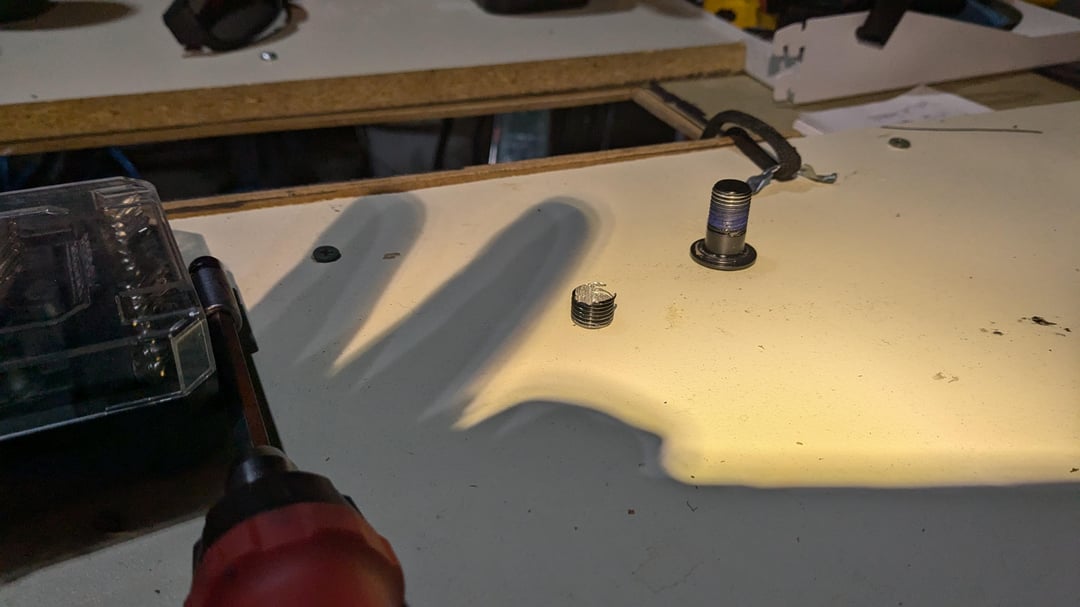
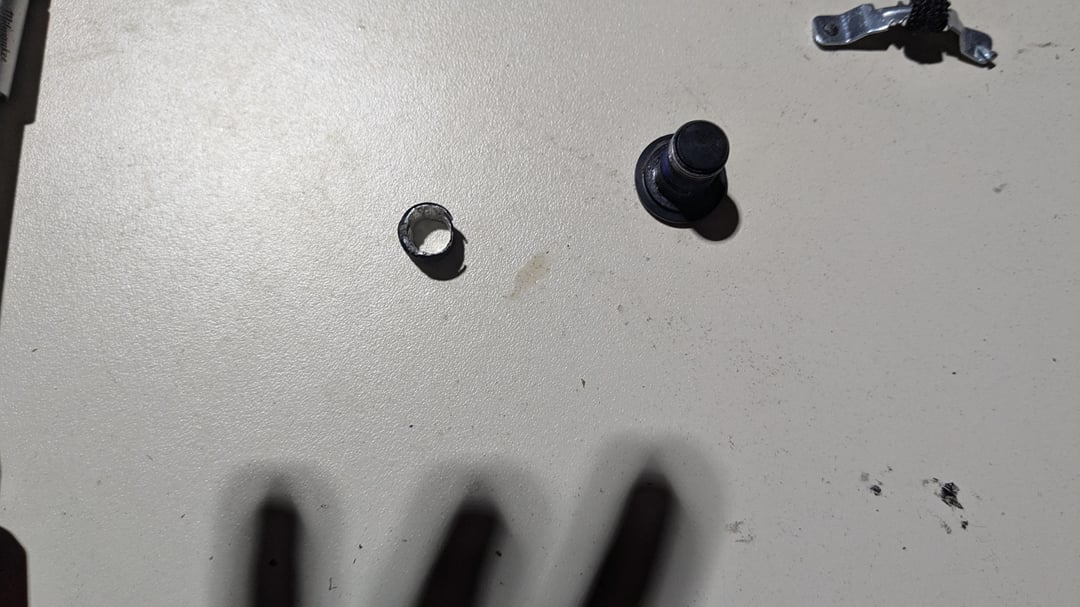
I posted a couple days ago on removing a reverse threaded pivot bolt that rounded out a couple days ago. What's left is on the left in the first photo and I put it next to the opposite side bolt to show what it started out as. I ended up spending hours on this and used almost every tool in the garage. Here are the steps I took and tools used:
- Tried loosening bolt with 5mm hex bit attached to ratchet.
- Put an in line torque adapter when it wouldn't budge to monitor torque use.Got to about 30 nm of torque and the edges rounded out in the bolt
- Realized that there was likely red loctite on the bolt when looking the bolt up. So, applied heat with propane torch and monitored surface temp with ir thermometer to get it to 200f, then used rubber glove with 5mm hex bit to get it to go. Then used t30 torx bit and just kept rounding out the bolt more
- Hammered t30 bit into bolt and tried again.
- Applied epoxy putty into bolt head then pushed t30 bit into it. Let it cure for 24 hours, epoxy failed and didnt budge. Then repeated process using JB weld original and gave a 48 hour cure time. Epoxy failed again, didn't budge.
- It being a reverse threaded bolt my choice of bolt extractors was limited. So, I instead tapped a 1/8 inch standard thread into the bolt head and was going to try and remove it using a standard bolt threaded into it. Didn't work because my taps are tapered and there wasn't enough of a depth to get the tap to cut threads. This is also when I noticed just how soft the aluminum was because the tap just shredded the bolt head like a drill bit.
Things then got serious and I moved on to the power tools
- Used 3 inch cutting tool to cut the bolt head's rounded edges into straight edges all the while being extremely careful to avoid cutting into the bike frame and blowing out all metal shards with an air compressor blower. I then used a 90 degree pick to pop off the edges of the bolt that was left and made the best attempt I could with the limited space to file the edge down using a filing tool I usually use on ski edges. I then used straight jaw pliers, needle nose pliers, locking pliers, then cone wrenches to attempt to use the straight edge to get it to budge. Every time I got leverage with the edge it was rounded out with the tool.
-
I then consulted a neighbor who is retired after years of owning a small engine shop assuming he had dealt with plenty of stuck bolts in his time. He recommended drilling into the bolt as far as possible then using an impact to get the bolt moving. So, he came out and we started off with a cordless drill and stopped frequently for cleaning and cooling of the piece. Eventually I was able to get the bolt head completely demolished and was able to get the chain stay to break free without any damage to the frame.
-
The body of the bolt remained. So, we drilled further in, then attempted an impact with t50 bit but still didn't budge. At this point I let him take over because it was making me nervous to see a bike I put so much time and effort into take this much abuse.
10.He then took over and brought a corded hammer drill and a larger bit and was able to drill all the way through the bolt, hammered a bit in but the thin layer of metal still did not come unthreaded.
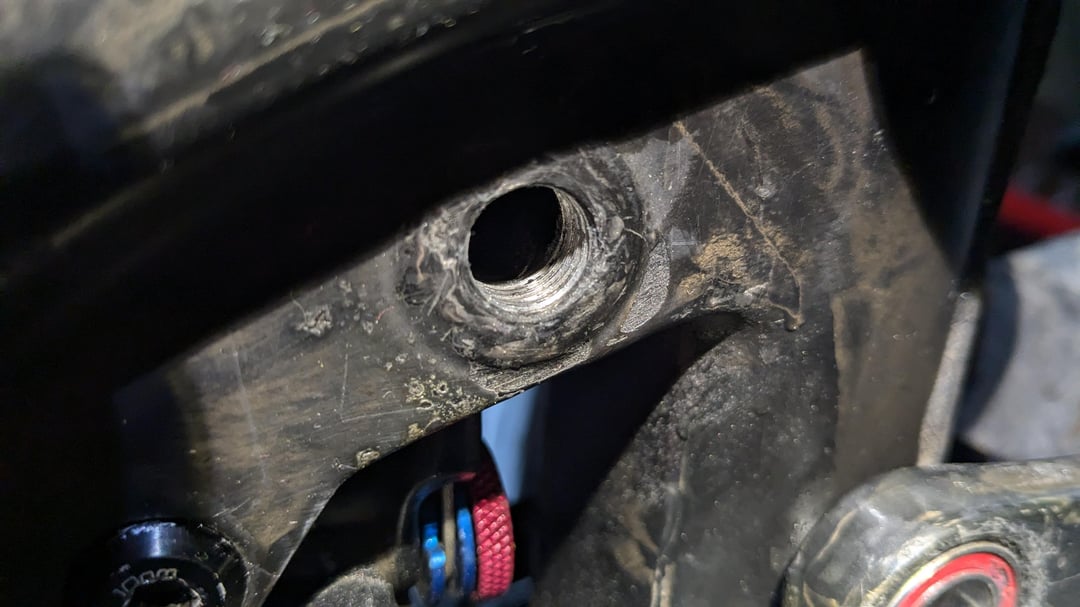
- He brought over a Dremel and etched away carefully at the thin layer of metal and finally cut down to the threads. Once there, he finally got what remained of the bolt to thread out and miraculously the threads appear to be in tact.
How I think this happened:
I think a combination of factors took place. This is a reverse threaded bolt that comes with red thread seal from the manufacturer. In the center there is a space where the cable housing for the rear remote lockout feeds to the rear shock. When I removed the bolt I saw evidence of a threaded material that went beyond the metal threading. I'm guessing that at some point somebody (maybe me) attempted to loosen the bolt counter clock wise and gave up when it wasn't moving. This caused the bolt to be way overtorqued. The threads that went beyond the metal internal threads were then in the center space with the internal threaded cable housing. Over the past few years of bike washing, mud, etc that exposed area was exposed to those elements because although sealed, it is not water tight. This in combination with the red thread seal formed an extremely strong glue that bonded it in the overtorqued position. In addition the aluminum used for the bolt is relatively soft when compared to the hardness used in the typical tools used in the shop. I think these combination of factors (reverse threaded, soft bolt with red thread seal in a spot that has some environmental exposure) was a poor choice by the engineers at trek and I'm a little confused what there reasoning was for using red thread seal especially. I feel like they are just asking for people to round out this bolt. Most people probably don't mess with those pivot bolts too often. However, they should be serviced every so often to just be sure the bearing underneath is properly cleaned and lubed.
by copharmer
1 Comment
That was a saga. Congrats on finally getting it.